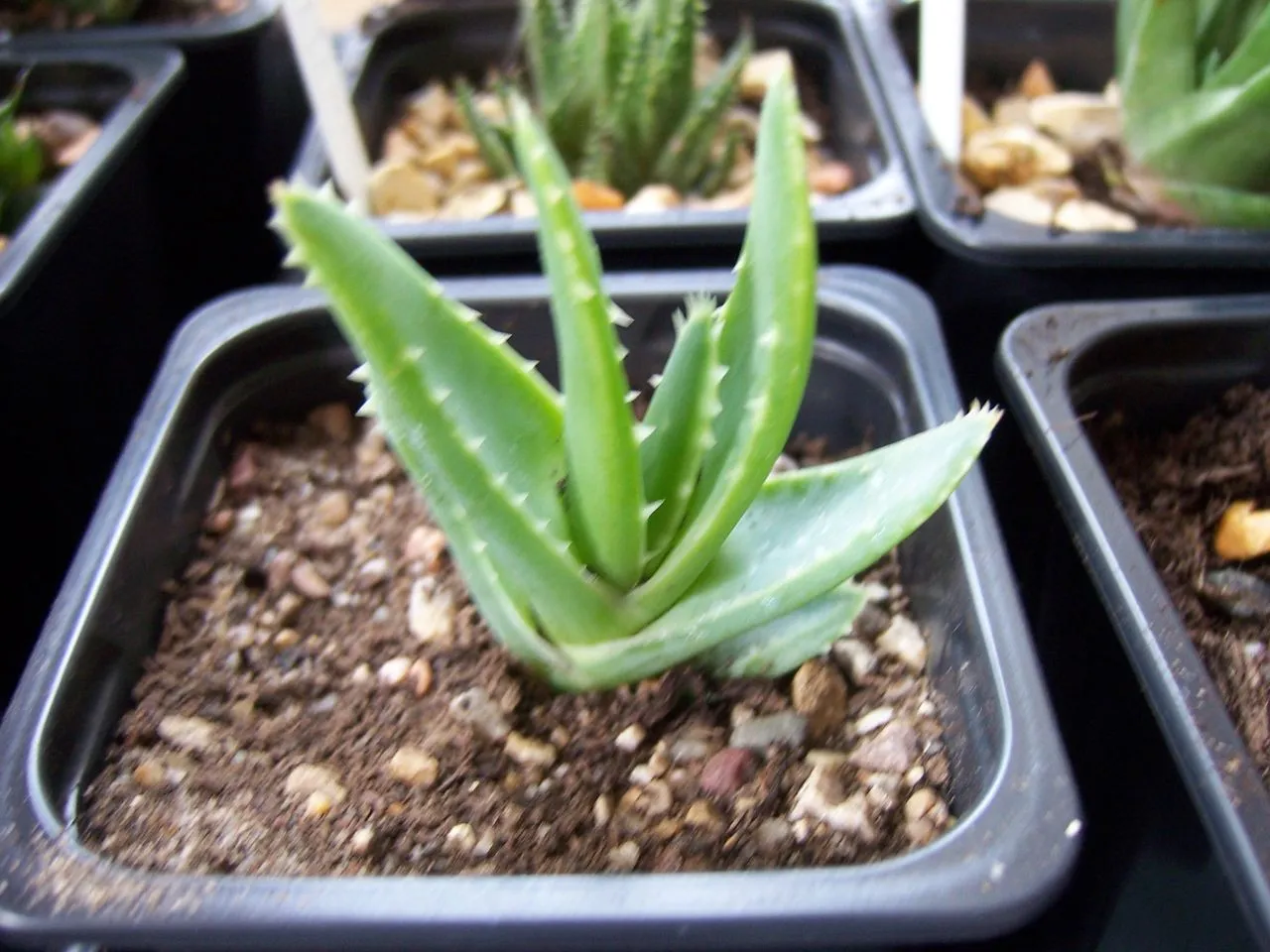
An Aloe vera that has never produced a flower stalk is almost always too young, too shaded, or too warm through winter to trigger the hormonal cascade that initiates flowering. Most aloe owners do not realise that their plant needs a genuine cool dry rest period in winter — not just reduced watering — and that indoor positions that look bright to human eyes often fall short of the 6 or more hours of direct sun that mature compact growth and flower stalk initiation require.
Part of the Complete Aloe Guide.
Immaturity: the plant is not yet old enough
The most frequent reason a household Aloe vera fails to bloom is age. Most pup-grown plants require 3 to 5 years of growth before they reach reproductive maturity, and a plant kept in low light or a restricting environment may take longer despite the calendar years passing. A mature A. vera that is ready to flower has a rosette of at least 15 to 20 cm across with 12 or more firm upright leaves, each 30 to 45 cm long. A plant that is still producing small narrow new leaves and has not yet begun offsetting is almost certainly still in its juvenile phase.
Seed-grown aloes take 4 to 7 years or more to reach flowering size, depending on species and growing conditions. Aloe polyphylla — one of the most frequently grown ornamental aloes, recognised by its striking spiral rosette — commonly takes 5 to 7 years before producing its first inflorescence even in optimal conditions. There is no reliable intervention that meaningfully accelerates botanical maturation. Attempts to force a juvenile aloe into flowering through chemical means or aggressive stress typically produce absent or abortive results and risk damaging a healthy plant. The correct approach is to optimise the growing conditions and wait.
Inadequate light: the most correctable cause in mature plants
Aloe vera requires a minimum of 4 to 6 hours of unobstructed direct sun per day for compact, robust vegetative growth, and the same intensity sustained across an entire active season to accumulate the reserves needed for reproductive output. Indoor plants grown near a window that provides only reflected or diffuse light may maintain compact green growth but rarely initiate a flower stalk. The plant must both accumulate sufficient photosynthate over spring and summer and experience the light-intensity signal that distinguishes an outdoor season from a year-round dim interior.
Indoors, the only reliable way to achieve the threshold for flowering is an unobstructed south-facing window (in the Northern Hemisphere) at less than 60 cm from the glass, or a high-output LED grow light running 12 to 14 hours daily at the manufacturer-recommended succulent distance. For most LED panels marketed for plant growth, that is approximately 20 to 40 cm from the canopy. Moving a previously shaded plant outdoors for the summer months and acclimating it gradually to direct sun over 10 to 14 days is the single most effective intervention for encouraging a first bloom in a mature plant. See Aloe Vera Leggy for the light acclimation procedure if the plant has been growing in low light and the leaves have already stretched.
Absence of a winter cool-dry period
Most cultivated aloes — including Aloe vera, which likely originates from a seasonally dry subtropical climate — use a winter cool and dry period as a flower-induction trigger. When a plant is kept at 18 to 24°C year-round with consistent watering and no photoperiod change, the hormonal cycle that converts the growing apex from vegetative to reproductive mode is not reliably triggered. Many collectors do not realise their central heating regime keeps their plants perpetually locked in a mild-summer approximation through winter.
Provide a genuine rest period: reduce watering to once every 3 to 5 weeks from November through February, keep the temperature at 10 to 14°C if possible — a minimum of 4°C for A. vera; warmer is tolerable but less effective as a flower-initiation cue — and reduce any supplemental lighting to 8 to 10 hours per day. Resume normal watering and full light exposure in late February or early March. In most years, plants that have not flowered before will produce a stalk within 6 to 10 weeks of emerging from this rest. Aloes grown outdoors in seasonally mild climates experience this natural cycle without any management and flower more reliably than indoor plants kept in uniform conditions year-round.
Chronic over-watering and insufficient energy reserves
A plant kept perpetually moist does not store the carbohydrate and nutrient reserves needed to divert to a reproductive effort. Aloe vera accumulates sugars, acemannan, and mineral reserves in its leaf parenchyma during active growth; a waterlogged root system progressively loses fine root efficiency and limits nutrient uptake, leaving the plant unable to reach the condition threshold that initiates stalk formation. The plant may appear green and alive but grows slowly, stays thin-leaved, and never demonstrates the vigour that precedes flowering.
Correct the watering rhythm: water only when the top 3 to 4 cm of substrate tests dry by feel or probe, soak thoroughly until water flows from the drainage hole, and discard any standing water from the saucer within 30 minutes. A plant on a proper dry-down cycle builds the root architecture and leaf parenchyma storage that flowering requires. See Aloe Leaves Turning Brown for how to distinguish a correctly managed dry cycle from actual drought damage when outer leaves begin to crisp.
Pot restriction and root pressure
Aloe vera in a pot significantly larger than its root ball can expend energy exploring excess soil volume, delaying the resource concentration that triggers reproductive output. Conversely, a severely root-bound plant with densely circling roots and substrate that has been used for 3 or more years without replacement is also unlikely to flower, despite the commonly repeated belief that "pot-bound plants bloom." The productive middle ground is a pot 2 to 4 cm wider than the root ball diameter in well-draining mineral substrate that has not been exhausted of structure or nutrients.
Repot a plant that has not been repotted in 3 or more years, even if roots are not visibly emerging from drainage holes. Use a mix with 40 to 60% pumice or coarse grit to ensure drainage and substrate longevity. A spring repot, followed by resumed watering once the plant shows fresh new growth at the centre, positions the plant well for a flowering attempt in the same growing season.
Excess nitrogen and a vegetative growth bias
High-nitrogen fertilisers promote leaf expansion at the expense of reproductive growth. A plant fertilised monthly with a 10-10-10 or higher-nitrogen formula through both active and dormant seasons produces abundant large leaves but rarely initiates flowering. The nitrogen-driven cell expansion and chlorophyll synthesis pathways directly compete with the phosphorus-dependent biochemical pathways associated with floral induction.
Switch to a low-nitrogen, phosphorus-emphasising formula — approximately 2-7-7 or similar — during the spring pre-flowering period, or rely on the natural nutrient accumulation in fresh substrate without added fertiliser for the first season after a repot. Feed only once per month during active growth from March to September. Apply nothing through the cool rest period. For most household Aloe vera plants, this modest regime is more effective in promoting flowering than any aggressive fertiliser schedule.
How to identify the cause
| Symptom | Likely cause | First action |
|---|---|---|
| Young small rosette, no offset history | Immaturity | Wait; optimise light and substrate |
| Mature size but in dim indoor position | Insufficient light | Move outdoors or supplement with grow light |
| Warm home year-round, no seasonal variation | No cool-dry dormancy trigger | Impose a 10 to 14°C rest from November to February |
| Wet substrate for extended periods | Over-watering limits reserve accumulation | Correct dry-down cycle and substrate |
| Same pot for 3 or more years | Exhausted substrate | Repot in fresh mineral mix in early spring |
| Recent high-nitrogen fertiliser applications | Vegetative bias over reproductive | Switch to low-N formula or suspend feeding through dormancy |
Risk and severity
Failure to flower is not a health emergency. A mature non-flowering aloe is not sick — it is simply in suboptimal conditions for reproductive output. The correction timeline is slow: most environmental changes take at least one full growing season to produce a result. Act consistently across the entire growing profile — light intensity, watering rhythm, cool-dry rest, correct pot size, appropriate nutrition — rather than addressing only one factor and expecting a rapid response. A plant corrected on all dimensions usually blooms in its first or second season following the change.
Solutions
Improve light and trigger the cool-dry cycle together
Move the plant to the strongest available light position in early spring. If moving outdoors, acclimate over 10 to 14 days, starting with morning sun and protection from midday. Run a genuine winter rest from November: reduce watering to once every 3 to 5 weeks and allow night temperatures to fall toward 10 to 14°C if indoor arrangements allow, without going below 4°C. Resume full watering and light in late February. This two-part cycle mimics the natural seasonality that most aloes require to initiate flowering.
Repot and reset the substrate
In early spring, repot into a pot 2 to 4 cm wider than the current root ball using fresh mineral-heavy substrate. Withhold water for 7 days after repotting, then resume normal watering. New root growth in fresh substrate supports the nutrient accumulation the plant needs before stalk formation. A repot also corrects any pH drift that has built up through years of hard-water use.
Review fertiliser timing and formula
Stop all feeding from September through February. In spring, apply a low-nitrogen phosphorus-emphasising formula at half strength once monthly from March through the active growing season. Stop again at the onset of dormancy. For most aloes in containers, this modest regime delivers better flowering outcomes than aggressive feeding.
Prevention
Grow Aloe vera in strong direct light from the start, repot every 2 to 3 years, and impose a genuine cool dry rest each winter. A plant established on this cycle typically flowers annually from year 4 or 5 onward. The most consistently overlooked step is the winter rest — it matters more to flowering outcome than any fertiliser change.
See also
- Monocarpic vs Polycarpic Succulents — understanding which plants die after flowering and which flower repeatedly.
- Aloe Vera Leggy — light correction procedure for plants that have been growing in insufficient light before attempting to induce flowering.
- Aloe arborescens — a reliably flowering species that blooms earlier and more consistently than A. vera in marginal indoor conditions.
Frequently Asked Questions
How old does Aloe vera need to be before it flowers?
Plants grown from pups typically flower for the first time at 3 to 5 years of age. Plants grown from seed take longer, 4 to 7 years depending on conditions. A plant kept too small through chronic pot restriction or insufficient light may never reach flowering readiness despite being technically old enough.
What does an aloe flower stalk look like before it opens?
The inflorescence emerges as a single grey-green cylindrical spike from the centre or side of the rosette, 30 to 90 cm tall depending on species. In Aloe vera the stalk is unbranched and topped with densely packed tubular yellow-to-orange buds that open progressively from the bottom upward over 2 to 4 weeks.
Should I cut the flower stalk off my aloe?
Not while it is actively blooming. The plant invests significant resources in flowering and the stalk can be left until all buds have opened and the stalk begins to yellow and dry. Cut it cleanly at the base with sterile scissors or secateurs at that point.
Does flowering weaken or kill the aloe?
No. Unlike monocarpic plants such as agaves, Aloe vera is polycarpic: the rosette flowers year after year without dying. Flowering does divert resources temporarily and some lower leaves may look slightly thin in the weeks following, but the plant recovers fully once the stalk is removed.