| Question | Short Answer |
|---|---|
| What is the main identification point? | The Identification section separates Aloe arborescens by plant habit, leaf form, marginal teeth or surface markings, flowers, and lookalikes named in the article. |
| How should this aloe be watered? | Follow the Cultivation section rather than a fixed calendar. |
| How is it propagated? | Use the Propagation section. |
| What should buyers watch for? | Check the Notes and lookalike sections. |
Aloe arborescens Mill. (krantz aloe, candelabra aloe) is the most widely cultivated tree-aloe in the world and the species most gardeners encounter as a large landscape shrub across Mediterranean, Californian, and South African plantings. Its natural range covers a vast arc from the Cape Peninsula north into Malawi and Mozambique, making it one of the most ecologically flexible Aloe species.
Part of the Complete Aloe Guide.
Identification
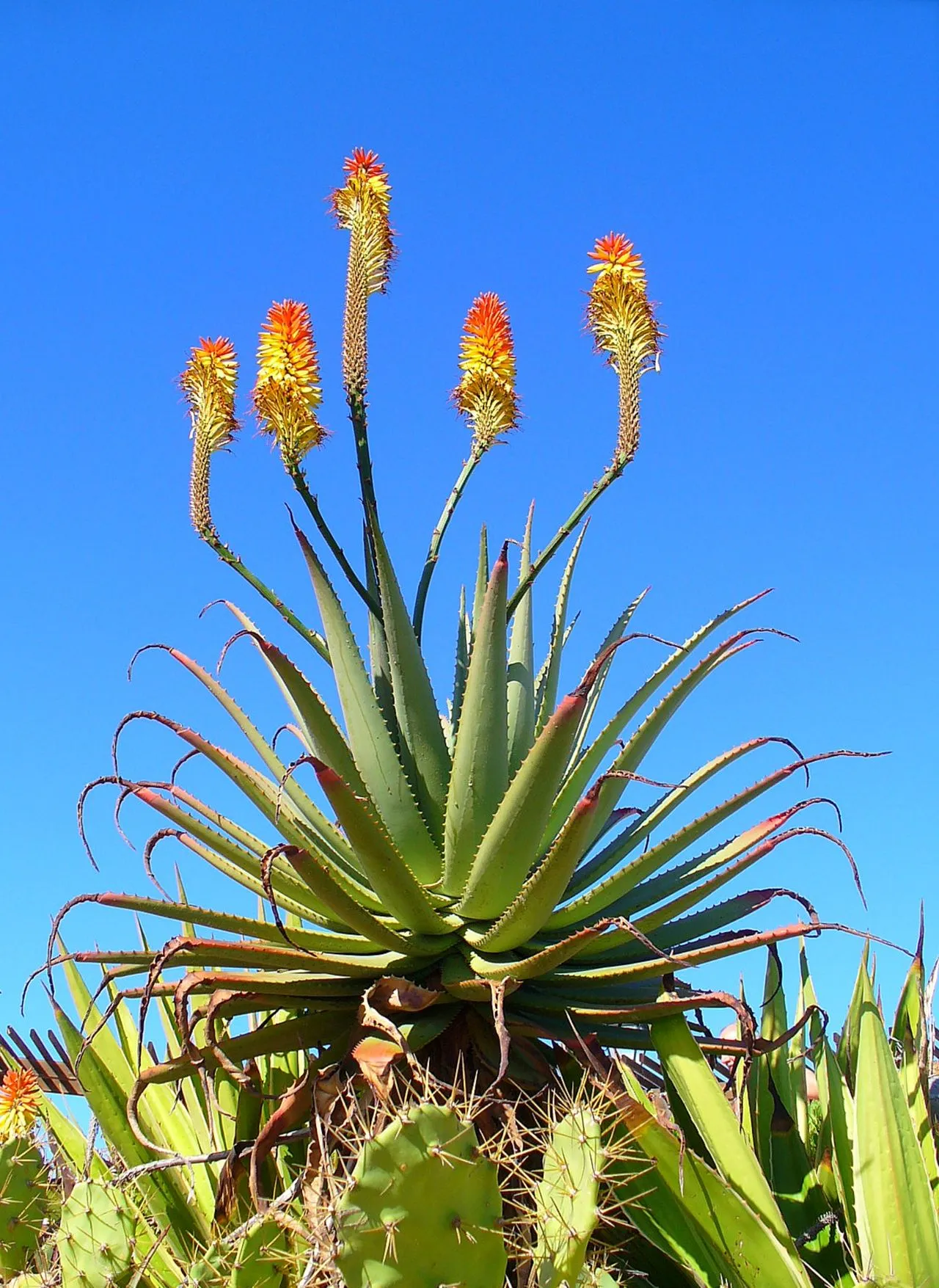
A multi-stemmed shrub or small tree reaching two to three metres in height and often wider in spread, branching repeatedly from the base and along the stems. Each stem ends in a rosette of 30 or so recurved narrow lanceolate leaves, 40 to 60 cm long, grey-green to bluish-green depending on sun exposure, with pale cartilaginous teeth along the margins. The leaves are distinctively narrow and recurved compared with most large aloes; this is the quickest field character for separating A. arborescens from A. ferox and A. africana.
The species name arborescens means "becoming tree-like" and captures the habit well: a mature plant is effectively a shrubby tree of succulent rosettes.
Inflorescence is a simple unbranched raceme 30 to 50 cm tall, densely packed with tubular bright scarlet-orange flowers. Flowering occurs in midwinter in the southern hemisphere (roughly July to August) and a mature specimen can produce many dozens of simultaneous spikes, an ornamental feature that drove the species into global landscape trade.
Cultivation
The easiest large aloe to grow. Full sun, any free-draining substrate, and infrequent deep watering are enough. The species tolerates a wider range of conditions than almost any other aloe: full coastal exposure to inland heat, brief frost to −4°C in dry conditions, and temperatures up to 45°C without damage. In ground, established plants survive on rainfall alone across much of the Mediterranean basin.
Two practical cultivation points. First, A. arborescens grows fast, at ten to twenty centimetres per year from a rooted cutting, and adult plants can outgrow container culture within three to four years. Pot-grown specimens benefit from being planted out or repotted into substantially larger containers every two seasons. Second, the species is wind-sensitive only in the sense that tall weakly rooted plants topple in storms; tie or stake young specimens until the root system is robust.
Propagation
Stem cuttings are the fastest and most reliable route, and this is one of the few aloes where stem cuttings of any length work. Take a 30 to 40 cm section from an actively growing stem, remove the lower leaves, callus in shade for seven to fourteen days, and insert into dry mineral mix. Roots form within four to six weeks. Water sparingly until new growth is visible.
Basal offsets are produced freely and can be separated conventionally. Seed germinates easily between two unrelated plants but is rarely used because stem cuttings are faster and yield uniform material.
Notes
A. arborescens has a long history of medicinal and ethnobotanical use in southern Africa, where it is one of the species traditionally used for wound care alongside Aloe ferox. The leaf gel chemistry is similar to A. vera in broad terms, and some clinical literature supports its use in topical wound healing. As with all aloes, the outer leaf latex contains aloin and carries the safety considerations covered in the pillar.
The species is a parent of many landscape hybrids, most prominently the crosses with A. ferox and A. marlothii sold under trade names in the mass-market nursery trade. Named clones of true A. arborescens include variegated forms, but these are best treated as cultivars rather than distinct species.
See also
- Aloe africana
- Aloe vera
- Aloe ferox — the other major South African tree-aloe, with a single trunk contrasting the multi-stemmed arborescens habit.
- Aloe striatula — frost-tolerant South African aloe suitable for open-ground cultivation in temperate gardens.
Frequently Asked Questions
What is the main identification point?
The Identification section separates Aloe arborescens by plant habit, leaf form, marginal teeth or surface markings, flowers, and lookalikes named in the article.
How should this aloe be watered?
Follow the Cultivation section rather than a fixed calendar. The article gives drying depth, seasonal growth rhythm, and the wet-cold risk for this plant.
How is it propagated?
Use the Propagation section. The article states whether offsets, stem cuttings, or seed are practical, and notes that single-leaf cuttings do not work for aloes.
What should buyers watch for?
Check the Notes and lookalike sections. The article flags trade confusion, hybrid material, or conservation sourcing where those issues apply.