| Question | Short Answer |
|---|---|
| What is the main identification point? | The Identification section separates Aloe vera by plant habit, leaf form, marginal teeth or surface markings, flowers, and lookalikes named in the article. |
| How should this aloe be watered? | Follow the Cultivation section rather than a fixed calendar. |
| How is it propagated? | Use the Propagation section. |
| What should buyers watch for? | Check the Notes and lookalike sections. |
Aloe vera (L.) Burm.f. (true aloe, Barbados aloe) is the most widely cultivated species in the genus and almost certainly the most widely propagated succulent on earth. It has no confirmed wild provenance and exists in trade as a single pentaploid clone distributed vegetatively for at least two thousand years, with the Arabian Peninsula the likely centre of original cultivation.
Part of the Complete Aloe Guide.
Identification
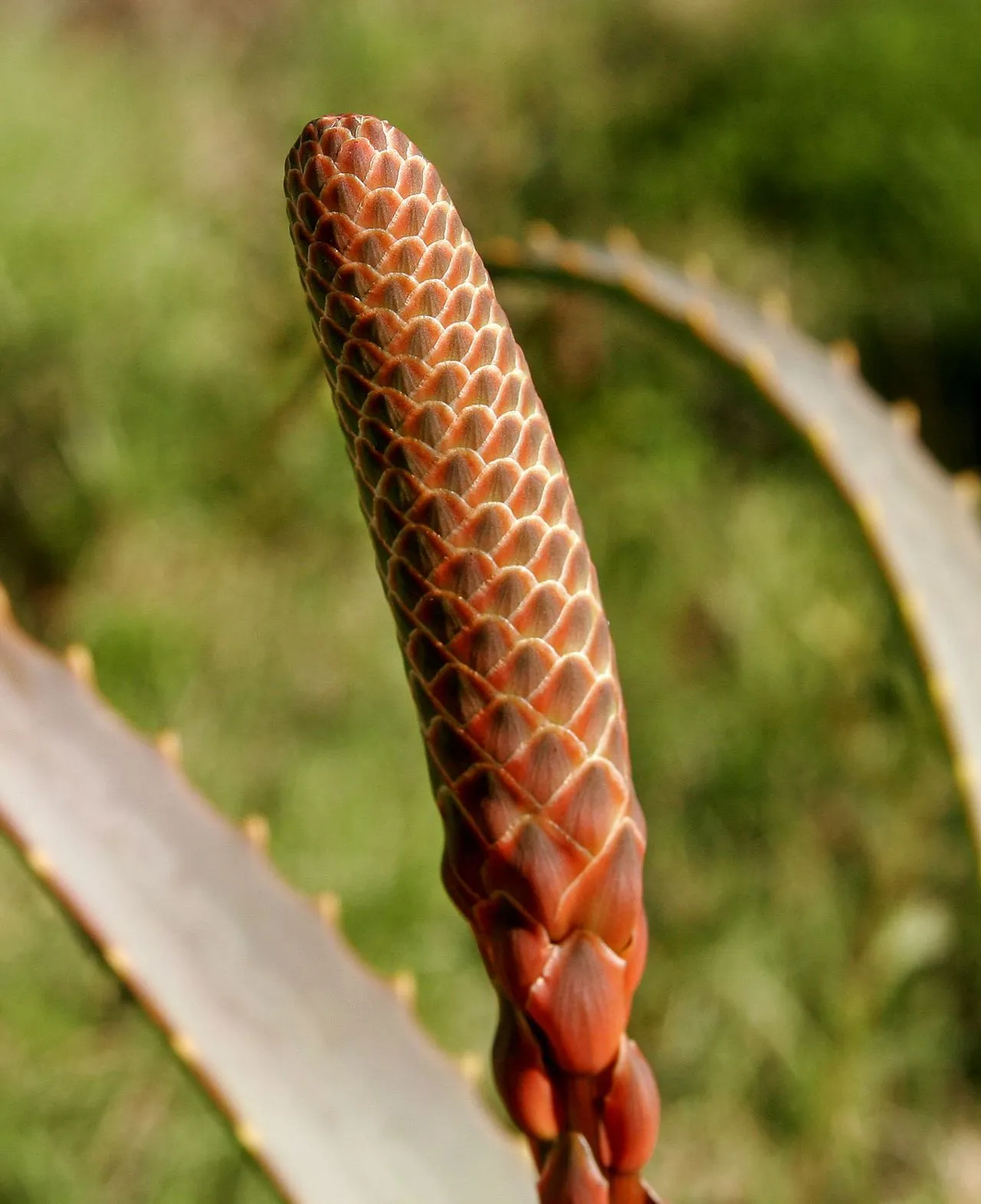
A stemless or short-stemmed rosette of thick grey-green lanceolate leaves, typically 40 to 60 cm long at maturity, with pale tubercles on juvenile leaves that fade with age. The leaf margins carry small widely spaced cartilaginous teeth. Cut the leaf transversely and you get the diagnostic sandwich: a thin outer rind, a yellow latex layer immediately under the rind, and a clear mucilaginous gel filling the centre. Inflorescence is an unbranched raceme 60 to 90 cm tall with tubular yellow flowers. Plants in cultivation rarely flower indoors because the clone requires a stronger seasonal signal than windowsill conditions provide.
Common confusion is with Aloe arborescens, which has narrower recurved leaves and a branched arborescent habit, and with Aloe chinensis (now considered synonymous with A. vera by most authorities but sometimes listed separately in older trade literature).
Cultivation
Standard aloe cultivation applies with two qualifications worth knowing. First, A. vera is tropical African in provenance and does not tolerate temperatures below 4°C for any sustained period; unlike Aloe ferox or Aloe arborescens, it is not a candidate for unheated cold frames in temperate regions. Second, A. vera often grows through mild winters if kept above 12°C, reversing the dormancy pattern assumed by most general aloe care advice. Water when the substrate dries, regardless of calendar month, and you will rarely go wrong.
The species tolerates somewhat more shade than most aloes, which is why it survives on kitchen windowsills where A. aculeata would etiolate within a season. Colour is a good indicator: deep sage-green means adequate light, yellow-green suggests mild nutrient or water stress, and pale stretched leaves mean the plant wants more light.
Propagation
Offsets are the only reliable route. Mature plants produce pups prolifically around the rosette base, and a three-year-old specimen in a 5-litre pot will typically yield four to eight separable offsets per year. Unpot the clump, tease the offsets apart with as many of their own roots as possible, callus the cut surfaces for two to four days in shade, and pot into dry mineral mix. Withhold water for another week, then resume normal irrigation.
Seed propagation is almost useless for this species. The cultivated clone is self-incompatible and pentaploid; even when two clonal plants flower together, viable seed production is negligible, and any seedlings that do appear show extreme variability rather than uniform A. vera character. Commercial production is entirely vegetative.
Notes
The gel and latex chemistry covered in the pillar applies to this species specifically. Two clarifications for growers. First, the aloin concentration in the latex of cultivated A. vera is lower than in Aloe ferox, which is why the latter was historically preferred as the commercial source of pharmaceutical aloin. Second, the commercial "aloe vera" food and drink products you find in supermarkets are made from the inner gel with the outer latex rind mechanically removed, specifically to avoid aloin. Raw whole-leaf preparations are a different matter; treat with the caution outlined in the pillar.
Toxicity to pets is real. Dogs and cats chewing an A. vera leaf develop vomiting and diarrhoea within hours due to aloin and other anthraquinone glycosides. If you keep pets, site the plant out of reach.
One horticultural quirk worth mentioning: A. vera is one of the few succulents that responds measurably to fertiliser. A dilute balanced feed (NPK around 5-5-5) once monthly through the active growing season produces noticeably larger leaves and more offsets than unfed plants. Do not feed through dormancy.
See also
- Aloe arborescens
- Aloe aculeata
- Aloe vera Soft and Mushy — emergency diagnosis for the most serious care problems affecting this species.
- Aloe vera Leggy — how insufficient light causes etiolation and long stems in indoor-grown plants.
Frequently Asked Questions
What is the main identification point?
The Identification section separates Aloe vera by plant habit, leaf form, marginal teeth or surface markings, flowers, and lookalikes named in the article.
How should this aloe be watered?
Follow the Cultivation section rather than a fixed calendar. The article gives drying depth, seasonal growth rhythm, and the wet-cold risk for this plant.
How is it propagated?
Use the Propagation section. The article states whether offsets, stem cuttings, or seed are practical, and notes that single-leaf cuttings do not work for aloes.
What should buyers watch for?
Check the Notes and lookalike sections. The article flags trade confusion, hybrid material, or conservation sourcing where those issues apply.