| Question | Short Answer |
|---|---|
| What is the main identification point? | The Identification section separates Aloe aculeata by plant habit, leaf form, marginal teeth or surface markings, flowers, and lookalikes named in the article. |
| How should this aloe be watered? | Follow the Cultivation section rather than a fixed calendar. |
| How is it propagated? | Use the Propagation section. |
| What should buyers watch for? | Check the Notes and lookalike sections. |
Aloe aculeata Pole-Evans (prickly aloe, red-hot-poker aloe) is a stout stemless to short-stemmed aloe of the bushveld of northern South Africa, Zimbabwe, and southern Mozambique. It grows on rocky outcrops and quartzite ridges between about 600 m and 1,800 m, characteristically in open sun with sparse grass cover.
Part of the Complete Aloe Guide.
Identification
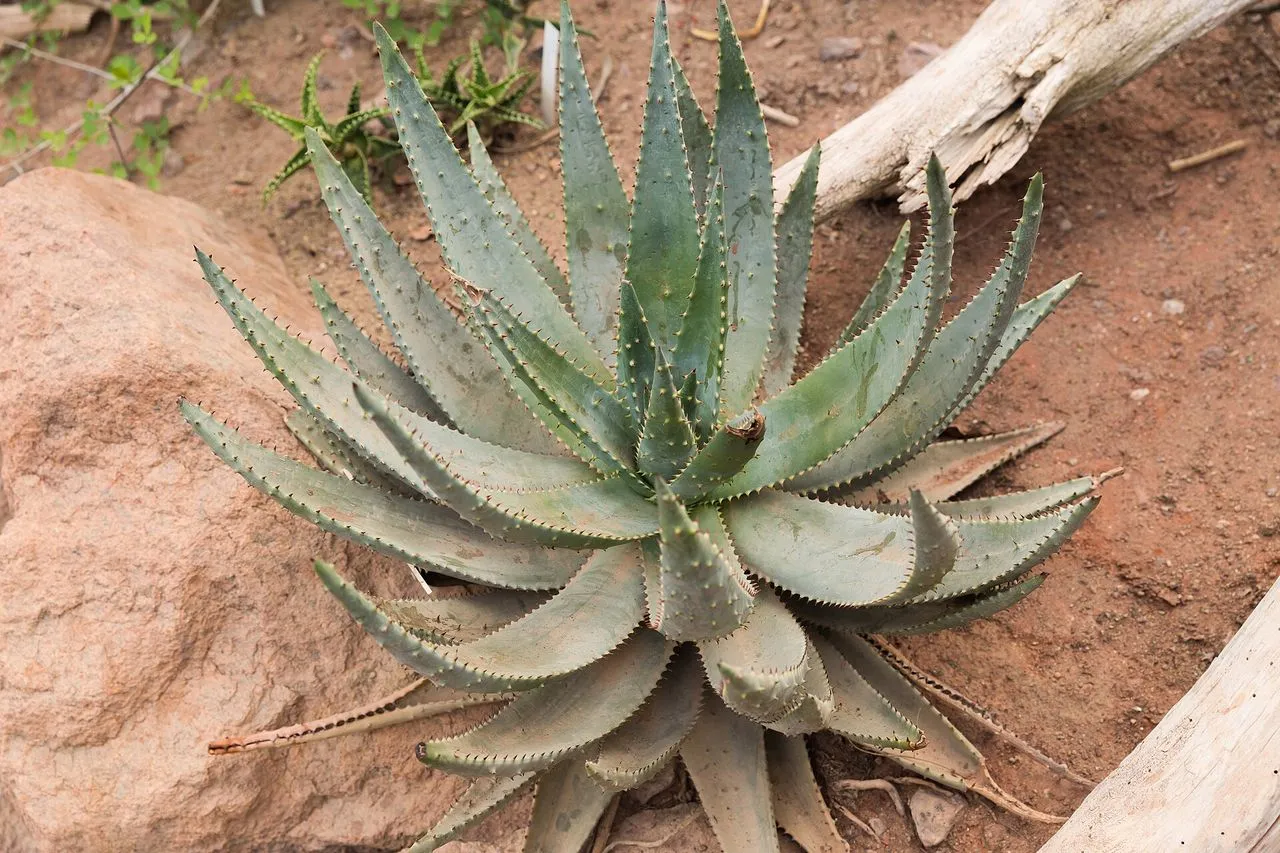
A single robust rosette 60 to 80 cm across, composed of thirty or more broad deeply channelled leaves that recurve outward at maturity. The diagnostic feature is the distribution of spines: A. aculeata carries reddish-brown tubercles across both upper and lower leaf surfaces, not just along the margins. The species name aculeata means "prickly" and refers specifically to this armed leaf surface, which separates it cleanly from most other South African rosette aloes. Leaf colour is a dull grey-green, often flushing bronze in sustained full sun.
Inflorescence is typically a single unbranched raceme up to 1.2 m tall, densely packed with tubular flowers that open in sequence from the base upward. Flower colour is variable: most populations produce bright orange-red buds opening to yellow, giving a bicoloured effect reminiscent of a red-hot poker. Flowering occurs in midwinter to early spring in habitat.
The closest confusion is with Aloe marlothii, which is taller, more clearly tree-forming with age, and carries a branched inflorescence. A. aculeata remains a ground-level rosette throughout its life or develops only a very short stem.
Cultivation
Full sun is non-negotiable. Under glass at temperate latitudes the species holds its compact rosette form only under a clear roof, and even then benefits from summer outdoor placement. In shade or filtered light, the leaves elongate and the tubercles become less pronounced, which reduces the species to a generic green rosette.
Cold tolerance is moderate. A. aculeata tolerates brief frosts to −3°C if dry but sustained sub-zero temperatures damage the growth point. In temperate cultivation, protect from winter wet above all else; a cold dry greenhouse at 5°C suits it better than a warm humid one at 15°C.
Substrate should be the standard aloe mineral mix leaning heavier on pumice, around 50% by volume. The species is slow-growing and resents frequent repotting; allow three to four years between pot changes.
Propagation
Seed is the primary route. A. aculeata is solitary and rarely produces basal offsets. Two genetically distinct plants flowering together are required for viable seed. Germination is straightforward on mineral-heavy sterile mix at 22 to 26°C, with seedlings emerging within two to three weeks. Juvenile plants develop the characteristic surface tubercles only from the third or fourth year.
When basal offsets do occur, usually after apical damage or flowering stress, they can be separated once large enough and rooted conventionally. Stem cuttings are not applicable to this species.
Notes
The surface tuberculation in A. aculeata is a functional adaptation, not purely ornamental. The raised pustules reduce boundary-layer water loss by disrupting surface airflow, a trait shared with several other bushveld aloes in exposed sites. In cultivation under lower light, the tubercles are smaller and less prominent; growers who want the fullest development of the character should grow hard and lean.
The species is a parent of several commercial hybrids, notably the A. aculeata × A. ferox crosses sold as landscape aloes across southern Africa. Named hybrids vary in quality and rarely retain the full surface tuberculation of the true species.
See also
- Aloe africana
- Aloe arborescens
- Aloe ferox — Eastern Cape tree-aloe, a comparison species for scale and surface armature.
- Aloe striata — coral aloe with smooth toothless margins, contrasting with the armed leaf faces of A. aculeata.
Frequently Asked Questions
What is the main identification point?
The Identification section separates Aloe aculeata by plant habit, leaf form, marginal teeth or surface markings, flowers, and lookalikes named in the article.
How should this aloe be watered?
Follow the Cultivation section rather than a fixed calendar. The article gives drying depth, seasonal growth rhythm, and the wet-cold risk for this plant.
How is it propagated?
Use the Propagation section. The article states whether offsets, stem cuttings, or seed are practical, and notes that single-leaf cuttings do not work for aloes.
What should buyers watch for?
Check the Notes and lookalike sections. The article flags trade confusion, hybrid material, or conservation sourcing where those issues apply.