| Question | Short Answer |
|---|---|
| What is the main identification point? | The Identification section separates Aloe ferox by plant habit, leaf form, marginal teeth or surface markings, flowers, and lookalikes named in the article. |
| How should this aloe be watered? | Follow the Cultivation section rather than a fixed calendar. |
| How is it propagated? | Use the Propagation section. |
| What should buyers watch for? | Check the Notes and lookalike sections. |
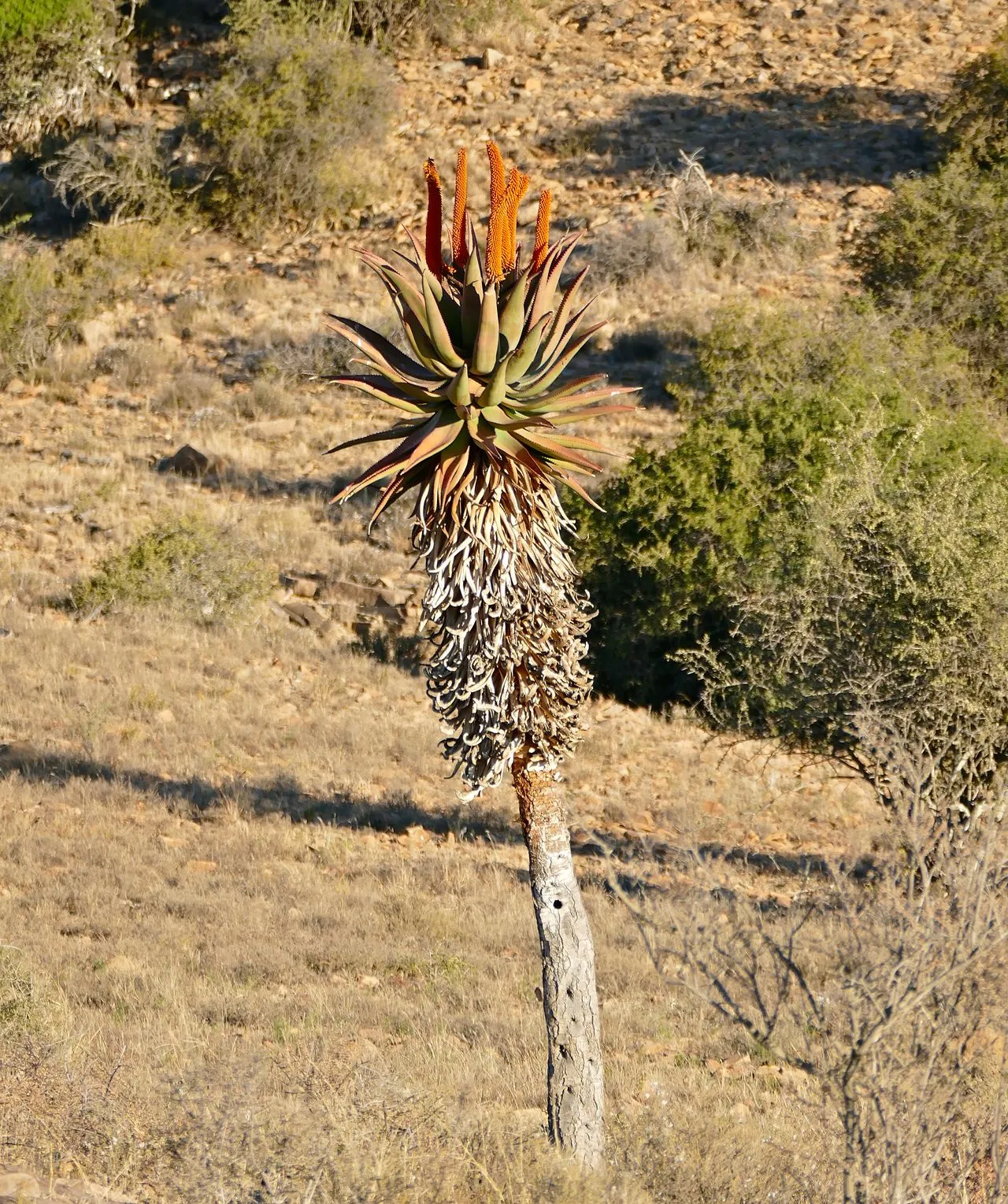
Aloe ferox Mill. (bitter aloe, Cape aloe) was described by Philip Miller in 1768 from Cape Colony material, making it one of the earlier South African succulents formally placed in European botany. It is endemic to the Eastern and Western Cape provinces of South Africa, where it colonises rocky open hillsides, grassy slopes, and scrub from sea level to approximately 1,500 m. A single-stemmed tree-aloe reaching two to three metres, A. ferox is recognisable at distance by its candelabra silhouette, the collar of dried lower leaves clinging to the stem below the living rosette, and its winter flower spikes.
The species is listed as Least Concern on the IUCN Red List. It is not listed on CITES Appendix I or II in its own right, though trade in aloin derivatives falls under pharmaceutical regulations in many markets. Wild populations across the Eastern Cape remain large and broadly stable; most commercial aloin is still harvested from wild plants under a regulated collection system, rather than from cultivated stock.
Part of the Complete Aloe Guide.
Identification
A. ferox grows as a solitary unbranched stem, rarely branching from the base unless the growing tip is damaged. That single-stem habit is the first and most immediate separator from Aloe arborescens, which branches freely and repeatedly from the base. A mature plant carries 50 to 100 leaves in a dense terminal rosette. Each leaf is 50 to 90 cm long, dull blue-green to grey-green, firm and recurved, and armed with reddish-brown teeth along the margins. The character most reliably separating A. ferox from other large South African tree-aloes is the presence of scattered reddish-brown prickles on the flat leaf surface itself, covering both the upper face and underside rather than appearing only on the margins. In the field, catching the leaf surface at an angle makes these surface teeth immediately visible.
Below the living rosette, shed lower leaves do not fall cleanly. They collapse against the stem and persist as a dense brownish skirt, a useful field mark visible at distance across open hillside habitat.
Flowers appear in late autumn to midwinter in the southern hemisphere, typically June through August. The inflorescence is a multi-branched panicle carrying five to twelve racemes, each a dense candle-shaped spike of tubular orange-red flowers 30 to 40 mm long. Plants grown in the northern hemisphere under natural light regimes flower from October through January.
Aloe africana is similar in stature and leaf colour but lacks the surface prickles and bears narrower, more compact flower spikes. Aloe marlothii (mountain aloe) is frequently confused with A. ferox in habitat and in nurseries; the clearest separator is the flower spike orientation: A. marlothii holds its racemes nearly horizontal, while A. ferox racemes point upward and slightly outward. Aloe spectabilis, a species described from KwaZulu-Natal, is now widely synonymised under A. ferox in current taxonomic treatments.
Cultivation
Light. A. ferox performs best with six or more hours of unobstructed direct sun. In a glasshouse or conservatory, give it the brightest unscreened position available. Insufficient light produces pale, elongated leaves that lose the compact recurved form of well-grown specimens; plants that do not colour in summer sun are almost certainly underlit.
Water. In active growth (spring through early autumn for most temperate collections), water thoroughly when the top 4 cm of substrate reads dry, roughly once every 10 to 14 days in a 10 to 15 litre container under warm summer conditions. Reduce to once a month or less from late autumn through winter. The species accommodates extended dry periods by sacrificing its lower leaves into the stem skirt; if the skirt is visibly expanding faster than usual, increase water frequency. Never let water pool in the growth point at the crown for more than a few hours.
Substrate. Free-draining and mineral-heavy, with a texture that wets fully and then drains within 48 hours. A workable mix is 50% pumice or perlite, 30% coarse grit (3 to 5 mm), and 20% loam-based compost such as John Innes No. 2. The root system of a mature plant is substantial, and a top-heavy rosette benefits from a heavy terracotta or concrete container for stability. More on substrate principles is at Succulent Soil & Substrate.
Temperature. Brief exposure to −4 °C causes no lasting damage provided the substrate is dry. Wet cold below 5 °C sustained for more than a week or two is the real risk, because saturated substrate at low temperatures brings on basal rot faster than any other factor. If overwintering outside in a climate that receives frost, ensure the pot drains completely and consider a rain cover for the root zone. Temperatures above 40 °C in open, ventilated conditions cause no damage to established plants.
Container size. Young plants establish well in 3 to 5 litre pots. Move into a 10 to 20 litre container when the plant reaches about 50 cm in height; from there, leave for several seasons before roots become crowded. Growth is considerably slower than A. arborescens: 10 to 15 cm of upward stem extension per year is typical under good conditions.
Propagation
A. ferox rarely offsets under cultivation or in habitat. The single-stem growth form means there are no basal pups to separate the way you would with Aloe vera or A. arborescens. Seed is the standard and reliable propagation route.
Seed germinates readily at 22 to 26 °C on a sterile, open, gritty mix. Sow on the surface rather than burying, water in gently, and cover loosely with glass or clear film to maintain surface humidity. Germination typically occurs within 14 to 21 days. Once seedlings show their second leaf, remove the cover and begin giving direct morning sun over the following two weeks, increasing exposure gradually. Seedlings are prone to damping-off in their first three months; good airflow and no standing moisture on the surface keep this in check.
Growth from seed is slow by the standards of the genus. Seedlings reach 5 to 8 cm across at the end of year one, 10 to 15 cm by the end of year two, and begin to resemble adult plants around year four or five. Flowering under cultivation typically occurs at seven to ten years from seed. Stem cuttings are not viable for this species; the stem is too tightly sheathed in leaf bases along its length to produce adventitious roots.
Notes
Medicinal history. The bitter yellow exudate draining from the cut base of A. ferox leaves has been traded commercially since at least the early eighteenth century, under the name "Cape aloes." European apothecaries distinguished it from "Barbados aloes" (the equivalent product tapped from Aloe vera in the Caribbean) and from "Curaçao aloes" traded through the Dutch West Indies. Cape aloes had a consistent commercial reputation for high aloin content and low resin contamination. The active compound, aloin (barbaloin), is a stimulant anthraquinone laxative; it appeared in the British Pharmacopoeia and the United States Pharmacopeia through much of the nineteenth and early twentieth centuries. Traditional harvesting required cutting the leaves near the base, propping them over a collecting trough, and allowing the exudate to drain by gravity, then evaporating the liquid to a dark, resinous cake. This method, still practised on a modest commercial scale in parts of the Eastern Cape, does not kill the plant: a harvested A. ferox regenerates its leaf canopy within one growing season. The US FDA withdrew aloe-latex laxative products from over-the-counter monographs in 2002 following rodent carcinogenicity studies at high doses; the European Food Safety Authority restricted hydroxyanthracene derivatives in food supplements in 2018. Both rulings concern the raw outer-leaf latex specifically, not the clear inner-leaf gel, which is a distinct tissue.
Aloe mite. A. ferox is attractive to Aceria aloinis, the eriophyid aloe mite, especially in enclosed or poorly ventilated collections. Inspect the base of new leaves and the centre of the rosette regularly for the cauliflower-like proliferative galling that signals an active infestation. Galled tissue cannot recover; remove it well past the margin, treat the plant with sulphur or abamectin, and isolate it from the rest of the collection. More on mite identification and control is in the Complete Aloe Guide.
Nursery trade confusion. Large single-stemmed aloes are routinely mislabelled at retail. If a plant sold as A. ferox has teeth only on the margins without any surface prickles on the leaf faces, treat the identification with scepticism. It may be A. marlothii, A. africana, or an unnamed hybrid.
See also
- The Complete Aloe Guide: full genus overview, cultivation principles, medicinal chemistry, and propagation methods.
- Aloe vera: the widely grown cosmetic and medicinal species; a useful comparison for gel chemistry.
- Aloe arborescens: the other well-known South African tree-aloe; multi-branched, faster-growing, and easier to propagate vegetatively.
Frequently Asked Questions
What is the main identification point?
The Identification section separates Aloe ferox by plant habit, leaf form, marginal teeth or surface markings, flowers, and lookalikes named in the article.
How should this aloe be watered?
Follow the Cultivation section rather than a fixed calendar. The article gives drying depth, seasonal growth rhythm, and the wet-cold risk for this plant.
How is it propagated?
Use the Propagation section. The article states whether offsets, stem cuttings, or seed are practical, and notes that single-leaf cuttings do not work for aloes.
What should buyers watch for?
Check the Notes and lookalike sections. The article flags trade confusion, hybrid material, or conservation sourcing where those issues apply.