| Question | Short Answer |
|---|---|
| What is the main identification point? | The Identification section separates Aloe africana by plant habit, leaf form, marginal teeth or surface markings, flowers, and lookalikes named in the article. |
| How should this aloe be watered? | Follow the Cultivation section rather than a fixed calendar. |
| How is it propagated? | Use the Propagation section. |
| What should buyers watch for? | Check the Notes and lookalike sections. |
Aloe africana Mill. (Uitenhage aloe) is a single-stemmed tree-aloe endemic to the Eastern Cape province of South Africa, where it grows on rocky hillsides and in valley bushveld between sea level and about 600 m. It reaches three to four metres in habitat, occasionally taller, making it one of the medium-sized South African tree-aloes in the same broad size class as A. ferox and smaller than A. pluridens.
Part of the Complete Aloe Guide.
Identification
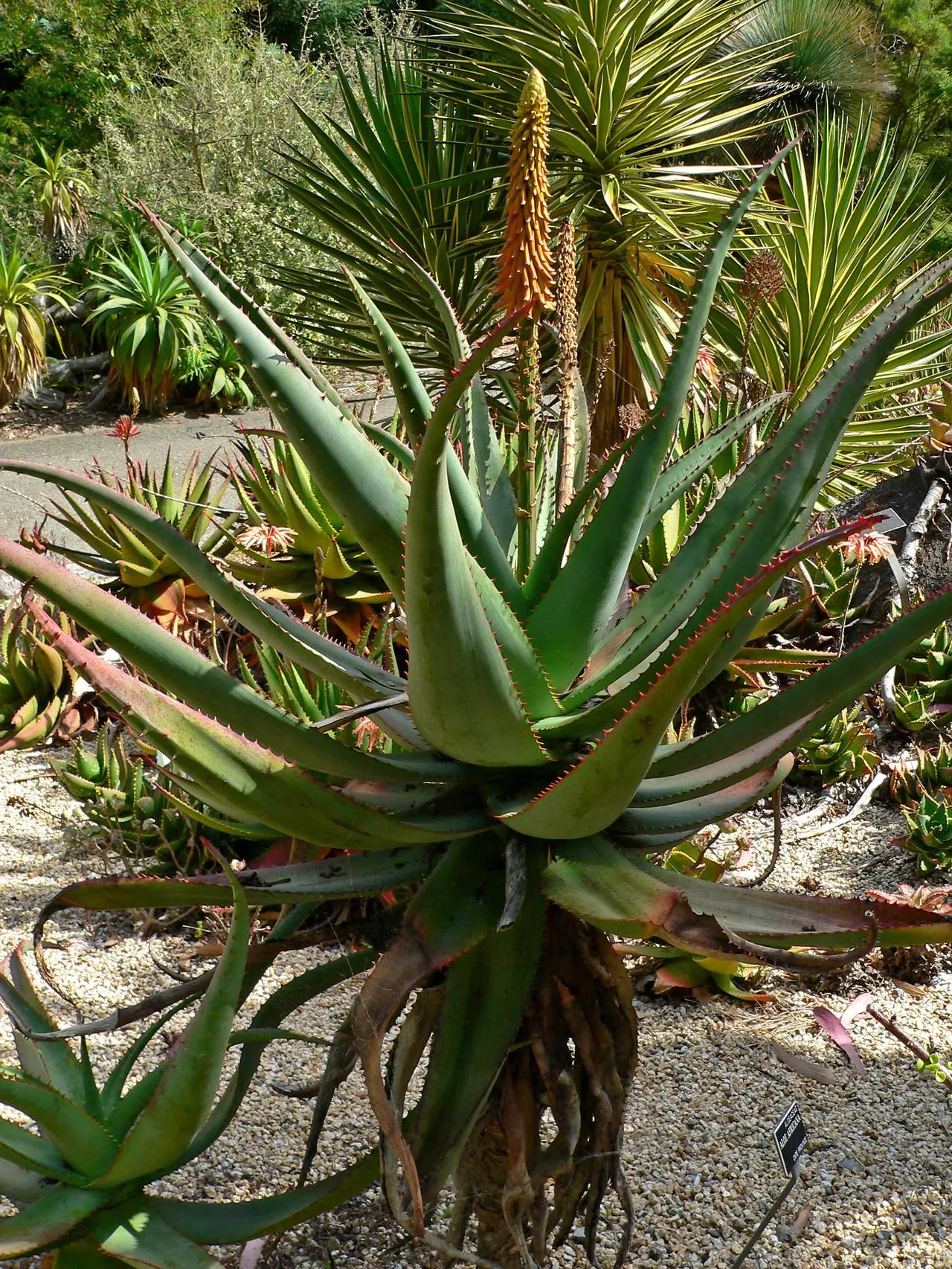
A solitary trunk crowned by a dense rosette of 30 to 50 glaucous-green leaves, each 60 to 80 cm long and 7 to 10 cm wide at the base, tapering to an acute tip. Leaf margins carry prominent reddish-brown teeth. The trunk retains its dried dead leaves in a persistent skirt (marcescence), a shared feature with A. ferox though more pronounced in habitat than under cultivation.
The diagnostic feature is the inflorescence. A. africana produces a multi-branched panicle with cylindrical racemes that curve downward at the tip in a distinctive S-shape, carrying orange-yellow tubular flowers in late winter. The downward-curving raceme is unusual in the genus and separates this species from the superficially similar A. ferox, whose raceme stays upright. Flowering in cultivation outside its native range is possible only in large specimens grown in ground in frost-free Mediterranean climates.
Cultivation
Standard cultivation for robust South African aloes applies. Full sun at any latitude, mineral-heavy free-draining substrate, deep but infrequent watering through the active season. A. africana is somewhat more frost-tolerant than most tree-aloes at the juvenile stage; mature specimens in dry winter conditions tolerate brief drops to −4°C without lasting damage.
The species grows slowly compared with A. arborescens and takes fifteen to twenty years to reach flowering size from seed. A juvenile rosette in a 20 cm pot will be happy for five to ten years before it begins to lift on a visible trunk. Pot size should be adequate but not generous; aloes in oversized pots retain wet substrate around unused roots and rot at the base.
Propagation
Seed is the only route of practical consequence. A. africana is solitary and does not produce basal offsets except rarely as a response to apical damage. Two unrelated plants flowering simultaneously are required for viable seed; this is the bottleneck for amateur propagation because cultivated material tends to trace to a handful of clones and suffers self-incompatibility. Fresh seed sown on sterile mineral mix germinates in two to three weeks at 22 to 26°C, and seedlings reach the one-year size of a 5 cm plant with two or three juvenile leaves.
Stem cuttings are not viable; the trunk is too woody and the species does not root along its length in the way A. arborescens does.
Notes
A. africana is sometimes sold in the general trade as a substitute for A. ferox because both are tall single-trunked South African aloes. The adult inflorescence distinguishes them, and juvenile plants can be separated on leaf colour (bluer in A. africana) and tooth distribution (A. ferox has larger, more widely spaced teeth, often with additional teeth on the upper leaf surface).
The species hybridises readily with A. ferox, A. arborescens, and A. speciosa where ranges overlap in the Eastern Cape, and intermediate specimens in cultivation are common. If you want true A. africana, buy from a specialist nursery with documented seed provenance.
See also
- Aloe arborescens
- Aloe aculeata
- Aloe ferox — closely related Eastern Cape tree-aloe, compared with A. africana on trunk, leaf, and inflorescence.
- Aloe striata — South African coral aloe from overlapping Eastern Cape range, with contrasting toothless leaf margins.
The care mistake that hurts Aloe africana fastest
Aloe africana can handle neglect better than wet roots. The risky setup is a decorative pot with no drainage, a peat-heavy mix, and a watering routine copied from leafy houseplants. If the lower leaves turn soft or translucent, check the roots before adding more water.
Soil and pot setup
Use a pot with drainage holes and a gritty mix that dries quickly around the root zone. A blend like Bonsai Jack Succulent, Cactus and Bonsai Soil is useful for growers who struggle with damp indoor mixes. As an Amazon Associate, we earn from qualifying purchases, at no extra cost to you.
- Choose terracotta or another breathable pot if your home stays cool or humid.
- Water deeply, then wait until the mix is dry well below the surface.
- Move the plant into brighter light slowly so old leaves do not scorch.
Can Aloe africana grow indoors?
Yes, but it needs your brightest window or a strong grow light. Indoors, growth is slower and flowering is less predictable. If the rosette stretches or leans hard toward the glass, it needs more light.
Frequently Asked Questions
What is the main identification point?
The Identification section separates Aloe africana by plant habit, leaf form, marginal teeth or surface markings, flowers, and lookalikes named in the article.
How should this aloe be watered?
Follow the Cultivation section rather than a fixed calendar. The article gives drying depth, seasonal growth rhythm, and the wet-cold risk for this plant.
How is it propagated?
Use the Propagation section. The article states whether offsets, stem cuttings, or seed are practical, and notes that single-leaf cuttings do not work for aloes.
What should buyers watch for?
Check the Notes and lookalike sections. The article flags trade confusion, hybrid material, or conservation sourcing where those issues apply.