| Question | Short Answer |
|---|---|
| What is the main identification point? | The Identification section separates Aloiampelos striatula by plant habit, leaf form, marginal teeth or surface markings, flowers, and lookalikes named in the article. |
| How should this aloe be watered? | Follow the Cultivation section rather than a fixed calendar. |
| How is it propagated? | Use the Propagation section. |
| What should buyers watch for? | Check the Notes and lookalike sections. |
Aloiampelos striatula (Haw.) Klopper & Gideon F.Sm., described originally as Aloe striatula by Adrian Hardy Haworth in 1825 and transferred in 2013 by Klopper and Smith to the segregate genus Aloiampelos together with the other clambering aloes, is the cold-hardiest aloe in temperate-garden cultivation and the only species in the group that survives unprotected outdoors in mild parts of Britain and the Pacific Northwest. It is native to the Eastern Cape and southern KwaZulu-Natal of South Africa, on rocky slopes between roughly 800 and 2,000 m in the southern Drakensberg foothills and inland montane belt. A mature plant is a multi-stemmed shrubby clambering shrub 1 to 2 m tall and often as wide, woody at the base, with narrow recurved green leaves 10 to 15 cm long and the longitudinal grey-green striations on the stems that give the species its name and the field character that separates it from every other aloe in trade.
Habitat is summer-rainfall montane grassland and rocky outcrop country in the southern Drakensberg ranges, where summers are warm and humid, winters are dry and frequently subzero, and snow lies briefly on the higher sites. The species sits on coarse mineral colluvium over basalt and sandstone, in positions where rooting is shallow, drainage is total, and freezing rain is a winter routine rather than an exception. That ecology has produced a plant with a tolerance to cold that no other tree-aloe matches: established bone-dry plants survive brief drops to between -8 and -10 °C without rosette damage, the practical lower limit for the genus in temperate gardens. The species is not red-listed and is locally common in habitat. Like all aloes other than A. vera, it sits on CITES Appendix II.
Part of the Complete Aloe Guide.
Identification
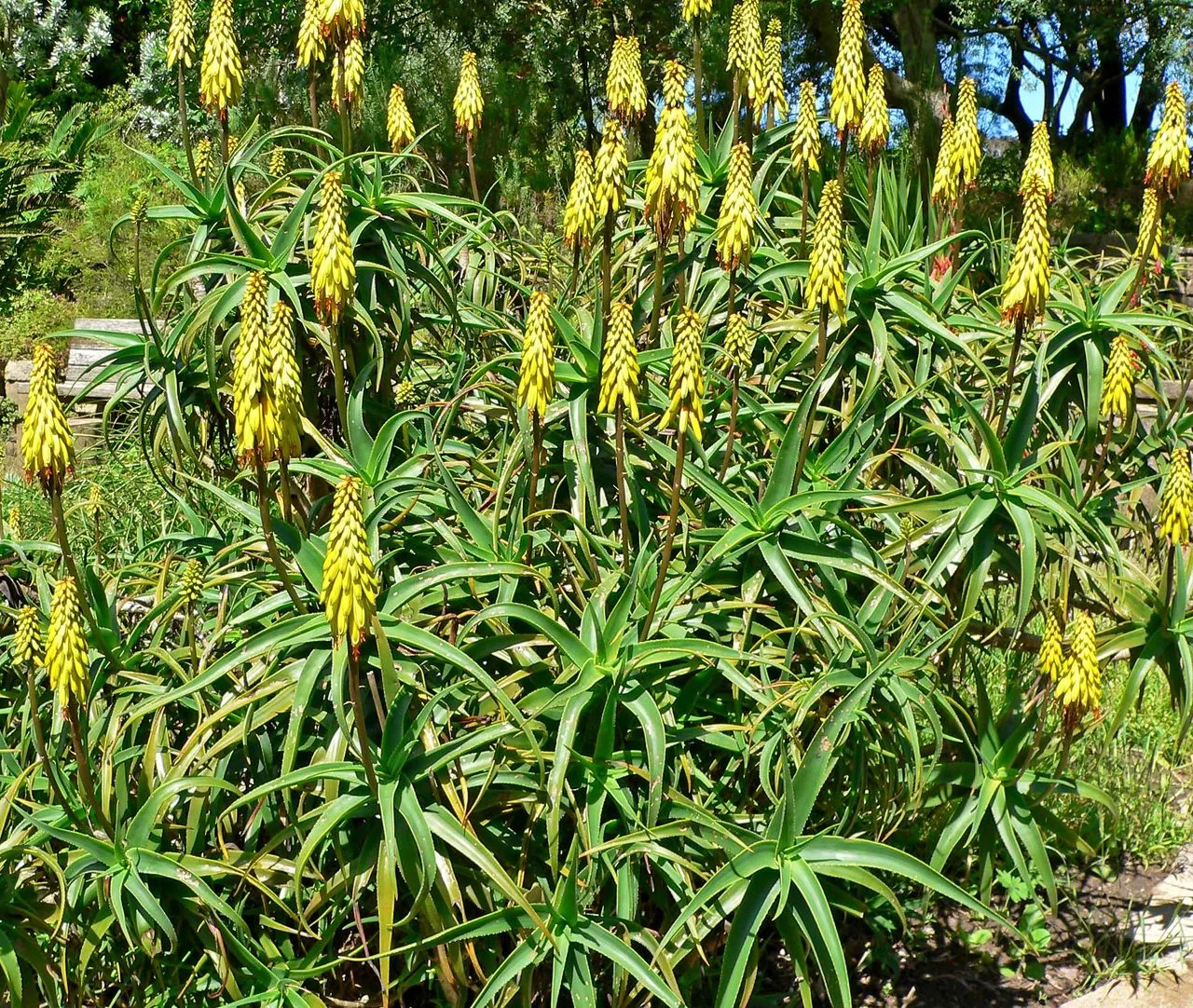
A settled A. striatula is a sprawling multi-stemmed shrub 1 to 2 m tall, often as wide as it is high, with a low woody framework that branches near the base and clambers outward over rocks or neighbouring shrubs. Stems are 1.5 to 2 cm thick at the base, woody and persistent, and carry the diagnostic feature: longitudinal striations of pale grey-green over a darker base, most visible on the lower bare wood once older leaves have shed. The stripe pattern is unique in Aloiampelos and the quickest field separator from any tree-aloe lookalike.
Leaves are narrow, lanceolate, and gently recurved, 10 to 15 cm long and 1.5 to 2 cm wide at the base, mid-green with no stress red, and arranged in loose terminal rosettes 15 to 20 cm across at the tips of the stems. Margins carry small soft teeth set close together, much paler and less prominent than the firm reddish-brown teeth of A. cameronii. There is no waxy bloom, no glaucous coat, and no winter colour change. Leaves stay green year round and shed cleanly from the lower stem as the rosette extends outward.
Flowers appear in summer, December to February in the southern hemisphere or June to August in the northern, on simple terminal racemes 20 to 30 cm tall held above each rosette. The raceme is a dense conical to cylindrical spike of tubular flowers 25 to 35 mm long, yellow at the bud and flushing orange as they open, so an active raceme reads bicolor yellow-orange overall. A mature shrub carries six to twelve simultaneous spikes through the warmest weeks.
Three lookalikes recur in cultivation, and the field separators are clean.
Aloe arborescens, the krantz aloe, is a much taller multi-stemmed shrub reaching 2 to 3 m, with broader recurved leaves 40 to 60 cm long, stems that lack longitudinal striations, and dense unbranched racemes of scarlet to red-orange flowers in midwinter rather than midsummer. Flower season, flower colour, and overall scale separate the two on sight.
Aloe cameronii, the Malawi red aloe, is a clumping stem-forming aloe 60 to 80 cm tall with narrow leaves that flush deep copper-burgundy under sun stress and dry winter, autumn coral-red flowers, and stems that lack the grey striations of A. striatula. A. cameronii is also a tender species frosted out at around 0 °C and cannot be confused in the open ground in any climate where A. striatula thrives.
Aloiampelos ciliaris, the climbing aloe, is the closest taxonomic relative within the segregate genus, but it is a smaller and more slender climber to 1 m, with much narrower leaves 6 to 10 cm long that carry a fringe of fine cilia (small hair-like teeth) at the leaf base where it sheaths the stem. Run a finger along the leaf base: ciliate hairs flag A. ciliaris, smooth bases flag A. striatula. A. ciliaris also tolerates only the briefest light frost and is not a temperate-garden plant outside the warmest sheltered positions.
Cultivation
A. striatula is the easiest aloe to grow in the open ground of a cool-temperate climate and is widely planted in the south-west of Britain, the Pacific Northwest of the United States, and the northern Mediterranean coast.
Light. Full sun is the standard, with at least 6 hours of direct light a day for compact growth and reliable summer flowering. The species tolerates a half-day of light shade in hotter inland positions without losing flower count, but a continuously shaded plant grows leggy, fails to firm its woody base, and refuses to bloom.
Water. Treat as a summer-rainfall grower with a long winter dry rest. From late spring through early autumn, water deeply when the top 3 to 4 cm of substrate has dried, then drain freely; in a 30 cm pot in warm growing weather that means roughly every 10 to 14 days. From mid-autumn cut watering hard and let the plant go dry through the cold months. This is the critical cultural point, since cold tolerance collapses in a wet substrate. A bone-dry plant survives between -8 and -10 °C without leaf damage; the same plant in damp substrate at -2 °C rots at the crown within a week.
Substrate. A mineral-heavy mix of about 60 percent inorganic to 40 percent organic suits the species. A working recipe is 30 percent pumice, 20 percent coarse perlite or lava grit at 3 to 6 mm, 10 percent quartz grit, and 40 percent sifted loam-based compost. In open ground on heavy clay, plant on a raised mineral mound 25 to 30 cm tall to ensure the crown sheds water in winter. The cultural baselines of the beginner's guide apply, with the proviso that this species wants a sharper winter dryness than any other temperate-grown aloe.
Temperature. Cold tolerance is the headline. An established bone-dry A. striatula tolerates brief drops to between -8 and -10 °C with only superficial leaf-tip damage, and recovers cleanly the following spring. Sustained frost below -10 °C, or any subzero temperature on a wet plant, kills the rosette. In maritime mild climates the species lives outdoors year round; in colder continental climates it is a glasshouse subject or a movable potted shrub. Heat tolerance is broad: the species takes 35 °C in dry conditions without visible distress, slowing growth and resuming after cooler nights and a deep watering.
Container. A sturdy terracotta or glazed stoneware pot 30 to 40 cm wide suits a settled clambering shrub. Repot every 3 to 4 years in early spring. Feeding is light: a quarter-strength balanced cactus fertiliser once or twice in the growing season.
Propagation
A. striatula propagates almost entirely from stem cuttings, with success rates close to 100 percent on settled material. This is one of the few aloes where stem cuttings of any reasonable length root reliably.
Sever a 20 to 30 cm length of leafy stem in late spring or early summer, strip the lower 5 cm of leaves, callus the cut surface 7 to 10 days in dry shade, and insert upright into a pot of pure pumice or the standard mineral mix. Roots emerge in 3 to 5 weeks at 20 to 25 °C with no watering until rooting is confirmed, then a light first water and a transition to the standard mix. This is the fastest route to a flowering-sized landscape plant and the route every commercial nursery uses to bulk up stock.
Basal offsets occur on settled plants but slowly. Lift the parent in early spring, separate offsets where they branch from the main stem, callus 5 to 7 days, and pot into the same mineral mix. Take rates over 90 percent are normal at 20 to 25 °C with restrained watering for three weeks.
Seed germinates at 18 to 24 °C in 3 to 5 weeks at a 50 to 70 percent rate, but the wait is rarely worth it when stem cuttings are this reliable. Seedlings reach flowering size after 4 to 5 years; a rooted stem cutting flowers in its second summer.
Notes
Why this species, and not another aloe. A grower in USDA zone 7b or 8a who wants a tree-aloe in the open ground has one realistic option, and this is it. The cold-hardy reputation rests entirely on a dry rootzone in winter; growers who plant A. striatula in heavy soil without raised drainage lose the plant after the first wet freeze and conclude the species is tender. It is not. The planting was wrong.
Trade confusion. A. striatula is still sold widely under its old name Aloe striatula, and most retail nurseries have not updated labelling to reflect the 2013 transfer to Aloiampelos. The plant is the same; the name is current. The transfer covers seven clambering species formerly in Aloe (including A. ciliaris and A. tenuior) and reflects molecular work that placed the climbing aloes outside the core Aloe clade.
Pests. Mealybug occasionally hides at the leaf bases of crowded plants under glass with poor airflow. The open multi-stem habit makes hand-lens inspection straightforward and quarterly checks are enough. Aloe mite, which deforms growing points into cauliflower-like masses, is rare on this species but possible; any affected stem should be cut out and destroyed.
See also
- The Complete Aloe Guide: genus-level cultivation and where the segregate genera Aloiampelos, Aloidendron, and Kumara sit alongside the core Aloe clade.
- Beginner's Guide to Succulents: light, water, and substrate fundamentals to settle before reading species-specific notes.
- Aloe cameronii — Malawi clumping aloe also discussed in the identification section.
Frequently Asked Questions
What is the main identification point?
The Identification section separates Aloiampelos striatula by plant habit, leaf form, marginal teeth or surface markings, flowers, and lookalikes named in the article.
How should this aloe be watered?
Follow the Cultivation section rather than a fixed calendar. The article gives drying depth, seasonal growth rhythm, and the wet-cold risk for this plant.
How is it propagated?
Use the Propagation section. The article states whether offsets, stem cuttings, or seed are practical, and notes that single-leaf cuttings do not work for aloes.
What should buyers watch for?
Check the Notes and lookalike sections. The article flags trade confusion, hybrid material, or conservation sourcing where those issues apply.