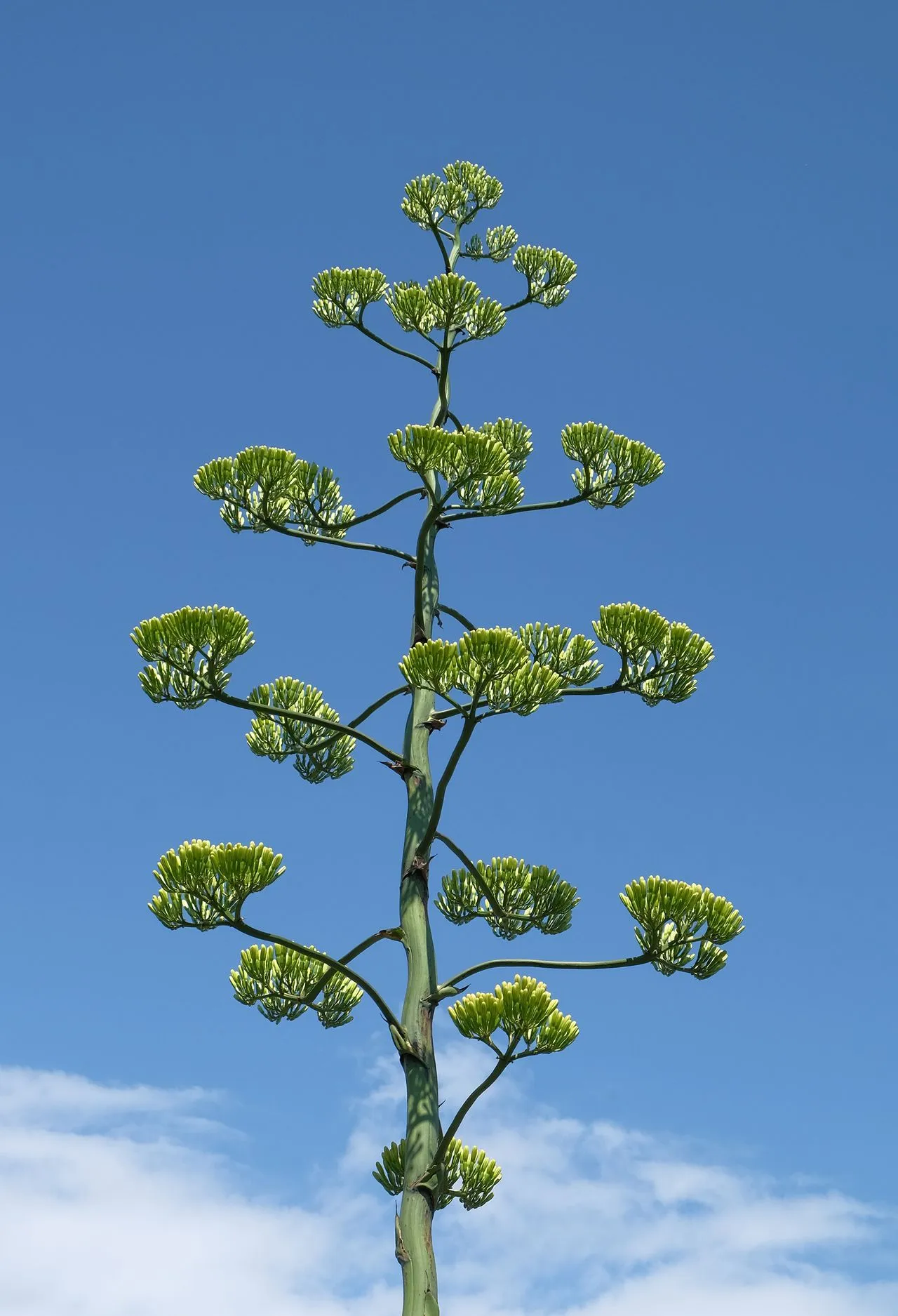
Quick Answer
The short answer: Some succulents (Agave, Sempervivum, some Aeonium) flower once and die (monocarpic). Others (Echeveria, Aloe, most cacti) bloom repeatedly for decades (polycarpic).
Best first step: Identify whether your plant is monocarpic before buying. If it is, plan for offsets or replacements before the bloom happens.
Avoid: Assuming a collapsed Echeveria after flowering is "normal" - it's usually rot, pests, or exhaustion, not a natural end.
Will my succulent die when it flowers? The honest answer is that it depends on the genus. Some lineages, Agave and Sempervivum among them, have rosettes that flower once and then die. Others, including Echeveria and most Aloe, bloom year after year without losing the plant. Both patterns are normal, but they ask different things of the grower. Plan replacements for monocarpic plants before they bolt. Treat a dying Echeveria after a bloom as a problem, not a natural end. Here is the rest of the picture: the genus lists worth memorising, the recognition signs of an incoming bloom, and the awkward sub-types that sit between the two clean categories.
Part of the Beginner's Guide to Succulents.
At a glance
| Trait | Monocarpic | Polycarpic |
|---|---|---|
| Flowering events per rosette | One | Many |
| Outcome for the flowering body | Dies | Survives, regrows |
| Continuity of the genetic line | Via offsets, seeds, or both | Via the same body, year after year |
| Cost of a missed bloom | Permanent loss of that rosette | A skipped season |
| Time from acquisition to flowering | A predictable countdown | Open-ended |
| Examples | Agave, Sempervivum, some Aeonium | Echeveria, most Aloe, most cacti |
What the two terms mean
In botany, monocarpic describes a plant that flowers once in its life and then dies. Zoologists use the equivalent term semelparous for the same pattern: salmon, mayflies, and Pacific octopuses all reproduce once and die. The opposite is polycarpic, also called iteroparous, where the same body reproduces year after year. Apple trees, oak trees, the Aloe vera on your kitchen windowsill, every cactus on the bench: all polycarpic.
The mechanism is resource allocation, not magic. A monocarp accumulates carbohydrate, water, and mineral reserves in storage tissue (thick succulent leaves, an underground stem, a rhizome) for years. When flowering begins, it converts the entire reserve into one massive reproductive event, so the body is left empty and cannot rebuild. A polycarp keeps a working reserve in the same tissue; flowering and fruiting use only the surplus, and the plant continues to grow.
Genera that flower once and die
Memorise this list before you buy. If a plant is in one of these genera, the rosette in front of you has a finite life that ends with flowering.
- Agave. Almost all of the roughly 200 species in the genus. Headline cases are Agave americana, A. salmiana, and A. tequilana. Time from germination to bloom ranges from 5 to 10 years for dwarf species like A. parviflora up to 25 to 50 years for the giants. Genus-wide working rule: assume monocarpic.
- Sempervivum. Each rosette is monocarpic. Houseleeks, hens-and-chicks, the entire genus. The clone, however, is effectively immortal because every flowering rosette is replaced from the dense ring of stoloniferous offsets it produced before bolting.
- Some Aeonium. Aeonium tabuliforme, A. nobile, and A. canariense are typically monocarpic at the rosette level. The branched shrub forms still continue, since each rosette in a multi-headed A. arboreum flowers and dies independently of its neighbours.
- Bromeliads adjacent to succulent collections. Tillandsia, Aechmea, and Vriesea rosettes are monocarpic, even though they sit on hardware-store shelves alongside echeverias.
- A handful of Yucca relatives. Most Yucca are polycarpic, but Hesperoyucca whipplei (formerly Yucca whipplei) is strictly monocarpic and famous for the trait.
Genera that flower repeatedly
Your Echeveria, your kitchen Aloe, the windowsill cacti you bought ten years ago: all polycarpic. Flowering is a normal seasonal event the plant does and recovers from.
- Echeveria. The entire genus. A flowering Echeveria agavoides loses no leaves to the bloom and resumes vegetative growth as soon as the spent inflorescence is cut.
- Most Aloe. Aloe vera, A. ferox, A. arborescens, A. striatula: all flower annually, often for decades. There are a small number of monocarpic exceptions in the closely related genera Aloiampelos and Aloidendron, but mainstream Aloe in cultivation is firmly polycarpic.
- Almost every cactus. Mammillaria, Echinopsis, Opuntia, Astrophytum, Echinocactus, Cereus, Schlumbergera: all polycarpic. Cacti are essentially built around repeated flowering. A well-grown Mammillaria zeilmanniana will throw a ring of pink flowers every spring for fifteen years.
- Crassula. Crassula ovata, C. perforata, C. arborescens: polycarpic. Flowering signals the plant is healthy, not finishing.
- Sedum. The whole genus. Every Sedum in the trade is polycarpic.
- Most Haworthia (now split between Haworthia, Haworthiopsis, and Tulista). All polycarpic, often flowering several times a year under lights.
- Most Kalanchoe. Kalanchoe blossfeldiana, K. tomentosa, K. luciae, K. pinnata: all polycarpic. The genus has no widely accepted monocarpic species in mainstream cultivation.
Recognising an imminent bloom in a monocarpic plant
The earlier you see a bolt coming, the more time you have to take cuttings, harvest seed, or simply move the plant out from under the patio roof before a 6 m flower spike grows through it. Three signs appear in roughly this order:
- Rapid central spear elongation. The new central leaves stop looking like leaves and start looking like a thick, finger-shaped stalk. In Agave americana the rate is 10 to 30 cm per week at peak. In Sempervivum it is a few millimetres per day, but the spike pushes up from the centre of the rosette in a way that breaks the previous symmetry.
- Outer leaves spread and the rosette flattens. To make space for the developing inflorescence, the rosette opens. Aeonium tabuliforme, normally a tight dinner-plate of overlapping leaves, loses its symmetry as the spike emerges from the middle.
- Acceleration of basal pup production. The plant invests in clonal continuity while it still has resources. Agave offsets emerge from the soil around the base, Sempervivum throws extra stolons, and a flowering Aeonium arboreum often pushes side branches just below the head.
If you see all three on a known monocarpic plant, the rosette is committed. Cutting the spike will not reverse the process, since the carbohydrates and minerals already in transit cannot move back into the leaves.
When a polycarpic plant dies after flowering
This is where the distinction matters most for new growers. If your Echeveria drops leaves and rots after producing a flower stalk, it is not following its life history. Polycarpic succulents do not naturally collapse after flowering. Likely causes, in order of frequency:
- Crown rot from overwatering during the bloom. Inflorescence stalks act as wicks, and a wet rosette stays wetter than usual.
- Mealybug or root mealybug populations exploiting the weakened plant. Flowering diverts resources, and a sub-clinical infestation catches up.
- Substrate exhaustion in a long-unrepotted specimen. Flowering uses the last of the available nutrients and the plant cannot rebuild.
- Heat stress during a summer bloom on a south-facing windowsill, where the rosette cooks while everyone is admiring the flower.
Treat the symptoms as you would in any other context: unpot, inspect the roots, check for pests, repot in fresh mineral substrate, water once and then withhold until firm new growth appears. "It flowered, so it died" is not an explanation for a polycarpic species.
Hapaxanthic, polycarpic, facultative
The clean monocarpic-versus-polycarpic split has three useful sub-categories:
- Hapaxanthic, or strict monocarpy. Agave americana is the textbook case. One bloom, certain death of the rosette, no exceptions in cultivation.
- Genuinely polycarpic. Aloe vera flowers every year for thirty or forty years. The same individual body, repeated reproduction, no decline tied to flowering.
- Facultative. Aeonium arboreum sits here. Most flowering rosettes die, but vigorous plants in cool maritime conditions sometimes survive a small bloom and continue. The pattern is statistical, not absolute. Treat the rosette as monocarpic for planning purposes, and count any survival as a bonus.
Collection strategy: stagger ages
If you collect Agave or Sempervivum, the practical rule is to keep specimens of different ages. A 2-year-old, a 5-year-old, and a 10-year-old of the same species means that as one rosette commits to flowering, others are still building reserves. The collection survives in continuous form even though no single rosette does. Specialist Agave nurseries often sell the same species at three pot sizes for exactly this reason.
When buying a near-mature monocarpic specimen, treat it as a short-term acquisition. A five-litre pot of Agave parryi with a thick crown is quite likely to bolt within a year or two. That is not a defect, it is the species. Plan for offsets, plan for the spectacle, and plan for what you will replace it with.
When the two get confused in trade
Garden centres rarely label by carpic-type, and the labels they do print are often vague. Two practical points:
- A flowering monocarpic specimen on the bench is a clearance sale, not a healthy plant. Agave attenuata in spike at a chain store will look impressive, but the rosette has already committed to dying. The buyer pays for a brief decoration and, with luck, a clutch of pups.
- A polycarpic plant that "dies after flowering" was sick, not done. Do not accept "they only flower once" as an explanation for a collapsed Echeveria or Crassula. The sales script is wrong. Inspect the plant for rot or pests before deciding what happened.
The clearest way to avoid both traps is to identify every plant by carpic-type at the point of acquisition and label it on the pot. For the broader cultivation framework that sits underneath all of this, the beginner's guide to succulents covers light, substrate, watering, and pot choice across all the genera mentioned above.
See also
- Beginner's Guide to Succulents, the master pillar covering basic cultivation across the genera referenced here.
- Agave monocarpy explained, the mechanism, signs, and aftermath of an Agave death-bloom in detail.
- Kalanchoe pinnata, profile of a prolific polycarpic kalanchoe and a counterpoint to the monocarpic flowering pattern.
- Indoor succulent care: the broader light, water, and seasonal framework for all the genera listed above
FAQ
How long does it take for an Agave to flower?
It depends on the species - dwarf Agave parviflora takes 5-10 years, while giant Agave americana takes 25-50 years. Assume any mature Agave could bloom soon.
If my Sempervivum flowers, does the whole plant die?
Each rosette dies after flowering, but the plant survives through offsets (pups). The "hen and chicks" produces new rosettes around the dying flowering one.
Can I stop a monocarpic plant from dying after flowering?
No. Once the flowering process begins, resources are committed and cannot be reversed. Cutting the flower stalk won't save the rosette.
My Echeveria died after flowering - was it monocarpic?
No, Echeverias are polycarpic. If your plant died after flowering, check for root rot, mealybugs, or substrate exhaustion - not natural death.
Frequently Asked Questions
What is the first step for monocarpic vs polycarpic succulents: which die after flowering?
Start by matching the symptom to the plant, substrate, light, and season before changing watering or treatment.
What should be avoided?
Avoid changing several variables at once; correct the limiting factor and observe the plant before escalating.
Which care factor matters most?
Match the plant to its light, substrate, pot size, and season. Most succulent failures trace to a mismatch between drying speed and the plant's current growth rate.
When should the plant be checked again?
Recheck after one to two weeks unless tissue is actively collapsing. Stable firmness and new growth are better signs than a fixed calendar interval.