| Question | Short Answer |
|---|---|
| What is the first step for coir and sphagnum in succulent mixes: where they belong? | Start by matching the symptom to the plant, substrate, light, and season before changing watering or treatment. |
| What should be avoided? | Avoid changing several variables at once; correct the limiting factor and observe the plant before escalating. |
| Which care factor matters most? | Match the plant to its light, substrate, pot size, and season. |
| When should the plant be checked again? | Recheck after one to two weeks unless tissue is actively collapsing. |
Quick Answer
The short answer: Most succulents don't need organic matter, but coir (5-15%) works in seedling mixes and tropical succulents, while sphagnum (50-100%) is for rooting difficult cuttings.
Best first step: Use coir at 10-15% in seedling mixes for slow-germinating Lithops and Conophytum. Use sphagnum for rooting stubborn cuttings like Adromischus.
Avoid: Organic matter in adult cacti and winter-dormant Echeveria mixes - it holds moisture too long and causes root rot.
Most serious succulent literature tells you to keep organic matter out of your substrate, and most of the time that advice is correct. The exceptions are narrow but real: coconut coir and Sphagnum moss both have specific physical properties that solve specific problems no mineral aggregate can solve. The bottom line is to use coir at 5 to 15 percent in seedling and tropical-origin mixes, and sphagnum at 5 to 10 percent as a moisture cap or 50 percent plus in dedicated propagation pots. Anywhere else, both materials cause more trouble than they prevent. Here is the rest of the picture.
Part of the Beginner's Guide to Succulents.
What coir and sphagnum are
Coir is the fibrous material from the husk of the coconut (Cocos nucifera), a by-product of coconut food and oil processing in Sri Lanka, India, the Philippines, Indonesia, and Vietnam. Once treated as a waste stream, it now substitutes for peat in much of the European horticultural trade, partly on cost and partly because the peat industry's environmental footprint has come under serious regulatory pressure. Compressed coir bricks rehydrate to roughly six to eight times their dry volume, and the material ships dry and light, which is part of the appeal.
Physical numbers worth knowing:
- pH 5.8 to 6.8, near neutral. Peat by comparison runs 3.5 to 5.0, distinctly acidic.
- Water-holding capacity 600 to 800 percent by weight, very high.
- Cation exchange capacity 60 to 130 meq per 100 g, in the medium-clay range, so it holds nutrients between feeds.
- Decomposes slowly: 5 to 10 years in a regularly watered pot, against 2 to 5 for peat.
- Residual salts are real. Cheap unwashed coir can carry 100 to 2000 ppm sodium and potassium chloride from coastal processing water, which is why reputable suppliers wash and buffer the product before sale.
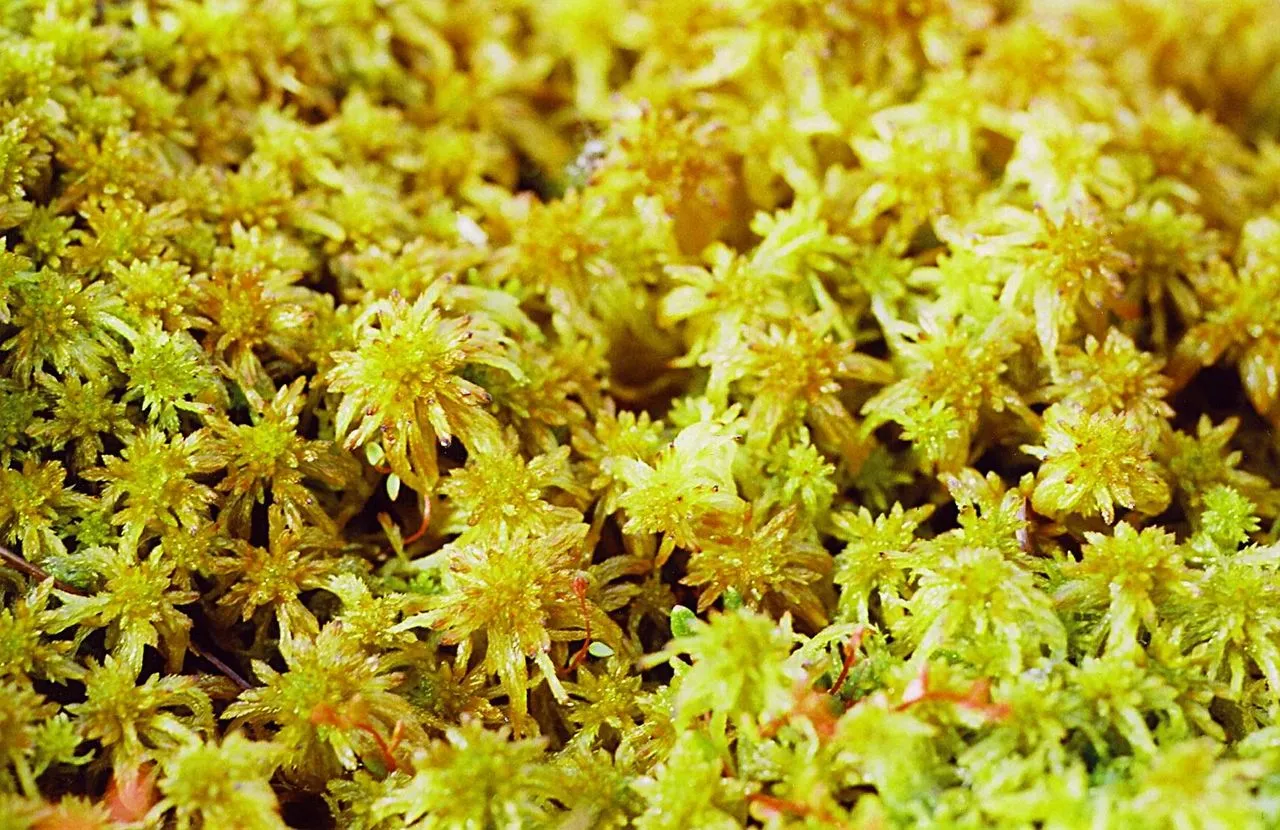
Sphagnum moss is the dehydrated whole-plant material of the genus Sphagnum, a group of bog mosses with a remarkable cellular architecture: dead hyaline cells form a sponge-like network around the live photosynthetic cells, so the plant body itself behaves as a passive water reservoir. Most horticultural sphagnum sold in Europe comes from New Zealand (Mt Tama is the premium grade), Chile, or Indonesia, harvested from sustainably managed bogs and dried.
Physical numbers:
- pH 3.5 to 4.5, distinctly acidic.
- Water-holding capacity 1500 to 2500 percent by weight, the highest of any growing medium in common use.
- CEC 80 to 120 meq per 100 g, comparable to coir.
- Decomposes 3 to 7 years depending on grade and how often it goes through wet-dry cycles.
The two materials look like they should be interchangeable. They are not. Coir is near-neutral, holds steady moisture, and lasts a long time. Sphagnum is acidic, holds extreme moisture, and is structurally lighter and more breathable. Those four differences determine where each one earns its keep.
Why they're controversial for succulents
The standard advice from most cactus and succulent guides is to use zero organic matter in adult mixes, and the reasoning is sound. Organic decomposition consumes oxygen and produces carbon dioxide. In a tight pot with poor air exchange, that gas accumulation suffocates fine roots. The same decomposition collapses pore structure, which means the substrate that drained well in week one holds water like a sponge in month eighteen.
Organic matter also feeds the pests that succulent growers most want to avoid. Root mealybugs (Rhizoecus spp.) breed faster in organic-rich substrate, fungus gnats lay eggs in damp peat or coir surfaces, and many soil-borne fungal pathogens establish more readily where there is decomposing carbon for them to consume.
So the rule of thumb in serious cultivation is mineral first, mineral second, and organic only where you can name a specific reason it earns the slot. Both coir and sphagnum can earn that slot. Neither is a default ingredient.
Where coir actually helps
Three scenarios where coir is the right call.
The first is seedling mixes for slow-germinating species. Lithops, Conophytum, Tylecodon, and small Aizoaceae take weeks to push their first cotyledons through substrate, and during that window the surface needs to stay evenly damp without going anaerobic. A 10 to 15 percent coir fraction blended into a fine pumice or akadama base buffers the moisture cycle without the pH drop you would get from peat. The near-neutral pH matters because seedling roots are far less tolerant of acidic substrate than adult plants of the same species.
The second is tropical-origin succulents. Holiday and forest cacti like Schlumbergera truncata, Schlumbergera buckleyi, Hatiora gaertneri, Selenicereus chrysocardium, and most epiphytic Rhipsalis did not evolve in deserts. They live on tree branches in cloud forest and rainforest, where their roots run through a thin film of damp organic detritus on bark. A substrate that mimics that environment, typically 30 to 50 percent fine bark plus 10 to 20 percent coir over a mineral base, supports them far better than the lean pumice mix that suits desert taxa.
The third is pad-mounted display work. For Tillandsia-style mounts where a Rhipsalis baccifera or a similar epiphyte is wired to driftwood or cork bark, a coir pad behind the rootball gives the plant a thin, breathable, near-neutral substrate layer that holds moisture between mistings without rotting against the bark.
Where sphagnum actually helps
Three scenarios where sphagnum is the right call.
The first is initial rooting of difficult cuttings. Live or freshly dehydrated sphagnum is sterile straight from the bag (the bog environment is bacteriostatic), holds extreme moisture, and remains breathable because of its hyaline cell structure. For Adromischus leaf cuttings, Tylecodon stem segments, and certain Crassula species that resent dry callusing, a 50 to 100 percent sphagnum propagation pot reliably produces roots within four to six weeks where bare-substrate methods fail. The acidic pH happens to inhibit a number of common rot organisms, which is part of why the technique works.
The second is bare-root transit. Mail-order succulents from specialist nurseries arrive with their rootballs wrapped in damp sphagnum because nothing else combines this much moisture retention with this much air space. The rootball stays alive in a parcel for a week, which an exposed dry rootball cannot, and which a peat-wrapped rootball would not (peat compacts wet and suffocates fine roots in transit).
The third is seed germination caps. A thin layer of milled sphagnum on top of a mineral seed-sowing substrate behaves as a moisture cap: the cap stays evenly damp, the underlying mineral layer drains, and the seed lies at the interface where both conditions are correct. This method is standard in Lithops and Conophytum sowings and improves germination uniformity over either pure mineral or pure organic surfaces.
When to avoid both
Several common situations where neither material belongs in the mix.
For dry-substrate cacti, including Mammillaria, Echinocactus, Astrophytum, and Ferocactus, the answer is no organic matter at all in the adult pot. These plants evolved on lean, mineral substrates, their roots resent the gas exchange penalty of decomposition, and the moisture profile that organic content produces is wrong for their physiology in every season except active summer growth.
For winter-resting rosette succulents, including most Echeveria, Aeonium, and many Crassula, organic matter that holds moisture into a 5 to 10 °C dormancy window is the single most reliable way to rot roots. A pot that holds 30 percent moisture by volume in cold weather stays wet for weeks, and the plant is not transpiring fast enough to dry it. Mineral mixes dry within days under the same conditions.
For pots without good drainage, no organic content rescues a poorly drained pot, and 5 percent coir in a pot with one small hole behaves worse than 0 percent coir in a pot with proper drainage. Fix the pot first.
For collections with a known root mealybug problem, organic matter measurably accelerates Rhizoecus population growth. If you are managing an active infestation across several pots, switching to fully mineral substrate for the affected plants until the population crashes is part of the standard response. Reintroduce coir, if at all, only after a full year of clean root inspections. The collection-wide management approach for root mealybugs, including substrate replacement and drench protocols, is set out in root mealybug identification.
Mix proportions
A working set of starting points, all percentages by volume:
- Adult succulent mix (general rosettes, Echeveria, Crassula, Sedum): 0 to 5 percent coir, balance pumice plus a small grit fraction. The coir slot is optional and many growers omit it entirely.
- Adult cactus mix (Mammillaria, Astrophytum, Ferocactus): zero coir, zero sphagnum.
- Seedling tray for slow species (Lithops, Conophytum, Tylecodon): 10 to 15 percent fine coir blended into a fine pumice or akadama base, with an optional 2 to 3 mm milled sphagnum cap on top of the seed layer.
- Tropical succulent mix (Schlumbergera, Hatiora, Rhipsalis): 10 to 20 percent coir, 30 to 50 percent fine bark, balance pumice. This is the only adult mix where coir reaches double figures.
- Cutting pot for difficult propagation (Adromischus, Tylecodon, certain Crassula): 50 to 100 percent long-fibre sphagnum, used for the rooting period only. Pot up into a normal mineral mix once roots reach 2 to 3 cm.
The 5 to 15 percent guidance for coir in adult succulent mixes is the one number most worth memorising. Below 5 percent the coir contribution is invisible. Above 15 percent the moisture and decomposition penalties start to outweigh the buffering benefit, and the substrate behaves more like a houseplant mix than a succulent mix.
Quality grades
Coir grade matters more than most growers realise, because the salt question is real and the cheaper bricks often skip the wash step.
Reputable washed and buffered coir from suppliers like FibreDust, Coco Coir Direct, or Canna Coco runs 10 to 15 EUR per 5 L compressed brick once expanded. The product carries a certificate of EC (electrical conductivity, a proxy for residual salt) below 0.5 mS/cm, which is the threshold below which residual sodium and potassium will not measurably interfere with succulent root function. Lower-cost generic coir from non-specialist sources can run 100 to 2000 ppm in residual salts, and rinsing it at home through several changes of rainwater before use is the only reliable correction.
Sphagnum grade matters even more. Long-fibre New Zealand Mt Tama grade sphagnum runs 30 to 50 EUR per kilogram dry weight, holds its structure for 18 to 30 months in a propagation pot, and supports root colonisation through the fibre rather than around it. Indonesian short-fibre sphagnum at 15 to 25 EUR per kilogram is half the price but breaks down to a dense mat in 6 to 12 months, and the dense mat behaves like wet peat: anaerobic, slow-draining, and prone to surface algae. The premium product lasts two to three times as long. On a per-year-of-use basis the Mt Tama grade is closer to comparable in price than the bag price suggests, and for difficult cuttings it is the only grade I trust without reservation.
Two products marketed as sphagnum are not sphagnum. The first is sheet moss, which is a different group of mosses sold for terrarium decoration, and which compacts wet and offers none of the propagation benefit. The second is "peat moss" sold as an interchangeable product, which is partially decomposed sphagnum, behaves like peat, and lacks the live-cell structure that gives true sphagnum its propagation properties. Read the label.
See also
- A Beginner's Guide to Succulents, for the broader substrate, watering, and light foundation that determines whether organic content would help your specific plants at all.
- John Innes and succulents, for how the traditional UK loam-based mixes compare against coir-based and pure mineral substrates for adult succulent pots.
- DIY substrate mixing, for ratios and sourcing notes when blending pumice, lava rock, akadama, coir, and sphagnum into a working succulent mix at home.
- Seed Propagation Introduction — where coir and sphagnum earn their place in germination mixes for slow-growing species.
- Pumice vs Perlite — the mineral alternatives that replace organic components in adult succulent pots.
FAQ
Can I use coir in my Echeveria mix?
Keep it minimal - 0-5%. Too much coir holds moisture into winter dormancy and causes root rot in cold conditions.
What's the best use for sphagnum moss?
Rooting difficult cuttings like Adromischus, Tylecodon, and some Crassula species. Use 50-100% sphagnum, then pot up into mineral mix once rooted.
Does coir break down like peat?
Slower - 5-10 years in a regularly watered pot vs 2-5 years for peat. This makes it more durable as a substrate component.
Which tropical succulents need coir?
Schlumbergera (Christmas cactus), Rhipsalis, Hatiora, and epiphytic cacti - they evolved in cloud forest conditions with organic matter around their roots.
Frequently Asked Questions
What is the first step for coir and sphagnum in succulent mixes: where they belong?
Start by matching the symptom to the plant, substrate, light, and season before changing watering or treatment.
What should be avoided?
Avoid changing several variables at once; correct the limiting factor and observe the plant before escalating.
Which care factor matters most?
Match the plant to its light, substrate, pot size, and season. Most succulent failures trace to a mismatch between drying speed and the plant's current growth rate.
When should the plant be checked again?
Recheck after one to two weeks unless tissue is actively collapsing. Stable firmness and new growth are better signs than a fixed calendar interval.