| Question | Short Answer |
|---|---|
| How do I distinguish thrips from spider mites? | Thrips leave both silver stippling AND black fecal dots. |
| What's the tap test for thrips? | Firmly tap or shake leaves over white paper. |
| What's the best treatment for thrips? | Spinosad spray or systemic acetamiprid. |
| What is the first step for thrips on succulents: id, damage pattern & control? | Use blue sticky cards for monitoring. |
Question: are the silvery scratches on your Haworthia leaves and the pinpoint black dots scattered across them really one pest, and is the right treatment different from what you would use for spider mites? The bottom-line answer: yes, the combination of silver stippling plus glossy black faecal pellets is the diagnostic signature of thrips, and the treatment of choice on a small indoor collection is a spinosad spray rotation backed by blue sticky cards for monitoring. Here is the rest of the picture.
Quick Answer
- Thrips cause silvery scratches on leaves plus black fecal dots. The signature is both together.
- Use blue sticky cards for monitoring. Treat with spinosad or systemic acetamiprid.
- They feed by scraping cells, causing silver stippling damage. Check undersides of leaves.
Part of the Beginner's Guide to Succulents.
What it is
Thrips are small, slender insects in the order Thysanoptera, and three species account for most damage in indoor succulent collections. Frankliniella occidentalis, the western flower thrips, is the dominant indoor pest and the species most often found on a windowsill Echeveria or in the bracts of a flowering Aloe. It originated in western North America and spread globally through the cut-flower trade. Heliothrips haemorrhoidalis, the greenhouse thrips, favours leaf surfaces over flowers and turns up on leathery foliage, including some woody-stemmed succulents. Echinothrips americanus is a more recent arrival in indoor European collections and feeds entirely on foliage rather than flowers, which makes it the most likely thrips to cause sustained leaf damage on a non-flowering rosette.
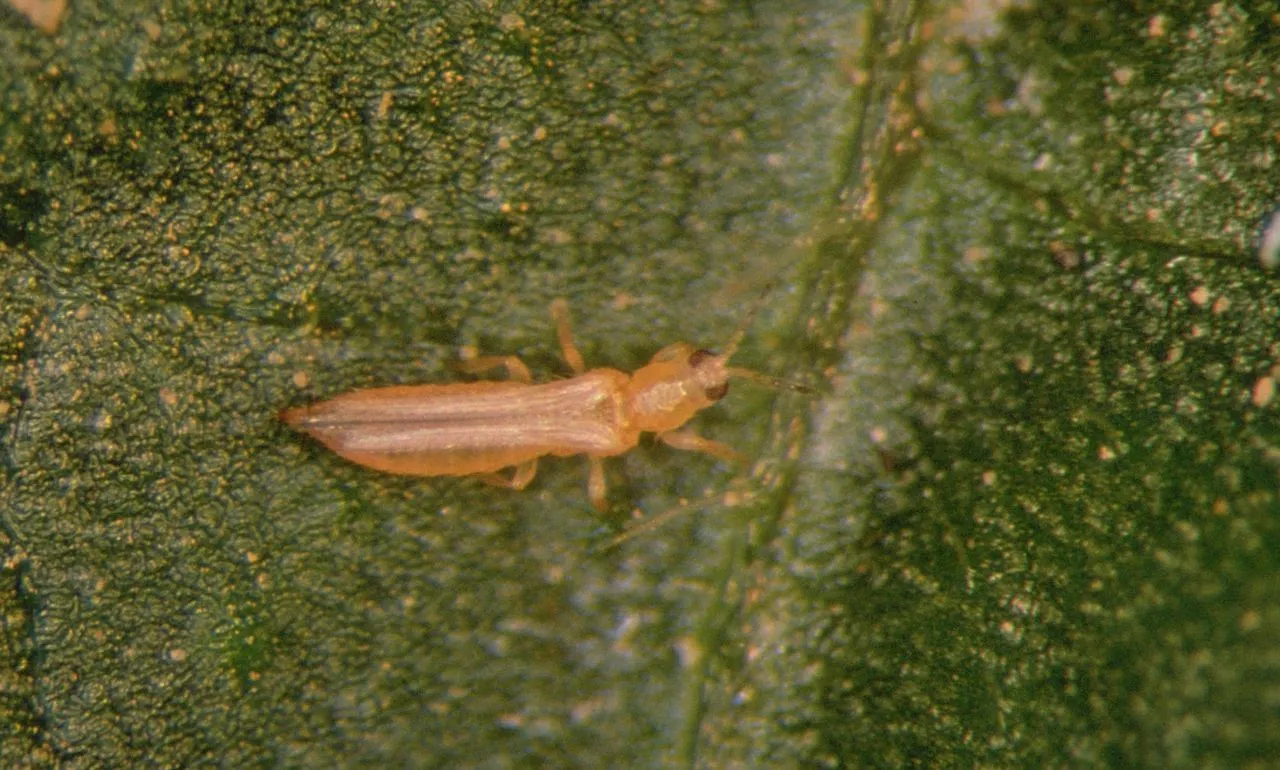
Adults are 1 to 2 mm long, slender, and four-winged. The wings are narrow, fringed with long hairs, and folded flat over the abdomen at rest, so under a hand lens the insect looks like a dark, hair-thin sliver rather than a typical-shaped bug. Body colour ranges from pale yellow through amber-brown to nearly black depending on species, age, and feeding history. Thrips feed by puncturing surface cells with an asymmetric stylet (one mandible plus paired maxillae) and sucking out the contents, which is what produces the characteristic dry, silvered injury pattern.
How to identify it
Two life stages dominate what you see on a succulent. Adults are the dispersers and the form that arrives on a new plant. Larvae are the feeders that build up local damage.
Adults of F. occidentalis are 1.4 to 1.7 mm, slim, and yellow-brown to dark brown, with the fringed wings only obvious under 10x magnification or when one takes off. H. haemorrhoidalis adults are dark with a paler abdominal tip and tend to sit motionless on the upper leaf surface. Echinothrips adults are dark and often clustered in small groups on the underside of leaves. Larvae across all three species are wingless, yellow-translucent to orange, and slightly smaller than adults. They prefer hidden microhabitats: tightly stacked leaf axils on Echeveria and Haworthia rosettes, the throat of an unopened flower bud on Aloe, the gap where a young leaf rolls out of the apical meristem on Crassula. If you can see thrips moving openly on a leaf, you are mostly seeing adults; the larval feeding population is usually three to five times larger and out of sight.
The feeding damage is the most reliable diagnostic feature and has two parts. First is silver stippling: irregular, pale, dry scars where surface cells have been emptied of chlorophyll and the cell walls have collapsed flat. Second is small, glossy black dots scattered near the silvered patches, which are faecal pellets. Stippling without dots could be many things; stippling plus tiny black dots is thrips.
This is where the diagnosis splits cleanly from spider mite injury and from aphid injury. Spider mite stippling is smaller, more uniform, and never accompanied by black dots, since mites do not produce visible faecal pellets on the leaf surface. Aphid damage on succulent flower stalks is honeydew and sooty mould without any stippling at all. The shorthand is: silver patches plus black dots means thrips; silver patches alone means mites; sticky stalks without silvering means aphids.
Distinguish thrips silvering from sun-stress pigmentation, too. Sun pigmentation is uniform across the most-exposed surface, often blushing pink, red, or amber, and it follows the geometry of the light, not the leaf. Thrips silvering is random across the leaf, follows leaf veins and curvature where larvae have crept, and is dry and dead-looking rather than pigmented. Hold the leaf at an angle to a window: thrips scars catch the light as a flat reflective patch where pigmentation does not.
Two field tests confirm the diagnosis quickly. The first is the white-paper tap: hold a clean sheet of white paper under a suspect leaf or rosette and tap firmly two or three times. After a few seconds, slender brown or black specks 1 to 2 mm long begin to crawl across the paper. Dust will not move; thrips will. The second is a blue sticky card. Thrips, particularly F. occidentalis, are strongly attracted to blue rather than yellow, so yellow cards catch fungus gnats and whitefly while blue cards selectively catch thrips. A new blue card hung 5 to 10 cm above an infested shelf shows captures within 24 to 48 hours.
Why it appears
Thrips populations explode under specific environmental conditions: warm, dry, still air. The narrow optimum is roughly 22 to 28 °C with relative humidity below 40%, which describes the typical winter living room with central heating running hard and plants sitting in dry pockets near south-facing windows. Generation time at the warm end of that range is about 12 to 15 days, so a low-level infestation in mid-November can become a serious one by mid-December even with no external introductions.
Two mechanisms explain the humidity dependence. First, thrips eggs and larvae desiccate readily at high humidity, so dry rooms give them better survival. Second, the entomopathogenic fungi that suppress thrips in nature, including Beauveria bassiana and Lecanicillium lecanii, need surface humidity above about 70% on the leaf to germinate and infect, so dry indoor air actively removes their main natural enemy.
The other indoor risk factor is the source plant. Most thrips arrive on cut flowers, on a recently bought ornamental, or on a plant moved indoors at the end of summer. F. occidentalis is heavily associated with commercial flower production, so a bunch of supermarket lilies on the table next to your Haworthia shelf is a real introduction route. A single mated female arriving on a leaf can establish a colony in two weeks if she finds suitable feeding tissue.
How to fix it
Treatment proceeds in escalating stages. For most indoor infestations, monitoring plus a spinosad rotation is sufficient. Use the heavier options only when the first round fails or the colony is already widespread.
Blue sticky cards for monitoring. Hang one 5 by 10 cm blue card per shelf or per metre of bench, with the lower edge 5 cm above the canopy. Replace cards every 14 days and check them weekly with a hand lens. Captured thrips are countable, so you can track whether a treatment is working rather than guessing. Yellow cards do not substitute: F. occidentalis responds about an order of magnitude better to blue than to yellow, and yellow cards instead select for fungus gnats and whitefly.
Spinosad spray at 0.02 to 0.04% v/v. Spinosad, a fermentation product of Saccharopolyspora spinosa, is the most reliable contact-and-ingestion insecticide for thrips on indoor ornamentals. Mix to 0.02 to 0.04% (around 2 to 4 ml of a 1% concentrate per litre, or follow the label for whatever strength you have) and spray both upper and lower leaf surfaces to wet, paying special attention to leaf axils, unopened flower buds, and the apical meristem where larvae shelter. Repeat at 7-day intervals for three weeks; the schedule covers the egg-to-adult cycle so newly hatched larvae meet a fresh dose before they reach reproductive age. Apply in low light to avoid leaf burn on farina-coated rosettes, and rotate the mode of action after three consecutive applications, since spinosad resistance has been documented in F. occidentalis populations under repeated exposure.
Beauveria bassiana fungal biocontrol. B. bassiana is an entomopathogenic fungus available as a wettable powder or oil suspension. Spores germinate on the cuticle of a thrips and the mycelium kills the insect within four to seven days. The biocontrol works only if leaf-surface humidity stays above about 70% during the first 24 hours after application, so it suits enclosed propagators or a covered shelf with a small humidifier rather than a bone-dry windowsill. Apply weekly during an active outbreak and pair it with a humidity bump for the same period.
Systemic acetamiprid drench at 0.02 to 0.05%. When the infestation has reached buds and tight leaf axils that a foliar spray cannot reach, a soil drench with acetamiprid (a neonicotinoid) at 0.02 to 0.05% is taken up through the roots and reaches feeding insects in the sap. Acetamiprid is the more bee-conservative neonicotinoid and the appropriate choice for any plant that may flower in the following weeks, but still avoid systemic neonicotinoids on Aloe or Agave species during bloom, because their nectar feeds wild bees, sunbirds, and bats. Pyrethroid sprays (deltamethrin, cypermethrin) are not a useful alternative: most populations of F. occidentalis in cultivated environments are resistant, and a pyrethroid spray often kills the predators of thrips while leaving the thrips themselves alive.
Bag-and-strip for severe small-collection cases. For one or two heavily infested specimens where chemical sprays are not practical, a sealed clear bag containing the plant plus a fragment of dichlorvos resin strip for 24 hours kills adults and larvae through fumigation. Remove the plant, rinse it gently, and ventilate for 48 hours before returning it to the shelf. This is a last-resort option for a treasured plant, not a routine treatment.
How to prevent it
Raise humidity, drop temperature. The single most effective preventive change is to push relative humidity above 50% and bring temperature down by 4 to 5 °C. A room held at 18 to 22 °C and 50 to 60% RH cuts thrips reproductive rate sharply and gives entomopathogenic fungi enough surface moisture to do their work. A small ultrasonic humidifier near the affected shelf, run for two to three hours daily, achieves the humidity shift without leaving foliage wet overnight.
Quarantine new arrivals for 30 days. Any incoming succulent, orchid, or ornamental should sit at least 2 metres away from the main collection for 30 days, with a blue sticky card hung above it from the day of arrival. The full inspection protocol is in quarantine new arrivals. Inspect with a hand lens twice a week and tap-test once a week onto white paper. Cut flowers brought into the house, the most common indoor introduction route for F. occidentalis, should not share airspace with a sensitive collection at all during the dry winter months.
Inspect flower buds and growth points weekly. F. occidentalis and Echinothrips hide preferentially in unopened flower buds and apical meristems. Once a week during the growing season, gently part the youngest leaves of each rosette and check the cleft between them, then look down into any developing inflorescence. A blue sticky card on the shelf provides a second line of defence between weekly inspections.
Keep blue sticky cards permanent. A blue card on a shelf prone to thrips is a continuous trap-and-monitor tool. Replace every 14 days and check at every watering.
Treat the underlying conditions, not only the population. Like spider mites, thrips thrive in hot, dry, still indoor air. The light, water, and substrate baseline in the Beginner's Guide to Succulents covers the cultivation corrections that keep foliage firm and the room conditions that suppress most warm-dry pests, including thrips.
See also
- A Beginner's Guide to Succulents, the cultivation baseline that makes a collection less hospitable to thrips, mites, and other warm-dry-air pests.
- Spider Mite Identification, how to tell thrips silver stippling with black dots from spider-mite stippling without dots, and run a parallel monitoring program for both.
- IPM for Succulents, integrated pest management for an established collection, covering inspection schedules, biological control, sticky-card colour selection, and resistance-aware pesticide rotation.
- Quarantine new arrivals: the isolation protocol that prevents the most common thrips introduction route from reaching the collection
FAQ
How do I distinguish thrips from spider mites?Thrips leave both silver stippling AND black fecal dots. Spider mites cause stippling without the dots, plus fine webbing.
What's the tap test for thrips?Firmly tap or shake leaves over white paper. Thrips are 1-2mm and may fly briefly.
What's the best treatment for thrips?Spinosad spray or systemic acetamiprid. Use blue sticky cards for monitoring. Repeat treatments essential.
Frequently Asked Questions
How do I distinguish thrips from spider mites?
Thrips leave both silver stippling AND black fecal dots. Spider mites cause stippling without the dots, plus fine webbing.
What's the tap test for thrips?
Firmly tap or shake leaves over white paper. Thrips are 1-2mm and may fly briefly.
What's the best treatment for thrips?
Spinosad spray or systemic acetamiprid. Use blue sticky cards for monitoring. Repeat treatments essential.
What is the first step for thrips on succulents: id, damage pattern & control?
Use blue sticky cards for monitoring. Treat with spinosad or systemic acetamiprid.