| Question | Short Answer |
|---|---|
| What light does this Crassula need? | Bright light is the default. |
| How should it be watered? | Water thoroughly, then allow the upper 3–4 cm of substrate to dry before watering again. |
| What substrate works best? | Use a free-draining mix with substantial pumice, grit, or perlite. |
| How is it propagated? | Stem cuttings are the most reliable method for most Crassula. |
Crassula conjuncta N.E.Br. is an older botanical name now treated in most modern references as a synonym of Crassula perfoliata var. minor (Haw.) G.D.Rowley. Plants sold under the conjuncta label are the small-leaved stacked form of the wider C. perfoliata species complex, which also includes the horticulturally popular propeller plant C. falcata as another variety.
Part of the Complete Crassula Guide.
Identification
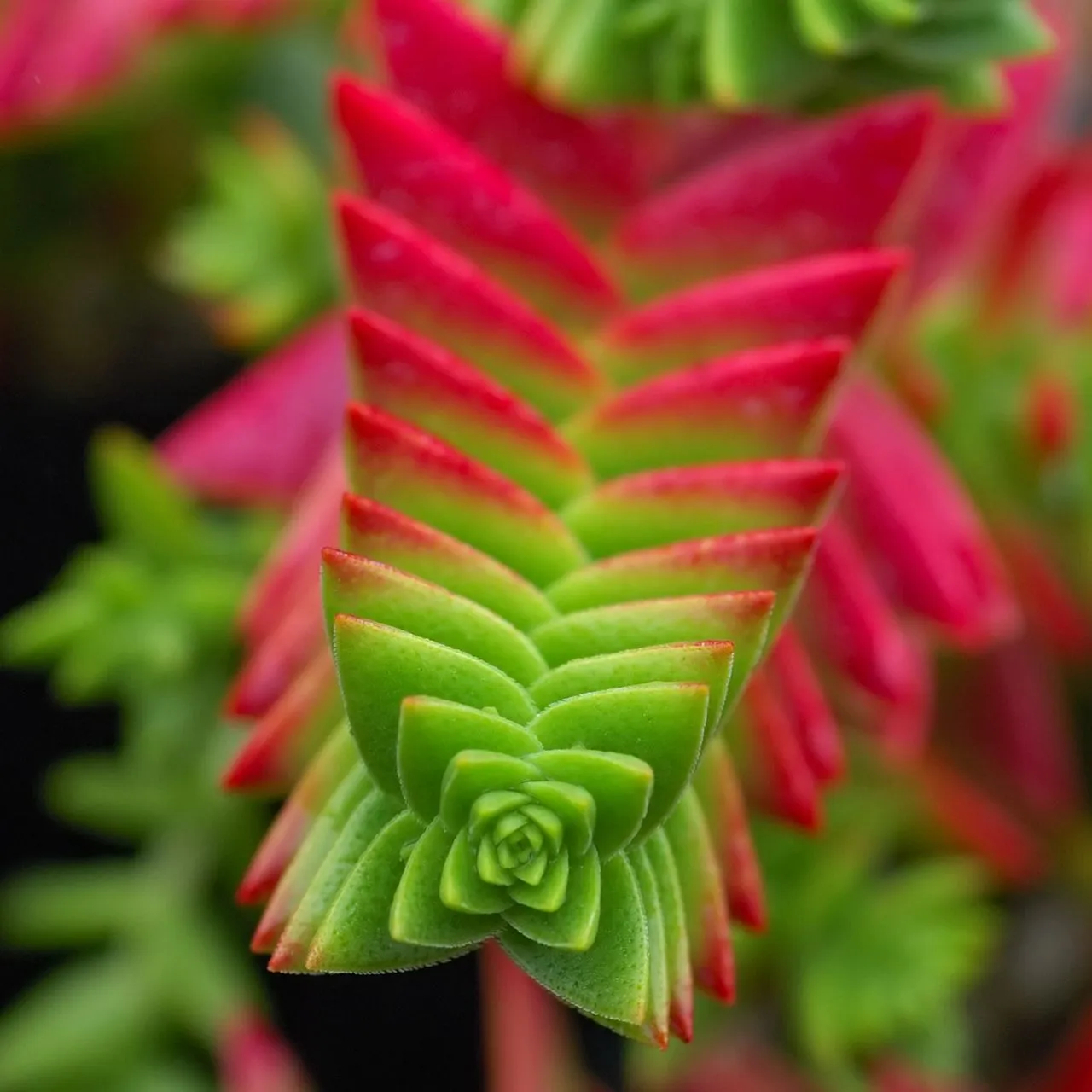
- Leaves. Triangular to lanceolate, 2–4 cm long, thick and fleshy, arranged in opposite decussate pairs fused at the base. Leaf pairs stack along a short stem to form a loose column. Colour pale grey-green with a fine waxy bloom; margins flush pink in strong light.
- Stems. Short and upright, 10–20 cm tall, branching at the base to form clusters.
- Flowers. Small star-shaped white to cream flowers in compact rounded clusters at stem tips, produced in summer.
- Habit. Upright columnar rosette, slowly clustering through basal offsets.
The plant resembles a scaled-down C. falcata without the dramatic falcate leaves, and a more compact C. perforata with thicker leaves and stems. Because all three sit within the C. perfoliata complex the family resemblance is strong.
Cultivation
Care follows the pillar defaults. The species is more tolerant of varied conditions than the smaller miniatures but benefits from the standard Crassula regime: bright light, gritty substrate, water when the top 3–4 cm dries, minimum 5 °C.
Where it diverges: like C. falcata, it is somewhat prone to basal rot in retentive substrate. Use at least 60% pumice or coarse grit and keep water off the short stem at the soil line.
Propagation
Offset division and stem cuttings. Mature plants produce basal offsets that can be detached with a clean blade, callused for 5–7 days, and potted on. Stem cuttings of the upper rosette also root well, and the remaining base usually produces multiple new offsets.
Leaf propagation is slower than offset division and offers no practical advantage.
Notes and Quirks
The C. perfoliata species complex is a taxonomically messy group with a long history of splitting and lumping. Names you may see in circulation that refer to the same or closely related plants include C. conjuncta, C. falcata, C. perfoliata var. minor, C. perfoliata var. falcata, and occasionally C. heterotricha. If what you have is a stacked-leaf grey succulent with small fused leaf pairs and pink flower clusters, the precise name on the label matters less than the care regime, which is identical across the group.
For the broader context of the complex, see the propeller plant page: Crassula falcata.
See also
Frequently Asked Questions
What light does this Crassula need?
Bright light is the default. Compact species and red-flushing cultivars need several hours of direct sun after gradual acclimation.
How should it be watered?
Water thoroughly, then allow the upper 3–4 cm of substrate to dry before watering again. In cool winter conditions, reduce watering sharply.
What substrate works best?
Use a free-draining mix with substantial pumice, grit, or perlite. Dense peat-heavy compost keeps the root zone wet too long.
How is it propagated?
Stem cuttings are the most reliable method for most Crassula. Leaf cuttings work on jade-type plants but are less useful for tight stacked miniatures.