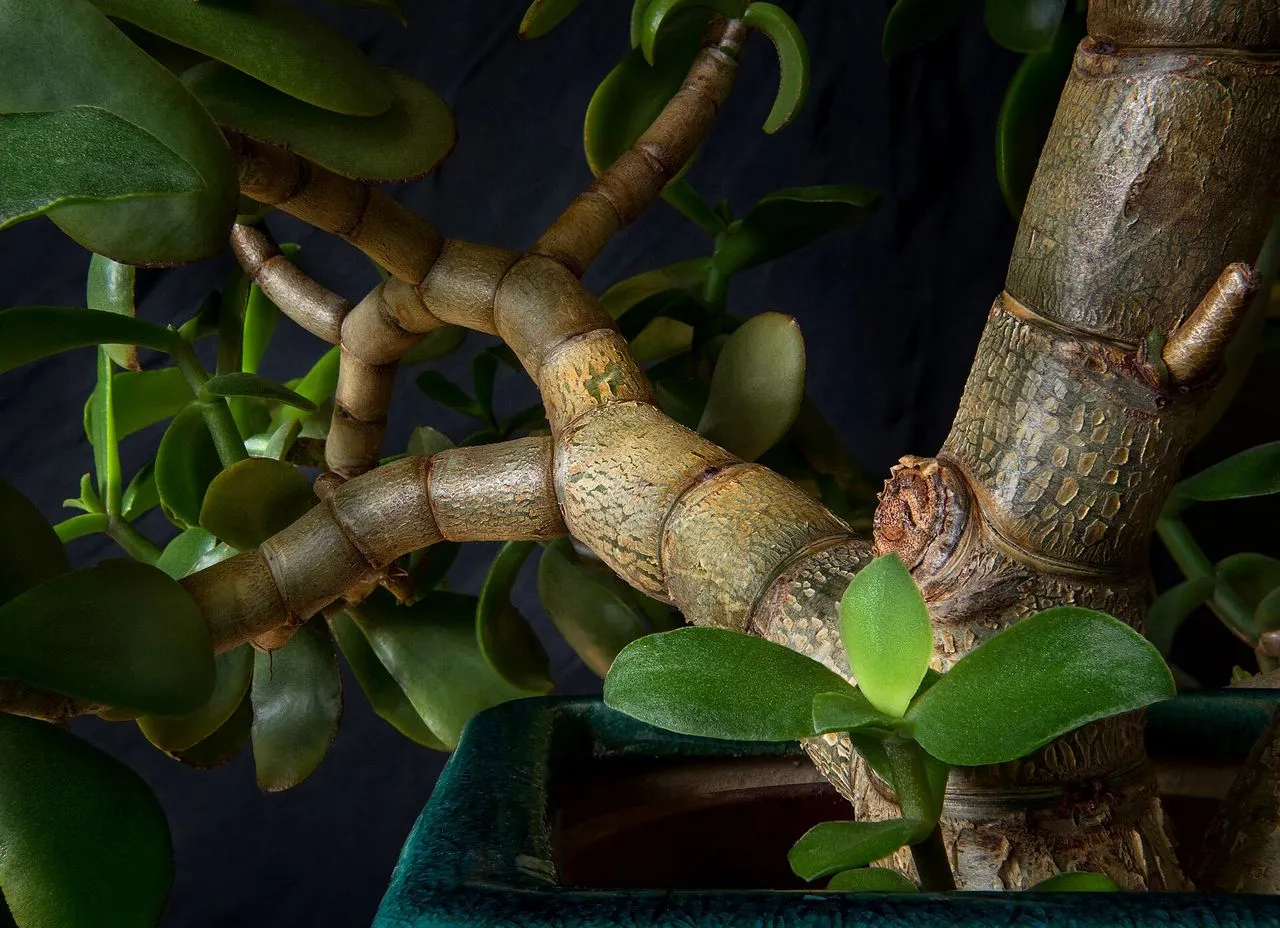
Leaf drop in a jade plant is a symptom, not a diagnosis. Crassula ovata can shed old leaves naturally, drop green leaves after cold shock, discard wrinkled leaves during drought, or lose soft yellow leaves when the root system is failing. The correct response depends on the texture, colour, speed, and position of the leaves that fall.
Most jade plants are killed by treating every fallen leaf as a request for more water. A jade with dry lower leaves may need nothing; a jade with wet compost and yellow translucent leaves needs the opposite. Part of the Complete Crassula Guide.
Normal lower-leaf ageing
Mature jade plants build woody stems by sacrificing some older leaves. Leaves at the lowest nodes lose gloss, thin slowly, turn dull green to tan, and detach cleanly as the branch hardens. This is normal senescence. It usually affects the oldest leaves closest to the trunk, not the fresh leaves at branch tips, and it happens gradually rather than as a single dump of foliage.
No treatment is needed when the trunk is firm, new leaves are compact, and the fallen leaves are dry or leathery. Remove loose leaves from the soil surface so they do not trap moisture against the stem. A few lower leaves falling each month from a large old plant is acceptable, especially after spring pruning or during seasonal shifts in light.
Sudden cold or draught shock
Jade plants tolerate cool conditions only when dry and stable. A windowsill that drops below 5 °C, a door draught, or transport through cold air can trigger sudden leaf drop within 24–72 hours. The leaves often fall while still green and plump because the abscission layer at the leaf base fails before the leaf has time to dry.
Cold shock is common in winter on single-glazed windows, conservatories, and shop-bought plants carried home unwrapped. Tissue that was wet at the time of chilling is at higher risk because cold wet cells rupture more easily and then invite rot. If branches remain firm and the stem base is not black, the plant can recover. If the trunk becomes soft after the cold event, treat it as stem rot rather than simple shock.
Over-watering and root rot
Over-watering does not mean one generous soak. It means the root zone stays wet long enough that fine roots die from low oxygen and fungal or oomycete rot follows. A jade with failing roots cannot regulate water movement, so leaves become yellow-green, translucent, heavy, and soft before dropping. The pot may smell sour, and the stem near the soil line may darken.
This pattern needs immediate inspection. Slide the plant from the pot and look at the roots. Healthy jade roots are pale tan to white and firm. Rotten roots are brown to black, wet, hollow, or foul-smelling. If only fine roots are damaged, the plant can often be saved by trimming rotten tissue and repotting into a dry mineral mix. If black softness has climbed into the trunk, the healthy top must be cut and re-rooted.
Under-watering and exhausted leaves
Drought produces a different type of leaf drop. Leaves wrinkle lengthwise, lose shine, feel flexible rather than mushy, and detach after the plant has drawn down stored water. The whole canopy may look limp, but the stem and roots remain firm. This is common in jade plants kept in tiny nursery pots, root-bound bonsai pots, or very porous mixes under summer sun.
The fix is a full soak, not repeated splashes. Water until excess runs through the drainage holes, wait 10 minutes, water once more, and let the pot drain completely. A drought-stressed jade should firm noticeably within 24–72 hours if its roots are alive. Leaves that were already too depleted will still fall, but new growth should resume once light and watering are steady.
Low light and leggy weak growth
Chronic under-lighting causes a slower version of leaf drop. Branches stretch, internodes lengthen beyond 2–3 cm, leaves become thinner, and shaded lower leaves are discarded because they no longer pay their photosynthetic cost. The plant may still look green and alive, but it becomes top-heavy and sparse.
The cause is light, not fertiliser. Move the plant to a brighter south or west window, or use a full-spectrum LED for 12–14 hours a day. Do not move a shade-grown jade directly into hard midday outdoor sun; acclimate over 10–14 days to avoid scorch. Once new growth is compact, prune leggy stems back to two or three leaf pairs in spring. A healthy jade back-buds readily from the nodes below each cut.
Mealybugs and root mealybugs
Mealybugs can cause premature leaf drop by feeding in leaf axils and on soft new stems. Above ground they look like white cottony flecks at nodes, under leaves, and in branch forks. Affected leaves yellow unevenly and fall earlier than normal. Root mealybugs produce the same weak growth and leaf drop but hide in the root ball as white waxy residue.
Isolate the plant before treatment. Dab visible insects with 70% isopropyl alcohol on a cotton swab, then repeat every 7 days for 4 weeks. For root mealybugs, unpot the plant, discard the old mix, rinse roots, and repot into fresh dry substrate. Severe infestations often need an integrated pest plan rather than one spray.
How to identify the cause
| Fallen leaf and plant condition | Most likely cause | What to check next |
|---|---|---|
| Dry tan leaves from the lowest nodes only | Normal ageing | New tip growth and firm trunk |
| Green plump leaves falling suddenly | Cold, draught, or relocation shock | Night temperature and window exposure |
| Yellow translucent soft leaves | Over-watering or root rot | Root colour, smell, and stem base |
| Wrinkled flexible leaves | Drought | Substrate dryness through the full pot |
| Sparse leaves on stretched stems | Low light | Internode length and window direction |
| Uneven yellowing with white flecks | Mealybug | Leaf axils, branch forks, and roots |
Texture matters more than colour. A dry yellow leaf and a wet yellow leaf point in opposite directions. Always feel the leaf, then check the root zone before changing the watering schedule.
Risk and severity
Act immediately if leaves are mushy, the stem base is black, the pot smells sour, or the plant is dropping green leaves after a freeze. These are time-sensitive because rot can move from roots into the trunk within days when tissue is cold and wet.
Wait and observe when only lower leaves are dry, the canopy is firm, and the plant recently moved to a different light level. Keep conditions stable for 2–3 weeks before pruning or repotting. Professional help is rarely needed, but a valuable old bonsai jade with trunk rot may be worth taking to a specialist grower for clean cutting and re-rooting.
Solutions
For normal ageing
Remove fully detached dry leaves. Do not cut partly yellow leaves from the stem because the wet wound can become an entry point for rot. Keep the plant in bright light and maintain the normal wet-dry cycle.
For cold shock
Move the plant to 10–18 °C, bright indirect light, and still air. Keep the substrate barely moist to dry until no new leaves fall for 7 days. If black patches appear, cut back to firm green tissue with a sterile blade.
For over-watering
Unpot, remove wet substrate, cut off dead roots, and let the plant dry bare-root for 3–5 days in shade. Repot into a gritty mix in a pot with a drainage hole. Do not water for 7 days after repotting.
For drought
Soak thoroughly, drain completely, and reassess after 48 hours. If the root ball repels water, stand the pot in 2–3 cm of water for 20 minutes, then drain. Resume watering when the top 3–4 cm dries.
Prevention
Keep jade plants in the brightest practical position, ideally a south or west window indoors. Use a pot only 2–4 cm wider than the root ball, with a drainage hole and a mineral mix that dries within 5–10 days in active growth. Protect from temperatures below 5 °C and from cold glass in winter. Water by dryness, not by calendar: check the top 3–4 cm and the pot weight before each soak. Inspect leaf axils monthly for mealybugs.
See also
- Crassula ovata — species profile for the jade plant.
- Root rot diagnosis — cross-genus guide to root inspection and recovery.
- Watering frequency method — how to water succulents by dryness rather than schedule.
- Jade Plant Leggy — when leaf drop accompanies stretched weak growth from insufficient light.
Frequently Asked Questions
Is it normal for jade plants to drop leaves?
Yes. A mature jade plant sheds a few older lower leaves as branches extend. Normal leaves dry gradually and the rest of the canopy stays firm.
Why did green jade leaves fall overnight?
Sudden green leaf drop usually follows cold exposure, a draught, a sharp light change, or a watering shock. Stabilise temperature above 10 °C and inspect the roots if the pot is wet.
Should fallen jade leaves be propagated?
Only firm, intact leaves are worth trying. Mushy, yellow, black-spotted, or frost-damaged leaves usually rot before they root.
Can a jade plant recover after losing most leaves?
Yes, if the trunk is firm and roots are alive. A leafless but firm jade can back-bud from nodes within 3–8 weeks in bright light.