| Question | Short Answer |
|---|---|
| What light does this Crassula need? | Bright light is the default. |
| How should it be watered? | Water thoroughly, then allow the upper 3–4 cm of substrate to dry before watering again. |
| What substrate works best? | Use a free-draining mix with substantial pumice, grit, or perlite. |
| How is it propagated? | Stem cuttings are the most reliable method for most Crassula. |
Crassula falcata J.C.Wendl., more correctly placed today as Crassula perfoliata var. minor (Haw.) G.D.Rowley, is commonly called the propeller plant or airplane plant. It is a sculptural upright succulent native to the Eastern Cape of South Africa, where it grows on rocky hillsides in semi-arid scrub.
Part of the Complete Crassula Guide.
Identification
The propeller plant is one of the most structurally distinctive species in the genus.
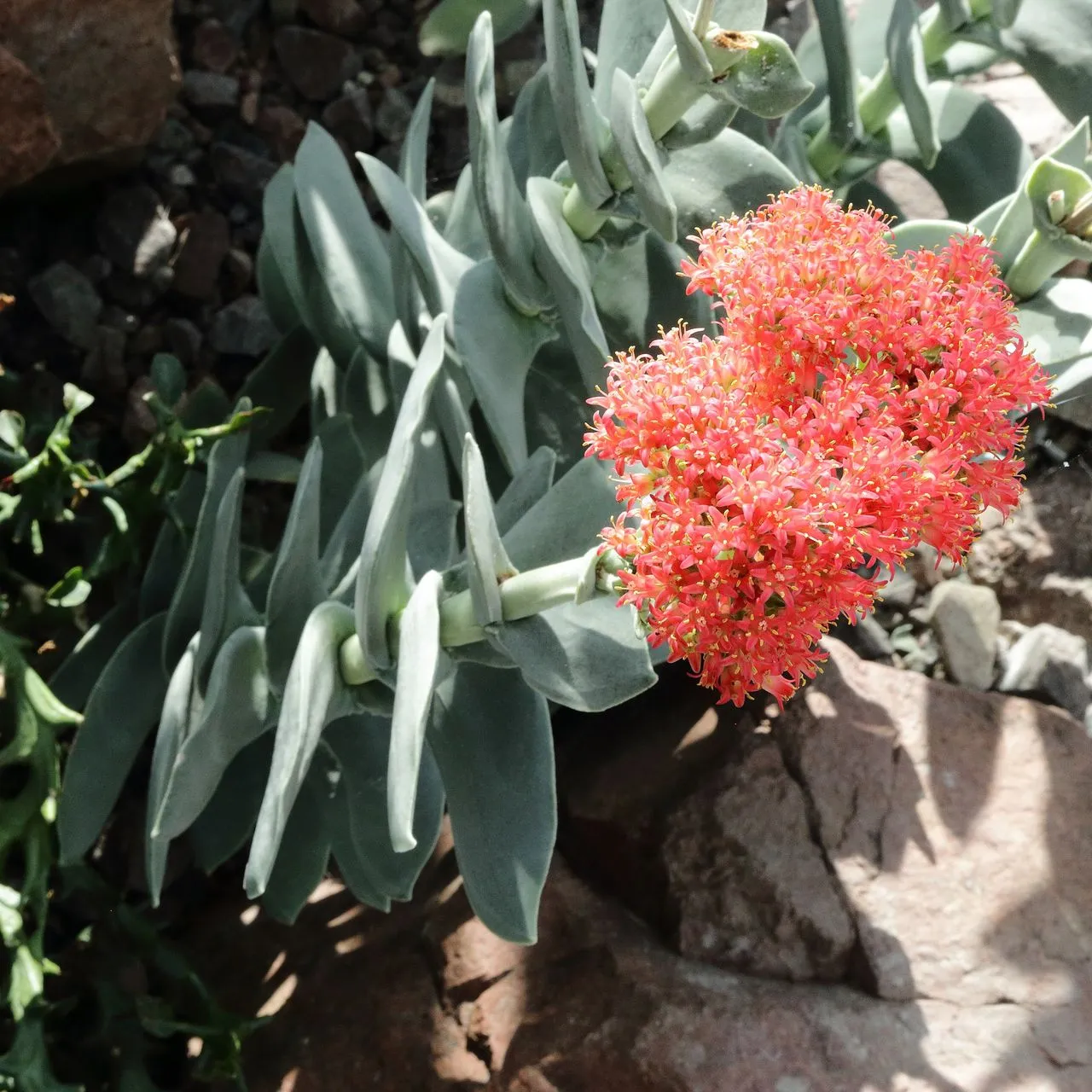
- Leaves. Sickle-shaped (falcate), 5–15 cm long, 1.5–3 cm wide, grey-green with a fine waxy bloom. Leaves arise in opposite decussate pairs but are each rotated roughly 90° from the pair below and held in a single vertical plane, giving the stacked propeller-blade appearance that gives the plant its common name.
- Stems. Short, thick, often unbranched until flowering; 20–40 cm tall at maturity. Offsets appear at the base after flowering.
- Inflorescence. A dense flat-topped to rounded head of bright scarlet-red flowers, carried on a short stout stem above the leaf column in midsummer. The inflorescence is large for the plant, often 8–12 cm across, and is the main ornamental feature.
- Flowers. Small star-shaped scarlet flowers packed tightly into a corymb. Strongly scented, attractive to pollinators.
The species is one of the few Crassulas where the inflorescence rather than the leaves is the principal visual attraction.
Cultivation
Care follows the pillar defaults with a few adjustments.
Light: bright direct sun, at least 5–6 hours a day, preferably more. Strong light produces compact leaf pairs and is a precondition for flowering. Low light produces widely-spaced leaves and no flowers.
Substrate: mineral-heavy mix, 60–70% pumice plus 30–40% loam compost. The short thick stem is prone to basal rot in retentive substrate.
Water: moderate in the growing season, sparing in winter. Do not let water sit in the V between leaf pairs; in hot humid weather this is an invitation to crown rot.
Temperature: minimum 5 °C, ideally above 8 °C when wet.
Propagation
Stem cuttings and offsets are the reliable methods. A rooted offset cut at the base with a sterile blade, callused for 5–7 days, roots within 2–3 weeks in gritty mix. Stem beheading of a tall specimen produces a usable cutting from the top; the remaining base usually produces multiple new offsets along its length, which is useful if you want to multiply stock.
Leaf propagation works but is slow. The leaves are large and take 4–6 weeks to callus and initiate new plantlets at the base.
Notes and Quirks
The stem is not truly monocarpic, but individual rosettes often decline after heavy flowering. Cut the spent flower stem and the exhausted rosette cleanly at the base; the remaining stem produces offsets from axillary buds.
Older literature and horticultural labels use Crassula falcata interchangeably with the strictly correct C. perfoliata var. minor. Both refer to the same plant. The cultivar C. 'Morgan's Beauty' has this species as one parent, which explains the silvery leaves and pink flower clusters it inherits.
See also
- Crassula 'Morgan's Beauty'
- Crassula capitella
- Crassula 'Moonglow'
- Crassula conjuncta — now synonymised with C. perfoliata var. minor, the same complex that includes C. falcata.
Frequently Asked Questions
What light does this Crassula need?
Bright light is the default. Compact species and red-flushing cultivars need several hours of direct sun after gradual acclimation.
How should it be watered?
Water thoroughly, then allow the upper 3–4 cm of substrate to dry before watering again. In cool winter conditions, reduce watering sharply.
What substrate works best?
Use a free-draining mix with substantial pumice, grit, or perlite. Dense peat-heavy compost keeps the root zone wet too long.
How is it propagated?
Stem cuttings are the most reliable method for most Crassula. Leaf cuttings work on jade-type plants but are less useful for tight stacked miniatures.