| Question | Short Answer |
|---|---|
| What light does this Crassula need? | Bright light is the default. |
| How should it be watered? | Water thoroughly, then allow the upper 3–4 cm of substrate to dry before watering again. |
| What substrate works best? | Use a free-draining mix with substantial pumice, grit, or perlite. |
| How is it propagated? | Stem cuttings are the most reliable method for most Crassula. |
Crassula 'Moonglow' is a named hybrid with parentage typically given as Crassula deceptor × Crassula perfoliata var. falcata (syn. C. falcata). It is a columnar upright plant grown for its tight stacks of densely packed triangular leaves, coated in a pale silver-white wax that gives the cultivar its name.
Part of the Complete Crassula Guide.
Identification
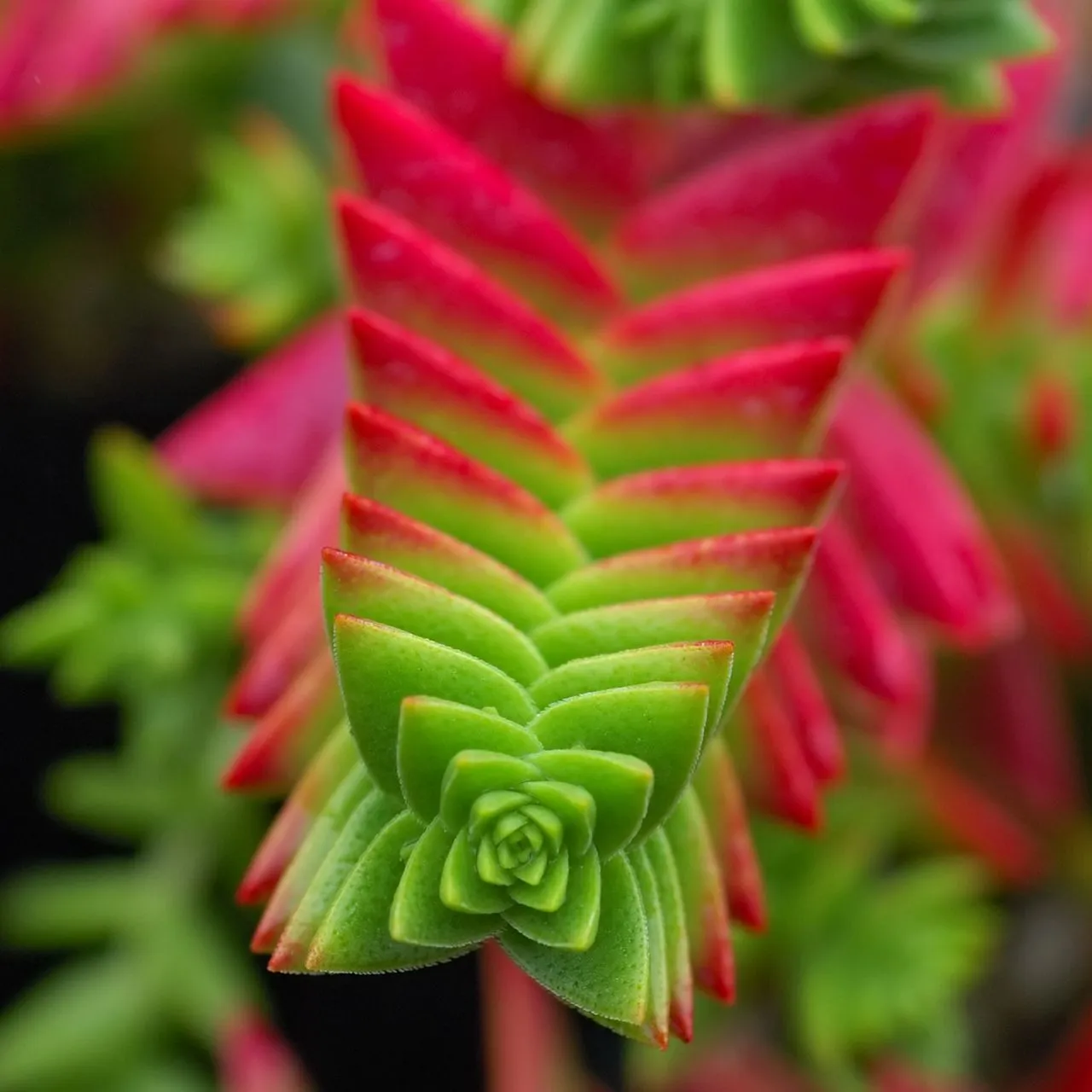
- Leaves. Triangular, 2–3 cm long, pressed tightly together in opposite decussate pairs that stack into a squared column. Surface covered in a uniform matte silver-white epicuticular wax; underlying leaf tissue is pale grey-green.
- Stems. Short and upright, 10–20 cm tall, unbranched until flowering. Offsets form at the base.
- Flowers. Small white to pale pink five-petalled stars in dense rounded clusters at the stem tip, produced in late spring or summer on mature stems. The inflorescence is proportionally modest for the size of the plant.
- Habit. A single tight column 10–20 cm tall, slowly forming a cluster through basal offsetting.
The cultivar is structurally similar to C. 'Buddha's Temple' (see the crassula-pagoda page) but distinguishable by the fine silver wax, the looser leaf pairs, and the less pronounced quadrangular profile. Confusion with C. deceptor itself is common in the trade; 'Moonglow' is bigger, with larger leaves and a more vigorous habit.
Cultivation
Care follows the pillar defaults with two adjustments for the cultivar.
Light: strong bright light with several hours of direct sun. The silver wax develops fully only under high light; in shade the plant stays a greener grey with a more open habit.
Substrate: heavily mineral, 60–70% pumice or coarse grit. Both parent species are rot-prone in retentive substrate, and 'Moonglow' is more so than its parents.
Water: moderate in the growing season, sparing in winter. Avoid any water pooling in the leaf axils or at the rosette tip; the densely packed leaves trap moisture and invite crown rot.
Minimum temperature 5 °C.
Propagation
Offset division is the standard method. Cut a rooted offset cleanly from the base, callus for 5–7 days, and pot up in gritty mix. Roots form within 2–3 weeks.
Stem cuttings work if you behead an elongated plant. Leaf propagation is not reliable for the cultivar; individual leaves carry little callus tissue and rarely initiate new plantlets.
Notes and Quirks
The silver wax is fragile. A cuttings tray that has been handled repeatedly will show fingerprint streaks on every leaf, and the wax does not regenerate on damaged leaves. Move plants by the pot, and if you must handle the stem use a single basal leaf as a grip.
'Moonglow' produces offsets readily, so a single plant becomes a small cluster within 2–3 years even without active propagation. Once a cluster is established, lift and divide in spring to prevent the centre rotting out.
See also
- Crassula falcata
- Crassula pagoda
- Crassula 'Morgan's Beauty'
- Crassula conjuncta — another silvery-wax-coated member of the C. perfoliata complex.
Frequently Asked Questions
What light does this Crassula need?
Bright light is the default. Compact species and red-flushing cultivars need several hours of direct sun after gradual acclimation.
How should it be watered?
Water thoroughly, then allow the upper 3–4 cm of substrate to dry before watering again. In cool winter conditions, reduce watering sharply.
What substrate works best?
Use a free-draining mix with substantial pumice, grit, or perlite. Dense peat-heavy compost keeps the root zone wet too long.
How is it propagated?
Stem cuttings are the most reliable method for most Crassula. Leaf cuttings work on jade-type plants but are less useful for tight stacked miniatures.