| Question | Short Answer |
|---|---|
| What light does this Crassula need? | Bright light is the default. |
| How should it be watered? | Water thoroughly, then allow the upper 3–4 cm of substrate to dry before watering again. |
| What substrate works best? | Use a free-draining mix with substantial pumice, grit, or perlite. |
| How is it propagated? | Stem cuttings are the most reliable method for most Crassula. |
Crassula 'Buddha's Temple', also sold as pagoda crassula or Buddha's tower, is a deliberately produced hybrid with parentage Crassula perfoliata var. falcata × Crassula pyramidalis. The cultivar was raised by Myron Kimnach at the Huntington Botanical Gardens in California in the 1950s and is now one of the most recognisable architectural succulents in the trade.
Part of the Complete Crassula Guide.
Identification
The plant is unmistakable once you have seen it.
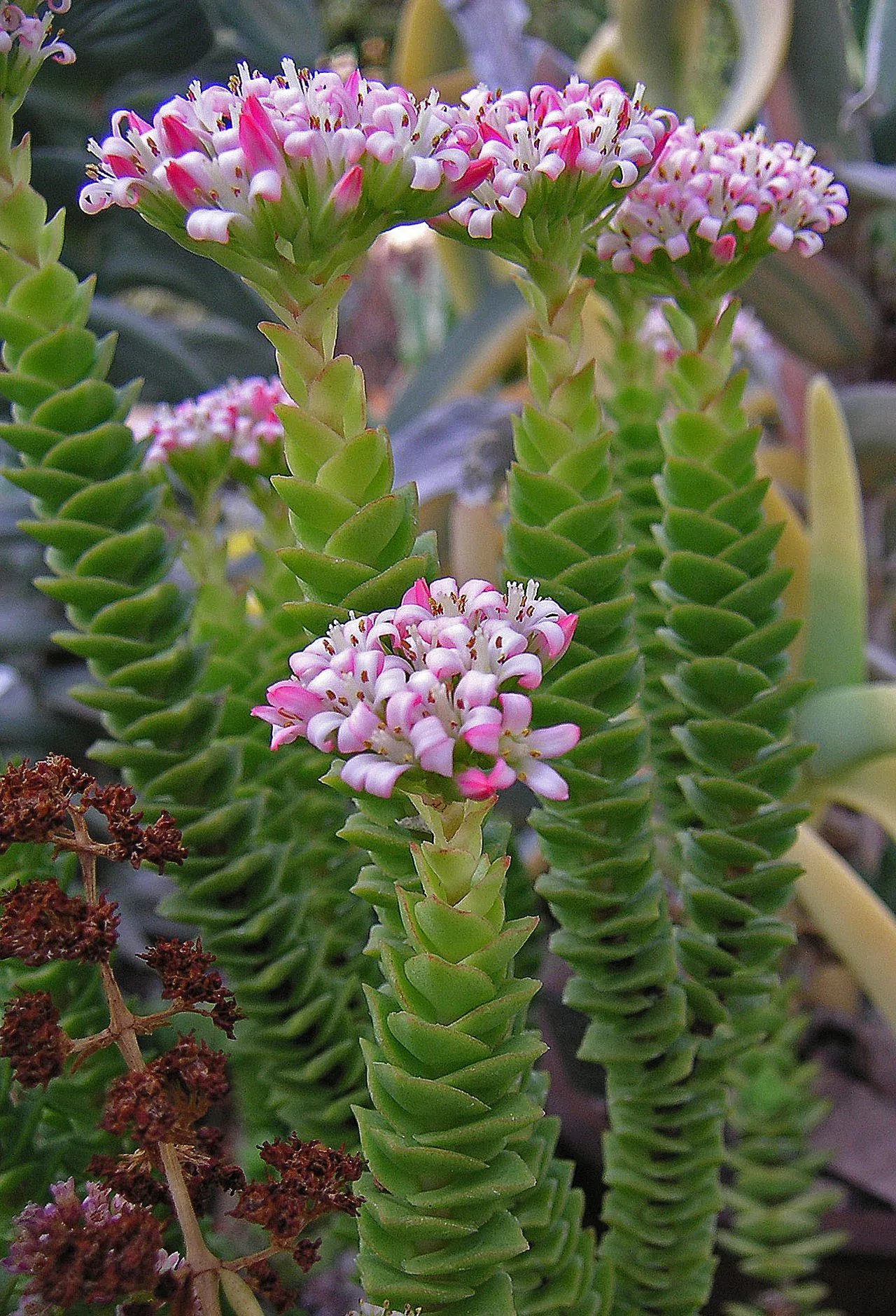
- Leaves. Triangular, 1–2 cm long, pressed tightly together in opposite decussate pairs fused at the base around the stem. Each pair is rotated 90° from the pair below, producing a squared-off cross-section. Colour grey-green with a fine bluish wax; leaf tips and margins flush red to purple in strong light.
- Habit. Short upright columns, 10–20 cm tall and 2–3 cm square, looking almost exactly like miniature stacked pagodas. Offsets produced at the base form small colonies over time.
- Flowers. Small white to pinkish star-shaped flowers in a flattened cluster at the stem tip. Flowering tends to exhaust the individual column, which then often declines.
- Growth rate. Slow. A column reaches mature height in 3–4 years from a cutting.
The two parents can both be seen in the cultivar: the stacked packed leaves of C. pyramidalis and the somewhat larger, more succulent leaves of C. perfoliata var. falcata.
Cultivation
Care diverges from the pillar defaults on three points: light, substrate, and water.
Light: very bright, with several hours of direct sun daily. Under-lit 'Buddha's Temple' loses its characteristic tight squared profile and the leaves separate and elongate. Supplementary LED lighting is the usual indoor winter solution.
Substrate: firmly mineral. At least 70% pumice or coarse grit with minimal organic content. The plant is among the more rot-prone of the common hobby Crassulas and fails quickly in retentive mixes.
Water: sparingly, and never into the column tip. Water pooled in the tightly stacked leaves is a direct cause of crown rot, which is usually fatal. Water the substrate only, let it dry completely between soakings, and reduce to near-nothing in winter.
Minimum temperature 5 °C.
Propagation
Stem cuttings and offset division. A rooted offset cut at the base, callused for a week, and potted up in pure pumice roots within 3–4 weeks. Beheading an elongated column and rooting the top also works, and the base usually produces multiple new columns after beheading.
Leaf propagation is not a reliable method for this cultivar; leaves rarely generate new plantlets.
Notes and Quirks
Individual columns do not usually survive flowering in good form. Treat 'Buddha's Temple' as a plant maintained through its offsets rather than as a long-lived single specimen. A healthy parent produces enough basal offsets to maintain a colony indefinitely.
The cultivar is sometimes confused with Crassula pyramidalis itself, which is a more tightly stacked and smaller species also sold under the pagoda name, and with Crassula 'Moonglow', which is a looser silver-white column with C. deceptor parentage. If the column is truly squared off in cross-section, tightly packed, and has red-tipped grey-green leaves, it is 'Buddha's Temple'.
See also
- Crassula perforata
- Crassula rupestris
- Crassula 'Moonglow'
- Crassula pyramidalis — one of the two parent species, sometimes sold under the pagoda label.
Frequently Asked Questions
What light does this Crassula need?
Bright light is the default. Compact species and red-flushing cultivars need several hours of direct sun after gradual acclimation.
How should it be watered?
Water thoroughly, then allow the upper 3–4 cm of substrate to dry before watering again. In cool winter conditions, reduce watering sharply.
What substrate works best?
Use a free-draining mix with substantial pumice, grit, or perlite. Dense peat-heavy compost keeps the root zone wet too long.
How is it propagated?
Stem cuttings are the most reliable method for most Crassula. Leaf cuttings work on jade-type plants but are less useful for tight stacked miniatures.