| Question | Short Answer |
|---|---|
| What light does this Crassula need? | Bright light is the default. |
| How should it be watered? | Water thoroughly, then allow the upper 3–4 cm of substrate to dry before watering again. |
| What substrate works best? | Use a free-draining mix with substantial pumice, grit, or perlite. |
| How is it propagated? | Stem cuttings are the most reliable method for most Crassula. |
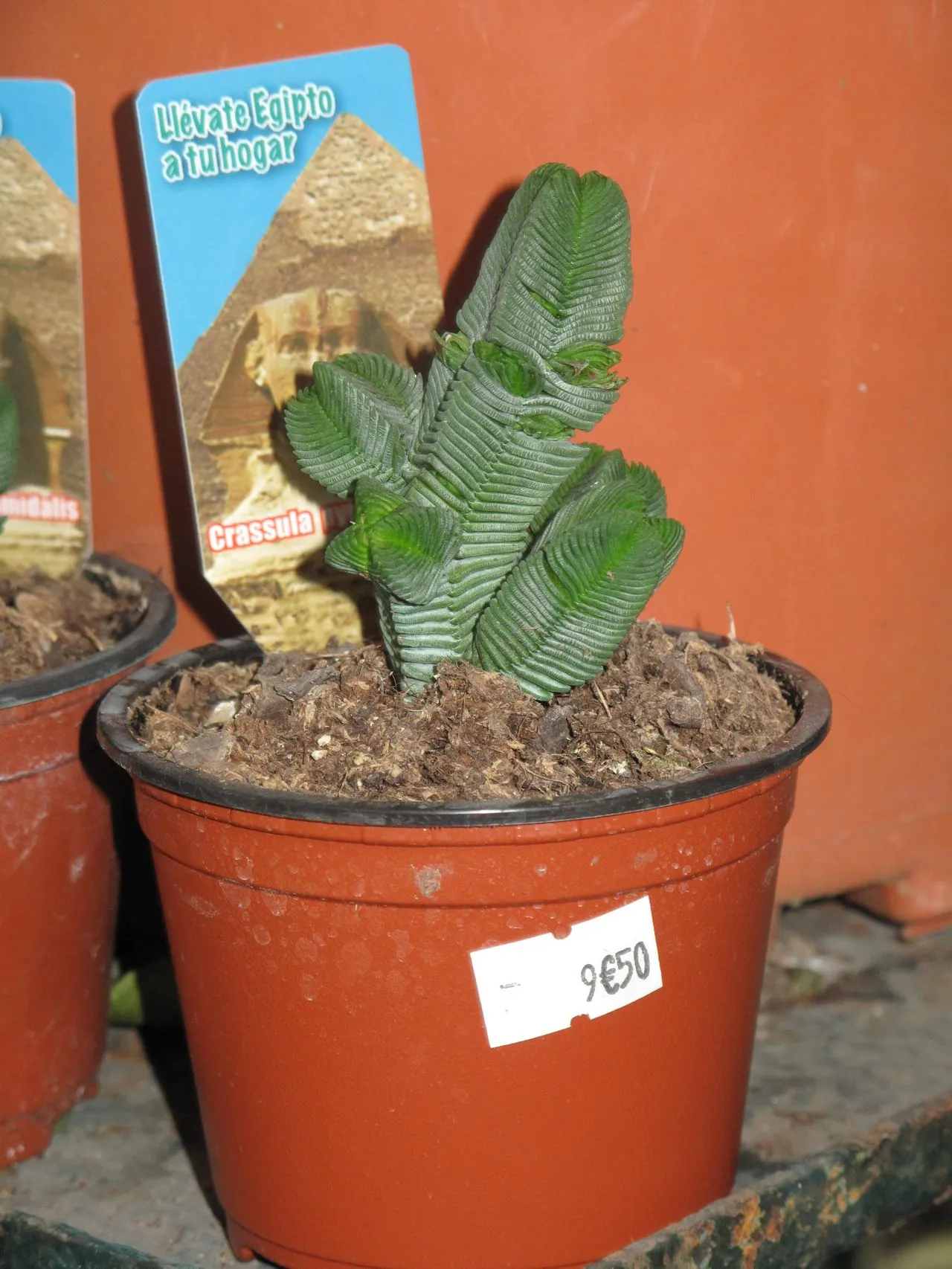
Crassula pyramidalis Thunb., described by Carl Peter Thunberg in 1778, is a slow-growing dwarf succulent from the dry interior of the Western and Northern Cape of South Africa. Plants form strictly symmetrical erect columns 5 to 15 cm tall, square in cross-section because the leaves are arranged in four straight ranks and pressed tightly against the stem. The species epithet refers directly to this geometry: pyramidalis, pyramid-shaped, although the column is actually a four-sided prism rather than a true pyramid. Each "leaf" is a thick, triangular, scale-like bract that overlaps the next like roof tiles, so the surface of the column is smooth, glaucous green, and finely ranked.
The native habitat is the rocky koppies and quartzite outcrops of the south-western interior, roughly 100 to 800 m above sea level, on the transition between the dry fynbos of the Cape Floral Region and the succulent Karoo to the north. Rainfall in this band falls almost entirely in winter, between May and August, and totals 150 to 350 mm a year. Summers are hot and bone-dry; January temperatures reach 35 °C and the substrate stays dry for four to five months at a stretch. C. pyramidalis responds to this regime by being a strict winter grower: it draws water and produces new column growth through the cool wet months, then retreats into a tight, almost sealed dormancy through summer.
In cultivation it stays small. A mature plant reaches 8 to 12 cm in three to four years and rarely exceeds 15 cm. Colour is a pale, slightly waxy green with a fine grey bloom; under sustained sun the upper bracts redden through bronze and copper tones, a reversible stress response that fades within ten days of softer light. White to cream flowers, very small (around 4 mm), appear in dense flat-topped terminal clusters in late winter. The flowering head usually marks the end of that column's growth: side shoots then form at the base and continue the colony.
Part of the Complete Crassula Guide.
Identification
The four-ranked, tightly imbricate leaf arrangement is diagnostic. Looked at from any of the four sides, the column shows a flat face with two parallel rows of triangular scale leaves; looked at from above, the apex is a small four-pointed star. Run a fingernail down the column and you can feel the four straight edges and four flat faces of a geometric prism. Stem internodes are essentially zero: each pair of leaves sits directly on the pair below, and no part of the stem is ever exposed.
Several other column-forming crassulas are confused with C. pyramidalis in the trade, and the four-ranked square geometry separates it from each of them.
Crassula muscosa (the watch chain) also carries leaves in four ranks, but the leaves are much smaller (1 to 3 mm), the column is round to softly square in cross-section, and the plant grows in lax branched chains the thickness of a pencil. C. pyramidalis is a stout, single column 1 to 2 cm wide with much larger triangular bracts and a strict square outline.
Crassula socialis is a smaller, shorter, looser plant with rosettes 1 to 2 cm across that grow in dense mats. It never forms an erect square column.
Crassula perforata (the string of buttons) is the most often confused at first glance because some growers know it as a stacked or "pyramidal" crassula. The geometry is completely different: in C. perforata the paired triangular leaves are flat and stand outward at right angles to the stem, with the stem visibly piercing through each leaf pair. C. pyramidalis has no exposed stem at all; the leaves wrap and overlap so tightly that the column's surface is unbroken.
The most stubborn naming muddle in the trade involves the cultivar C. 'Buddha's Temple', a hybrid of C. perforata x C. pyramidalis that inherits the square geometry of one parent and the broader, slightly outward-curving leaves of the other. Plants are widely sold under either parent's name. If your "C. pyramidalis" has leaves that flare outward at the tips, are noticeably wider than the column itself, or carry fine reddish margins along a thin leaf edge, you most likely have 'Buddha's Temple'. True C. pyramidalis leaves stay strictly inward-pressed and finish flush with the column's vertical line.
Cultivation
The winter-growing rhythm is the single most important cultivation point. Mistimed water (heavy summer water on a dormant plant, or sparse winter water on an actively growing one) is the failure mode that ends most collection specimens within their first year.
Light. Bright, direct light for at least four hours daily produces the tightest column geometry and the strongest copper colour. In low light the bracts loosen, the column edges blur, and the plant gradually loses its diagnostic square outline. A south-facing window in temperate latitudes, or morning sun and bright afternoon shade outdoors, suits it well. Avoid full midday sun above 32 °C, which scorches the apex.
Water. Water actively from autumn into early spring, when the plant is in growth. A typical 8 cm clay pot indoors takes a deep watering every 10 to 14 days through October to March, allowing the substrate to dry to within the bottom third between waterings. From late spring to early autumn, reduce to one light watering every four to six weeks, enough to keep the fine roots from desiccating. Never water when daytime highs sit above 30 °C: warm, damp substrate at the root zone is the most reliable way to rot this species.
Substrate. A high-mineral mix: roughly 70 to 80% pumice, lava grit, or coarse perlite with 20 to 30% sieved peat-free coir. The roots are fine and shallow and dislike any organic content that holds moisture against the base. A 2 cm gravel topdress keeps the column's lower bracts off damp substrate after watering, which matters more for C. pyramidalis than for shrubby crassulas because the entire plant is a contact surface.
Temperature. Comfortable from 5 °C to 30 °C in growth. Brief exposure to about −3 °C is tolerated when the substrate is bone-dry, but any moisture in the mix turns a frost into root collapse. The species is winter-growing but not winter-cold-loving: night temperatures around 8 to 12 °C, with daytime warmth, give the best growth response.
Pot. A small, shallow clay or unglazed terracotta pot, 8 to 10 cm wide and no more than 8 cm deep, suits a single specimen for several years. The species is shallow-rooted and slow, so resist the urge to overpot; an oversized pot stays damp at the centre and rots the root mass.
For substrate ratios and the underlying principles of mineral-heavy succulent mixes, see the Beginner's guide to succulents.
Propagation
Stem cuttings are the standard method and root reliably, although more slowly than for most other crassulas. Take a column section 3 to 5 cm long with a clean cut just below a node, allow it to callus on a dry tray for five to seven days, then set the cut end into barely-damp pure pumice. Roots appear in four to six weeks at 18 to 22 °C, slower than the two to three weeks typical for C. tetragona or C. ovata. Cuttings taken in early autumn, as the plant enters its growing season, root noticeably faster and with higher success than cuttings taken in summer dormancy.
Side offsets at the base of an established plant can be cut with a sliver of the parent's stem and treated as cuttings. They root on the same timing as stem sections.
Leaf propagation is impractical: the bracts are fused tightly to the stem and detach with damage, and meristematic activity at the leaf base is much lower than in fleshy-leaved crassulas like C. ovata.
Seed-grown plants are uncommon in trade. Flowers are small, self-incompatible in most clones, and seed set requires a second genetically distinct plant. If seed is available, surface-sow on a sterile pumice and coir mix at 20 to 24 °C; germination takes two to four weeks and seedlings reach about 1 cm in their first year.
Notes
The colony habit is worth planning for. A single specimen will, over five to eight years, produce a tight cluster of three to ten short columns at the base, each one a separate ramet. This is normal and looks well in a wide shallow pot. Removing offsets every few years to refresh the parent's symmetry is straightforward, and the removed offsets root readily as new plants.
Mealybugs are the chief pest, and the tightly imbricate leaf surface gives them excellent shelter. Quarterly inspection with a 10x lens, focused on the joints between scale leaves on the lower third of each column, catches infestations early. A 70% isopropanol swab clears small numbers without damaging the bracts; for heavier loads, a soak in dilute systemic at the label rate is more effective than topical sprays, which never reach the inner surfaces.
Toxicity is mild. Crassula species contain low levels of bufadienolides, and ingestion can cause vomiting and lethargy in cats and dogs, but C. pyramidalis is not on any major regulatory toxicity list. Treat it as low-risk in mixed indoor collections with curious pets.
The plant's slow growth (1 to 2 cm of column height per year) makes it a long-term collection piece rather than a producer. A mature specimen at 12 cm tall represents six to eight years of careful winter-cycle watering, and the geometric precision of an undisturbed column is the reward.
See also
- The Complete Crassula Guide: genus overview and cross-species care principles.
- Beginner's guide to succulents: foundational substrate, light, and watering for the genus.
- Crassula muscosa: the watch-chain crassula, the smaller-scaled four-ranked column.
- Crassula perforata: the string of buttons, with stem-piercing flat leaves and very different geometry.
- Crassula pagoda: the Buddha's Temple cultivar, a hybrid of C. pyramidalis with slightly broader outward-flaring leaves.
Frequently Asked Questions
What light does this Crassula need?
Bright light is the default. Compact species and red-flushing cultivars need several hours of direct sun after gradual acclimation.
How should it be watered?
Water thoroughly, then allow the upper 3–4 cm of substrate to dry before watering again. In cool winter conditions, reduce watering sharply.
What substrate works best?
Use a free-draining mix with substantial pumice, grit, or perlite. Dense peat-heavy compost keeps the root zone wet too long.
How is it propagated?
Stem cuttings are the most reliable method for most Crassula. Leaf cuttings work on jade-type plants but are less useful for tight stacked miniatures.