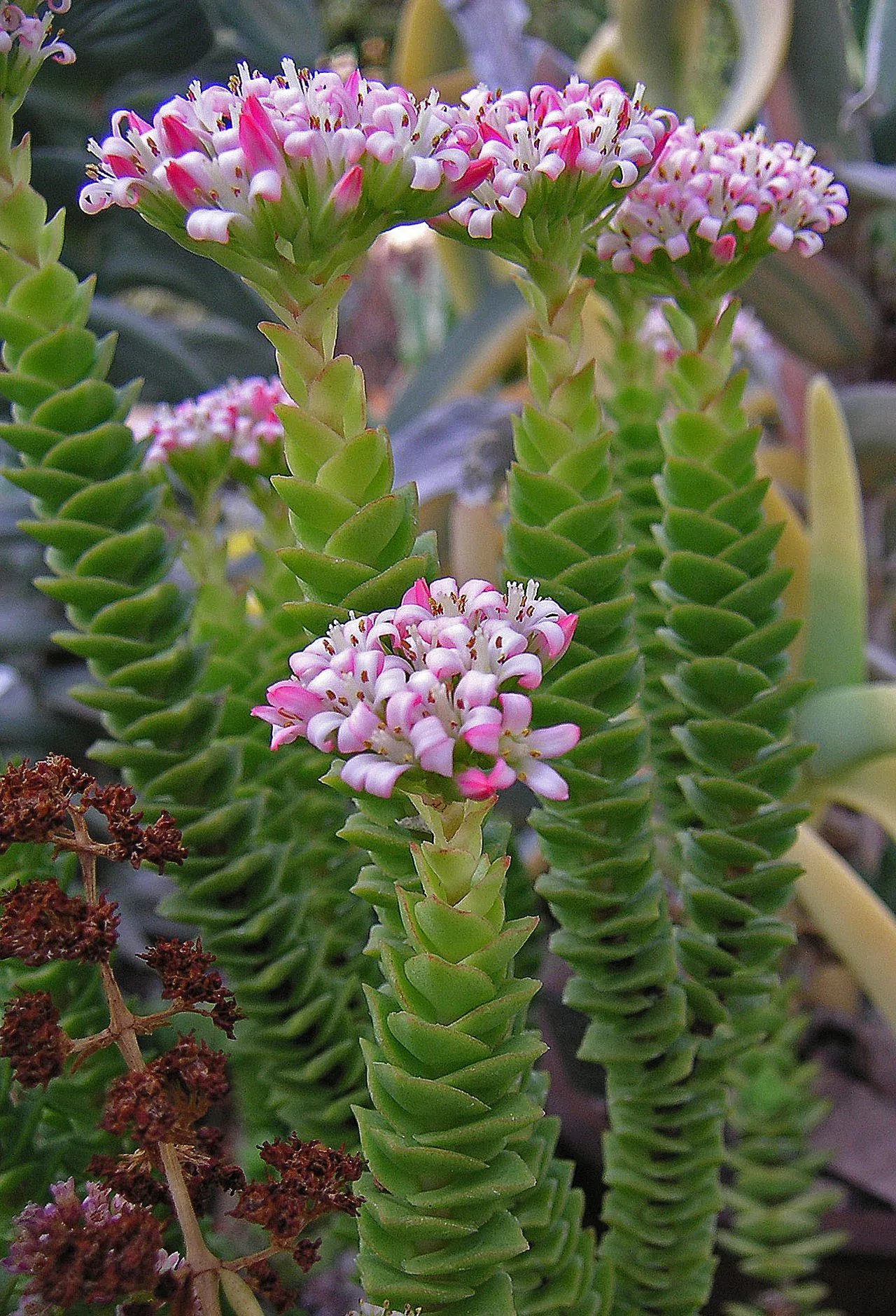
A jade plant (Crassula ovata) that grows vigorously, looks healthy, and never produces a single flower is one of the most consistent questions in succulent cultivation. The plant is not broken. It is not receiving the seasonal signal it evolved to expect. C. ovata originates from southern Africa, where summers are warm and bright and winters bring distinctly cooler temperatures with reduced rainfall — the combination that triggers flower bud initiation. Indoors in centrally heated rooms with steady year-round temperatures and consistent watering, that cue never arrives.
Other Crassula species have their own requirements, and for some, indoor flowering is genuinely difficult without supplemental lighting or a cool house. This article covers the main cultural reasons for non-flowering, the dormancy trigger and how to provide it, and realistic expectations for different species. Part of the Complete Crassula Guide.
Insufficient light through the growing season
The most common barrier to flowering in C. ovata is inadequate light through spring and summer. Flowering requires more than survival-level light. The plant must accumulate sufficient carbohydrate reserves during the growing season to support the formation of reproductive tissue later. A jade in a dim north window, a shaded interior position, or a room that receives only diffuse indirect light rarely builds those reserves, regardless of how well-managed every other aspect of its care is.
The practical threshold for reliable flowering is approximately 5–6 hours of direct sun per day through spring and summer, or the equivalent in full-spectrum LED output. A south- or west-facing window achieves this in most temperate latitudes from March through September. An east window is marginal; a north window or an interior position without supplemental lighting is not sufficient.
The diagnostic marker is leaf colour. A jade that receives adequate light develops a distinct red or rust blush on its leaf margins — this is anthocyanin production triggered by UV exposure and mild heat or drought stress. A plant that has never blushed across any season has probably not received enough light to flower reliably. Leaf blush is not a strict requirement for flowering, but its consistent absence is a reliable indicator that the light threshold is not being met.
Outdoors in summer, even a north-facing garden bed receives more light than the best indoor windowsill on a typical overcast temperate day. Moving the jade outside from late May through early September, placed where it receives at least 4–5 hours of direct sun, substantially increases the chance of flowering the following winter. Acclimate the plant over 10–14 days to prevent scorch when first moving it outdoors.
No winter cool-dry rest period
Crassula ovata initiates flower buds in response to shortening days combined with a reduction in temperature — a vernalisation-adjacent cue that signals the end of the growing season and the appropriateness of investing resources in reproduction. The required condition is roughly 6–8 weeks at 10–15 °C with significantly reduced watering frequency. A jade kept at above 18 °C in centrally heated rooms with regular weekly watering through autumn and winter will not receive this cue.
Providing the rest period requires a deliberate change in environment from October onward. Move the plant to a cooler part of the house: an unheated spare room, a cool hallway, or a sheltered porch that stays reliably above 5 °C. Reduce watering to once every 3–5 weeks. Stop fertilising entirely. Maintain the best available light even at the lower temperature — the cool rest is not a dark rest, and light through the rest period continues to support carbohydrate reserves. After 6–8 weeks, or once the winter solstice has passed, return the plant to normal warmth of 18–22 °C and resume regular watering. Flower buds typically emerge on branch tips 4–8 weeks after the return to warm conditions.
Plants moved outdoors for summer automatically receive this cue as autumn temperatures fall. A jade kept outdoors from May through September and brought indoors only when temperatures approach 5 °C will usually flower without any deliberate seasonal manipulation, provided it received adequate summer light and the indoor winter conditions are not excessively warm.
Over-fertilising with nitrogen
A jade plant receiving monthly high-nitrogen fertiliser through the growing season may develop dense dark-green foliage and vigorous branching while failing to flower. High nitrogen availability promotes vegetative growth at the expense of reproductive structures. In its natural habitat, C. ovata grows in nutrient-poor rocky and sandy soils where nitrogen is scarce; the plant's reproductive strategy evolved in conditions where the decision to flower represents a significant metabolic commitment, not a routine output.
If flowering is the goal, adjust the fertiliser regime from midsummer onward. Switch from a balanced or high-nitrogen formulation to a low-nitrogen, higher-phosphorus product — a 10-30-20 or 5-15-5 blend — from July through September. Stop all fertiliser 6–8 weeks before the intended cool rest begins in October. Resume low-dose balanced fertiliser in late February or March when the plant returns to active growth.
Conversely, a jade that has received no fertiliser for several years in old substrate may be nitrogen-deficient to the point that it lacks the resources to flower even if light and temperature are adequate. A light application of balanced fertiliser in spring and summer covers this case.
Plant not yet mature enough
Crassula ovata is not a juvenile flowerer. Most plants need a trunk diameter of at least 1–2 cm and a multi-branched canopy before reliable flower initiation occurs. A small rooted cutting or leaf propagule can take 4–7 years under indoor conditions to reach this structural threshold, depending on light intensity, pot size, and watering frequency.
Growth rate is the key lever. A plant grown outdoors in full sun with regular summer watering will thicken its trunk substantially faster than an indoor windowsill specimen. Bonsai training with tight, repeated pruning can slow trunk thickening significantly because energy is redirected into callus formation and shoot proliferation rather than primary stem expansion. Allow a young jade to grow freely for 2–3 years before beginning any serious bonsai restriction if early flowering is the goal.
A simple age diagnostic: if the stem at the base of the plant is still green, flexible, and under 8 mm in diameter, the plant is almost certainly a juvenile. Wait and grow.
Species and cultivar expectations vary widely
Crassula ovata is the species for which the cool-dry dormancy trigger is most well documented in cultivation, but the genus contains around 200 species with very different flowering behaviour.
Crassula falcata (the propeller plant) is among the most reliably flowering indoor Crassulas. It produces vivid orange-red corymbose flowerheads on mature rosettes in summer and does not require the same autumn cool rest as C. ovata. The spent flower stalk should be removed at the base once bloom fades; the rosette continues to grow and the surrounding offsets will flower in subsequent years.
Crassula capitella and its cultivar 'Campfire' develop vivid red stress colouring and flower freely in outdoor cultivation during summer, but rarely produce meaningful bloom under typical indoor conditions. Full outdoor sun and summer heat appear to be the key triggers.
The column-forming and stacked species — C. perforata, C. rupestris, C. 'Buddha's Temple' — produce small cream to white star-shaped flowers that are easy to miss. They flower mainly outdoors or under high-intensity supplemental LED lighting. The miniature mat-forming species (C. muscosa, C. socialis) rarely flower meaningfully in indoor conditions.
Crassula 'Morgan's Beauty' is a standout exception: it produces compact bright pink flowerheads that are disproportionately showy for the plant's modest size, and it flowers reliably indoors given adequate light and a cool winter rest.
How to assess flowering potential
| Factor | Condition suppressing flowering | Target condition |
|---|---|---|
| Light | Under 3 hours direct sun per day | 5–6+ hours direct sun, or LED equivalent |
| Winter temperature | Above 18 °C continuously | 10–15 °C for 6–8 weeks |
| Winter watering | Regular weekly watering | Once every 3–5 weeks |
| Fertiliser | High-nitrogen monthly | Low nitrogen from July; none from October |
| Plant maturity | Trunk under 1 cm diameter | Multi-branched trunk 1–2+ cm |
| Species | Miniature or column-forming indoors | C. ovata, C. falcata, C. 'Morgan's Beauty' most reliable |
Risk and severity
Non-flowering is not a health problem. The plant is not in danger and no emergency action is required. Every remedy described here — more light, a cooler winter, adjusted fertiliser — is beneficial to the plant's general health regardless of whether flowering follows.
Act urgently only if non-flowering is accompanied by other symptoms. A jade that has not flowered and also shows etiolation, persistent yellowing, or leaf drop likely has a concurrent care problem — see jade plant leggy if stretch and light deficit are the presenting symptoms.
Solutions
Improving light
From March onward, position the jade on the brightest available south- or west-facing windowsill. Outdoors from late May in temperate climates is better still. For supplemental indoor lighting, a full-spectrum LED grow light running 14 hours per day at 250–400 lux measured at leaf level supports carbohydrate accumulation equivalent to a reliable south windowsill. Acclimate the plant over 10–14 days if moving from low to high light to avoid scorch on new growth.
Providing a dormancy trigger
From early October, move the plant to a location reliably at 10–15 °C. Reduce watering to once every 3–5 weeks. Stop fertilising. Maintain the best available light even at the reduced temperature. After 6–8 weeks, or after the winter solstice, return the plant to 18–22 °C and resume normal watering. Flower buds typically emerge on branch tips 4–8 weeks after the return to warm conditions. The first year after implementing this regime, results may be modest; by the second or third year the response should be reliable.
Adjusting fertiliser
Apply a phosphorus-leaning fertiliser such as 10-30-20 once a month in July and August to support reproductive bud initiation. Stop all fertiliser from September onward. Resume low-dose balanced fertiliser at one quarter the label dose in late February or March when active growth recommences.
Prevention
Establish a seasonal rhythm from the outset: bright light and regular watering from March through September, a distinct cool-dry rest from October through December, and a gradual return to active conditions from January. Give the plant space to develop a mature trunk — a jade restricted to a tiny pot for a decade will not have the vascular and structural resources to flower freely. Remove spent flower stalks cleanly at the base in late winter to prevent the plant investing energy in producing seed rather than vegetative growth.
See also
- Crassula falcata — propeller plant, one of the most reliably flowering Crassulas in indoor cultivation.
- Crassula capitella — vivid stress colouring and outdoor summer-flowering habit.
- Jade Plant Leggy — when insufficient light prevents both compact growth and flowering.
- Echeveria Not Flowering — parallel diagnosis for a closely related genus in the same family.
Frequently Asked Questions
How old does a jade plant need to be before it flowers?
Most Crassula ovata plants need a trunk diameter of at least 1–2 cm and a well-developed branched canopy — typically 3–7 years from a small cutting — before they will flower reliably.
When does a jade plant normally flower?
In the northern hemisphere, Crassula ovata typically produces clusters of small pink-white star-shaped flowers between November and February after a cool-dry autumn rest.
Does Crassula ovata flower every year?
A well-grown jade in adequate light that receives a distinct seasonal cool-dry rest should flower most years. One missed season is not unusual; consistent non-flowering over several years points to a structural care problem.
Do I need to do anything after Crassula flowers?
Remove the spent flower stalk at the base once the bloom fades. Crassula ovata is not monocarpic — the plant continues growing and will flower again in subsequent seasons.