| Question | Short Answer |
|---|---|
| What light does this Crassula need? | Bright light is the default. |
| How should it be watered? | Water thoroughly, then allow the upper 3–4 cm of substrate to dry before watering again. |
| What substrate works best? | Use a free-draining mix with substantial pumice, grit, or perlite. |
| How is it propagated? | Stem cuttings are the most reliable method for most Crassula. |
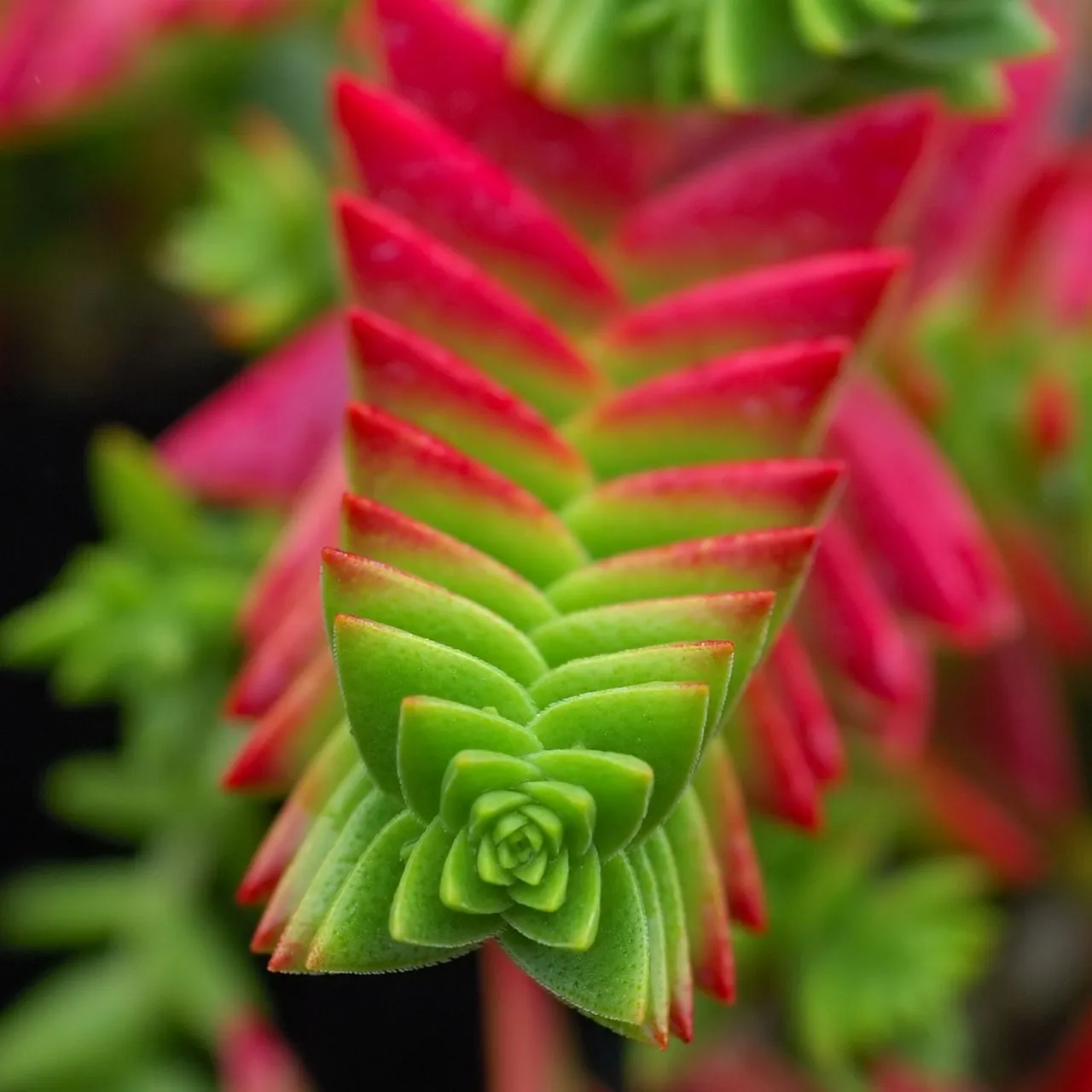
Crassula capitella Thunb. is a small clump-forming succulent native to South Africa and Namibia, where it occurs on rocky outcrops and in dry grassland. The species is most often seen in cultivation as the selected cultivar 'Campfire', a compact form that develops intense fiery red leaves under stress.
Part of the Complete Crassula Guide.
Identification
Habit and leaf colour are the two giveaway features.
- Leaves. Lanceolate to triangular, 2–5 cm long, tapering to a pointed tip. Arranged in opposite decussate pairs that stack into a loose propeller-like column on each stem. Colour ranges from pale green in shade through yellow-green in moderate light to flame-red in full sun.
- Stems. Thin, sprawling with age, rooting along their length where they touch substrate. A mature clump spreads 20–30 cm across from a single rooted piece.
- Inflorescence. A slender upright panicle to 30 cm tall, bearing small white star-shaped flowers in terminal clusters from summer into autumn.
- Habit. Mat- to cushion-forming; stems branch freely.
Several subspecies are recognised. C. capitella subsp. thyrsiflora is the tall upright form, and C. capitella subsp. capitella is the more common ground-hugging one. The cultivar 'Campfire' is a selection of subsp. thyrsiflora.
Cultivation
Baseline care follows the pillar defaults. The species diverges on two points.
First, it needs strong light and some drought stress to colour well. Given gentle indoor conditions the plant grows easily enough but stays a pale green, with widely-spaced leaves and a loose habit. Push it with full sun from spring to autumn, acclimated gradually, and hold back on water between soakings; the red pigmentation is a phenological response to that combination.
Second, it is a fast grower on thin substrate and does not need a deep pot. A wide shallow pan of 70% pumice plus 30% loam suits it better than a standard cactus mix, and encourages the spreading mat habit.
Minimum temperature 5 °C. Sustained cold wet roots are the main risk in winter.
Propagation
Stem cuttings root easily. Take a 5–8 cm piece, strip the lower pair of leaves, callus for 3–5 days, and insert into gritty mix. Roots appear within 2 weeks. Leaf propagation also works for C. capitella but is slower and less reliable than for C. ovata.
Self-layered pieces with roots already formed at the nodes can be lifted directly with a trowel and potted on.
Notes and Quirks
C. capitella is not monocarpic but individual stems sometimes deteriorate after heavy flowering. Cut spent inflorescences off at the base and new vegetative shoots appear from side buds within a few weeks.
The cultivar 'Campfire' is sold widely and is considerably more compact than the wild-type species. If you want the dramatic red leaves without managing sprawling stems, buy 'Campfire'.
See also
- Crassula 'Campfire'
- Crassula perforata
- Crassula falcata
- Jade Plant Turning Red — the anthocyanin stress response that C. capitella 'Campfire' takes to its most dramatic expression.
Frequently Asked Questions
What light does this Crassula need?
Bright light is the default. Compact species and red-flushing cultivars need several hours of direct sun after gradual acclimation.
How should it be watered?
Water thoroughly, then allow the upper 3–4 cm of substrate to dry before watering again. In cool winter conditions, reduce watering sharply.
What substrate works best?
Use a free-draining mix with substantial pumice, grit, or perlite. Dense peat-heavy compost keeps the root zone wet too long.
How is it propagated?
Stem cuttings are the most reliable method for most Crassula. Leaf cuttings work on jade-type plants but are less useful for tight stacked miniatures.