| Question | Short Answer |
|---|---|
| What light does this Crassula need? | Bright light is the default. |
| How should it be watered? | Water thoroughly, then allow the upper 3–4 cm of substrate to dry before watering again. |
| What substrate works best? | Use a free-draining mix with substantial pumice, grit, or perlite. |
| How is it propagated? | Stem cuttings are the most reliable method for most Crassula. |
Crassula perforata Thunb., commonly called string of buttons or necklace vine, is a column-forming succulent native to the Eastern Cape of South Africa. It grows in coastal thicket and on dry rocky slopes, where its stacked triangular leaves and sprawling stems are unmistakable once seen.
Part of the Complete Crassula Guide.
Identification
The diagnostic feature is the way the leaves are arranged on the stem.
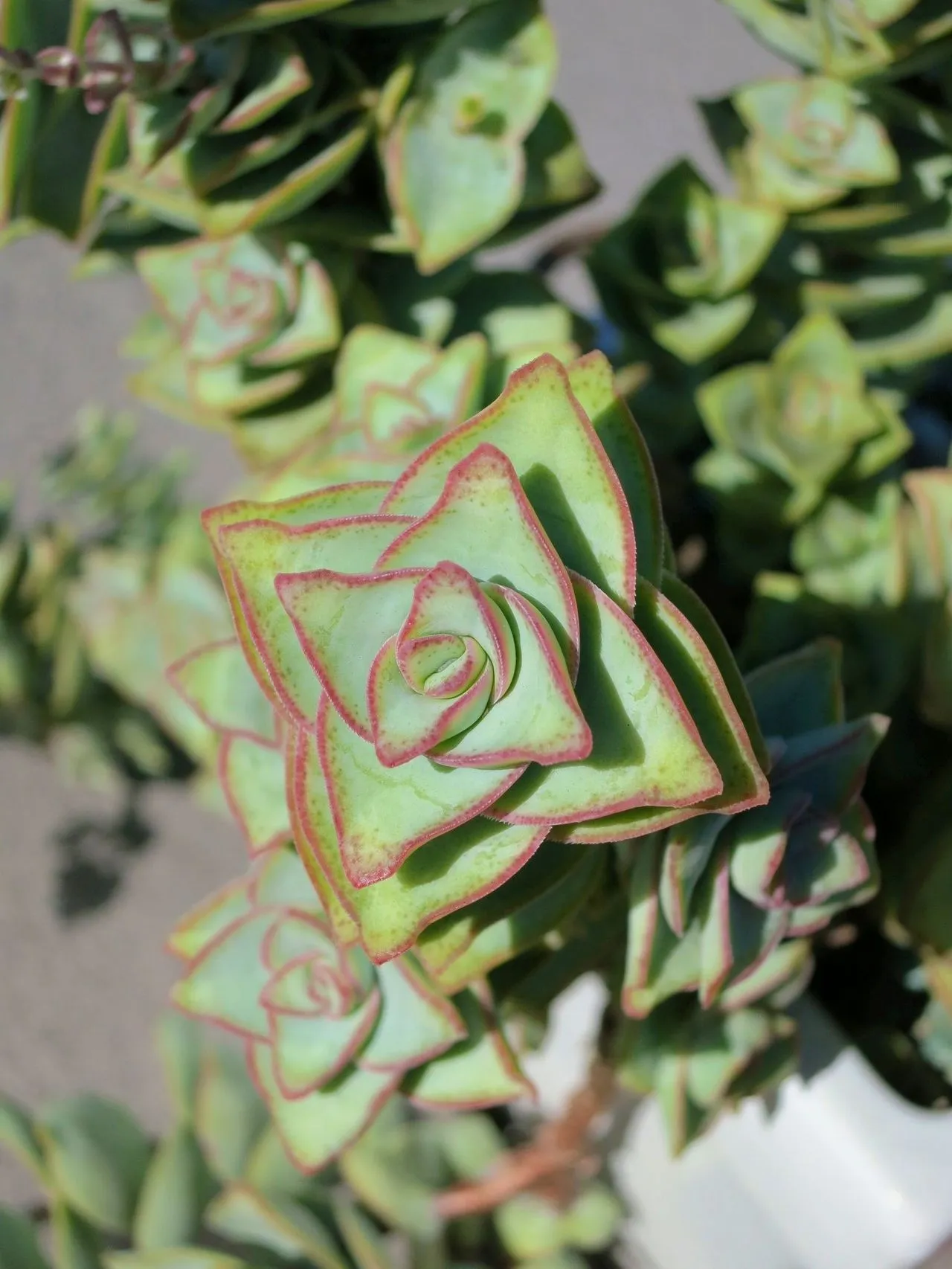
- Leaves. Triangular to rhombic, 1–2 cm long, fused at the base around the stem so that each pair appears to be threaded on it like a bead on a string. Colour pale grey-green with a waxy bloom; margins and leaf tips flush pink to red in strong light.
- Stems. Thin, semi-woody, lax, growing upright when young and sprawling as they lengthen. Mature stems reach 30–60 cm.
- Flowers. Tiny cream-coloured stars in small corymbose clusters tucked between leaf pairs, produced in late spring and summer on mature plants.
- Leaf arrangement. Strictly opposite decussate, four vertical ranks visible from above.
The "fused leaf base" is the structural reason for the stacked-bead look and separates C. perforata from superficially similar C. rupestris, in which the leaves are more rounded and the stems thicker.
Cultivation
Cultivation follows the pillar defaults with two adjustments. First, C. perforata wants still brighter light than a standard C. ovata: weak light produces widely-spaced, pale, soft leaf pairs instead of the compact stacks the plant is grown for. A south or west window with several hours of direct sun, or outdoor summer culture with acclimation, suits it well.
Second, substrate should be faster than the pillar default. Use at least 60% mineral grit; a pure pumice mix with light fertiliser works reliably. In a heavy mix the thin stems rot from the base.
Minimum temperature 5 °C, best kept above 8 °C when wet. Water when fully dry in the growing season; reduce to once every 4–6 weeks in a cool winter.
Propagation
This is one of the easiest succulents to propagate in bulk. A 5–10 cm cutting callused for a week and laid horizontally on gritty mix will root from the stem at multiple nodes and produce new rosettes at each leaf pair. Stem leaves knocked off during handling also strike readily if laid on damp grit. For a full pot in one step, take a cutting, shake loose a handful of leaves into a tray of gritty mix, scatter them flat, and mist weekly. You will have a dense pot of clones within 2–3 months.
Notes and Quirks
The leaves flush pink and red in strong light, a stress colour response from anthocyanin accumulation. This is cosmetic and reversible if the plant is moved to lower light.
C. perforata is often sold mixed with C. 'Buddha's Temple' and C. rupestris in "succulent assortments" and is frequently mislabelled. If the leaves are thin, triangular, and clearly fused at the stem, it is perforata; if they are rounder and the stems woodier, it is rupestris.
See also
- Crassula rupestris
- Crassula pagoda
- Crassula capitella
- Crassula muscosa — the smaller scale-leaved four-ranked column, often confused with C. perforata in mixed trays.
Frequently Asked Questions
What light does this Crassula need?
Bright light is the default. Compact species and red-flushing cultivars need several hours of direct sun after gradual acclimation.
How should it be watered?
Water thoroughly, then allow the upper 3–4 cm of substrate to dry before watering again. In cool winter conditions, reduce watering sharply.
What substrate works best?
Use a free-draining mix with substantial pumice, grit, or perlite. Dense peat-heavy compost keeps the root zone wet too long.
How is it propagated?
Stem cuttings are the most reliable method for most Crassula. Leaf cuttings work on jade-type plants but are less useful for tight stacked miniatures.