| Question | Short Answer |
|---|---|
| What light does this Crassula need? | Bright light is the default. |
| How should it be watered? | Water thoroughly, then allow the upper 3–4 cm of substrate to dry before watering again. |
| What substrate works best? | Use a free-draining mix with substantial pumice, grit, or perlite. |
| How is it propagated? | Stem cuttings are the most reliable method for most Crassula. |
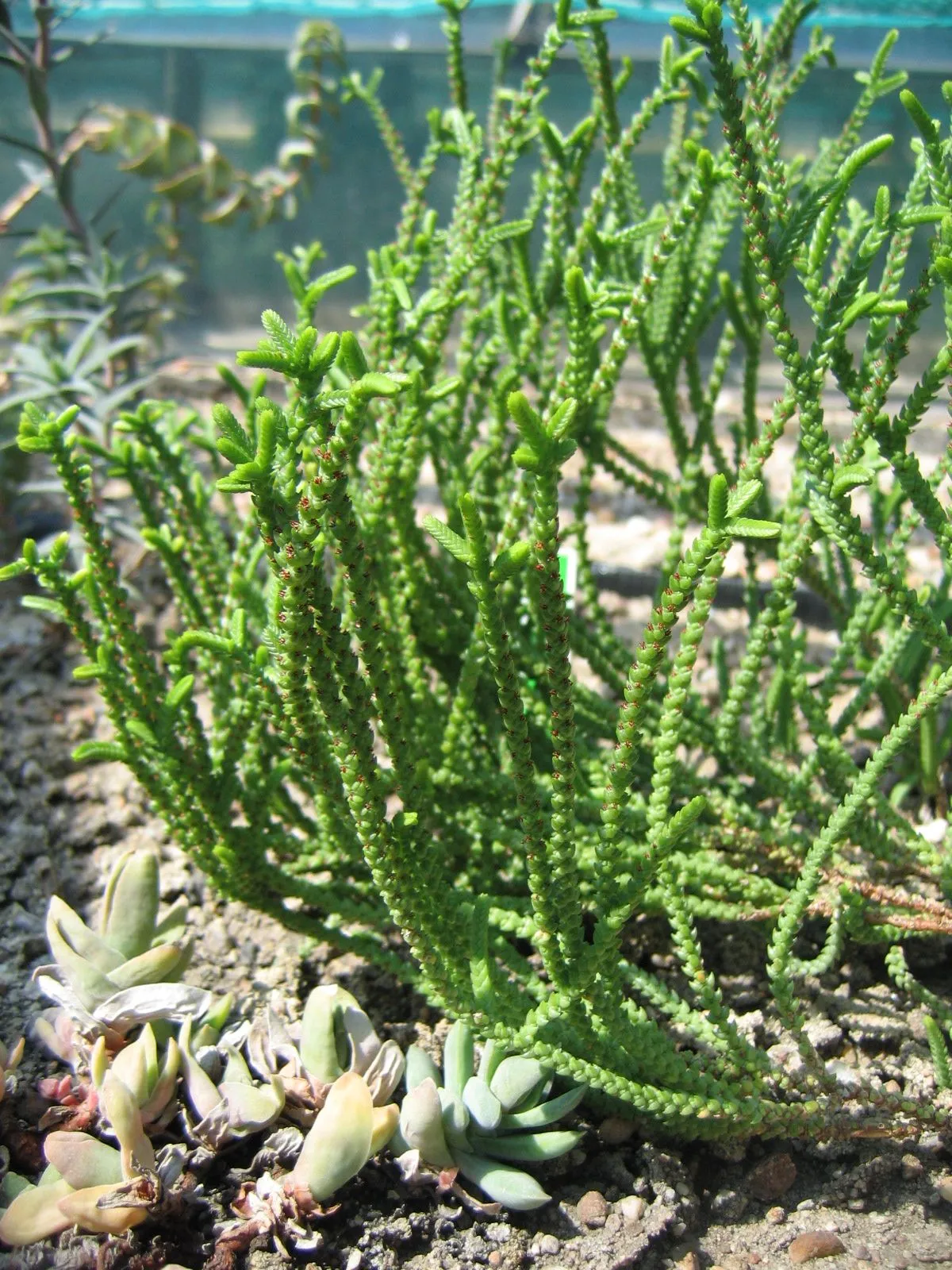
Crassula muscosa L., the watch chain crassula or princess pine, is a small clumping succulent native to South Africa and Namibia. In the wild it grows on rocky slopes and cliff ledges in semi-arid scrubland, forming dense wiry mats. In cultivation it is a staple of mixed-succulent bowls and a good starter miniature for collectors.
Part of the Complete Crassula Guide.
Identification
The plant looks at first glance like a bryophyte or a small conifer seedling rather than a Crassula.
- Leaves. Tiny, triangular to scale-like, 1–3 mm long, pressed tightly against the stem in four vertical ranks of opposite decussate pairs. The net effect is a perfect square column perhaps 2–3 mm across, so regular that the species is often sold as "zipper plant".
- Stems. Thin, semi-upright to sprawling, 5–20 cm long, branching freely from the base. Older stems lignify and turn brown.
- Flowers. Minute (1–2 mm), pale yellow-green, produced in the leaf axils along the stem rather than at the tip. Barely visible without close inspection; sweetly scented.
- Habit. A dense cushion or low spreading mat, 5–10 cm tall, with individual rosettes impossible to distinguish in a mature clump.
C. muscosa is occasionally confused with Crassula lycopodioides, an older name now treated as a synonym of C. muscosa, or with Crassula pseudolycopodioides, which is a more densely leaved relative.
Cultivation
Care follows the pillar defaults with mild adjustments for the miniature habit.
Light: bright, but tolerates more shade than most Crassulas. A bright east-facing window or light afternoon shade outdoors suits it. Full summer sun bleaches the leaves to yellow-green; this is a stress response and the plant recovers colour in gentler light.
Substrate: fast-draining, but the species handles a slightly more moisture-retentive mix than the rarer miniatures. A 50/50 pumice and loam-based compost works well. The shallow root system does best in a wide shallow pan.
Water when the substrate is fully dry. Reduce sharply in winter; cold wet roots are the main cause of sudden collapse.
Temperature minimum 5 °C, though the plant survives brief touches of frost on dry tissue.
Propagation
Trivial. Any piece of stem laid on damp gritty mix will root within 2–3 weeks. Take 3–5 cm cuttings, callus for a day or two, and press lightly into substrate. Division of mature clumps also works: lift the mat, tease it apart with fingers, and replant the pieces.
Notes and Quirks
C. muscosa has a long list of common names in addition to watch chain: princess pine, rattail crassula, lizard's tail, zipper plant, and the dubious "moss Crassula" from the species epithet. Nothing about it is mossy; the name comes from the plant's low mat-forming growth habit, not from any botanical similarity to bryophytes.
The tiny flowers are easy to miss but contribute a surprising honey-like fragrance to a plant room when a mature clump is in full bloom.
See also
- Crassula alpestris
- Crassula perforata
- Crassula sarmentosa
- Crassula tenelli — small mat-forming companion often grown alongside the watch chain.
Frequently Asked Questions
What light does this Crassula need?
Bright light is the default. Compact species and red-flushing cultivars need several hours of direct sun after gradual acclimation.
How should it be watered?
Water thoroughly, then allow the upper 3–4 cm of substrate to dry before watering again. In cool winter conditions, reduce watering sharply.
What substrate works best?
Use a free-draining mix with substantial pumice, grit, or perlite. Dense peat-heavy compost keeps the root zone wet too long.
How is it propagated?
Stem cuttings are the most reliable method for most Crassula. Leaf cuttings work on jade-type plants but are less useful for tight stacked miniatures.