| Question | Short Answer |
|---|---|
| What light does this Crassula need? | Bright light is the default. |
| How should it be watered? | Water thoroughly, then allow the upper 3–4 cm of substrate to dry before watering again. |
| What substrate works best? | Use a free-draining mix with substantial pumice, grit, or perlite. |
| How is it propagated? | Stem cuttings are the most reliable method for most Crassula. |
Crassula alpestris Thunb. is a compact cushion-forming succulent native to the high-altitude grasslands and rocky slopes of the Drakensberg, the Cedarberg, and the Eastern Cape mountains in South Africa. It is one of the genus's cold-adapted species and has a distinctly tidier growth habit than the lowland members of its section.
Part of the Complete Crassula Guide.
Identification
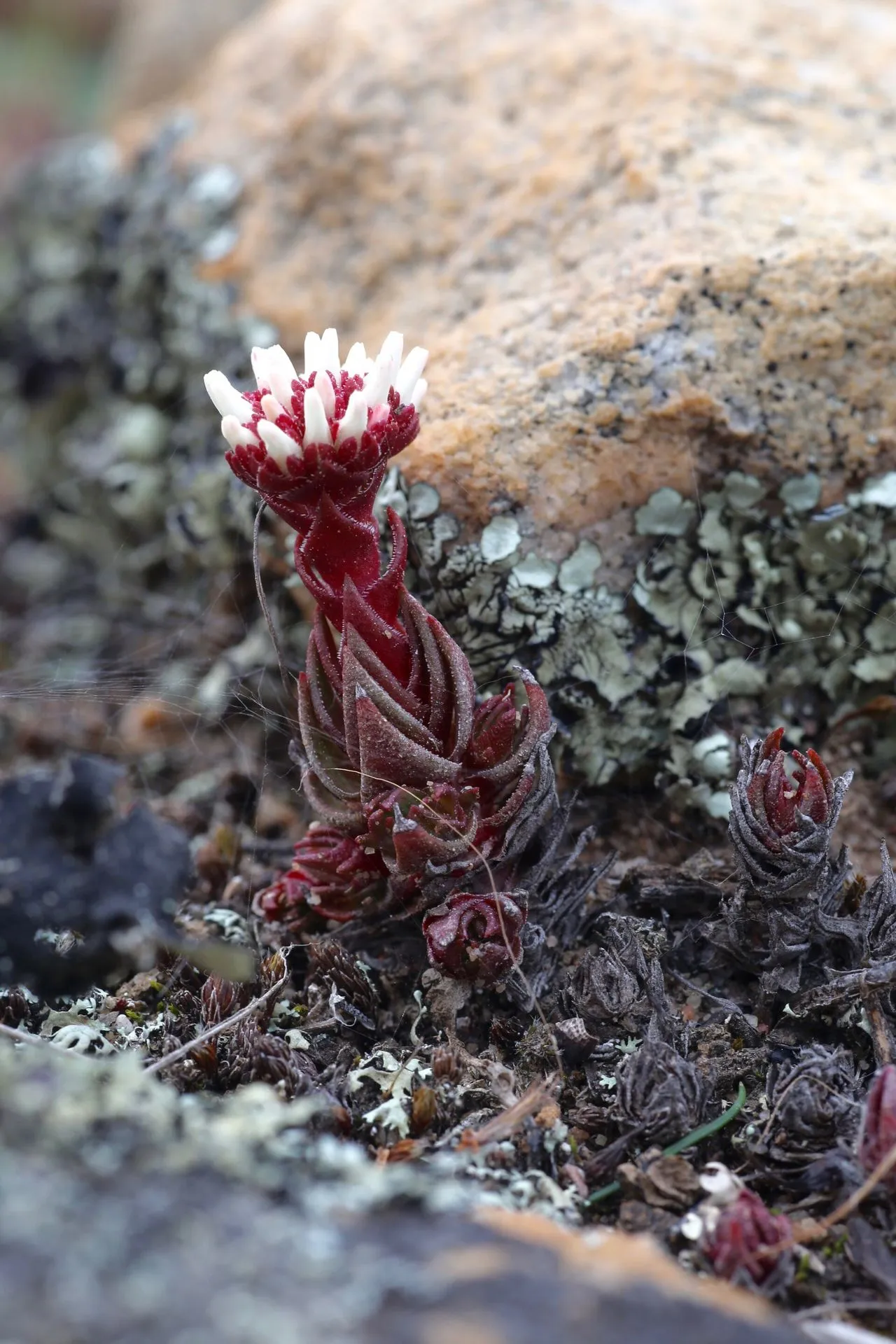
- Leaves. Ovate to broadly triangular, 5–10 mm long, thick and fleshy, arranged in tightly packed opposite decussate pairs. Colour pale grey-green with a waxy bloom; margins often flush pink to red under strong light or cold.
- Stems. Short and upright, 5–15 cm tall, with leaves packed so closely that the stem itself is mostly hidden. Mature plants form small cushions through basal branching.
- Flowers. Small white to pale pink stars in dense terminal clusters, produced in summer. The inflorescence is often proportionally large relative to the tiny rosettes.
- Habit. A dense miniature cushion, 5–10 cm across from a single rooted stem, eventually spreading through offsetting to 20 cm.
Two subspecies are commonly recognised: C. alpestris subsp. alpestris with the packed cushion habit described above, and subsp. massonii with looser leaves and slightly larger flowers.
Cultivation
Care differs from the pillar defaults in one direction: C. alpestris is more cold-tolerant and more moisture-sensitive than the common tree-form Crassulas.
Light: full sun or very bright light year-round. In insufficient light the tight leaf packing loosens and the plant takes on an unfamiliar stretched look.
Substrate: very free-draining mineral mix, at least 70% pumice or coarse grit. The fine fibrous root system rots rapidly in anything retentive, and a rotted cushion is rarely recoverable.
Water: sparingly, even in the growing season. Let the substrate dry out completely between waterings, and err toward under- rather than over-watering. In winter, keep nearly dry; the species is adapted to cold dry upland winters and handles those conditions far better than warm humid ones.
Temperature: tolerates brief frost on dry tissue, and in its native habitat routinely experiences overnight temperatures below 0 °C. In cultivation, treat 5 °C as a practical minimum when wet.
Propagation
Division and stem cuttings both work. The cushion habit makes division the usual method: lift a clump in spring, tease it apart into individual rooted rosettes, and pot each into a small gritty pan. Stem cuttings of 3–5 cm callused for 3–5 days also root reliably in gritty mix.
Leaf propagation is possible but slower than for the common hobby species; the small leaves carry less reserve and produce smaller, weaker plantlets.
Notes and Quirks
C. alpestris is one of several Crassulas sometimes offered as "alpine" or "cold hardy", but that claim needs qualifying. The species tolerates cold dry conditions; it does not tolerate cold wet conditions. The distinction is the usual one in southern-African high-altitude succulents and is the practical cause of most overwinter losses.
The waxy bloom on the leaves is delicate. Handle cuttings by the stem, not the leaves, or you will end up with permanent fingerprint marks.
See also
- Crassula muscosa
- Crassula rupestris
- Crassula obvallata
- Crassula socialis — another compact mat-forming species with similar cold tolerance and culture.
Frequently Asked Questions
What light does this Crassula need?
Bright light is the default. Compact species and red-flushing cultivars need several hours of direct sun after gradual acclimation.
How should it be watered?
Water thoroughly, then allow the upper 3–4 cm of substrate to dry before watering again. In cool winter conditions, reduce watering sharply.
What substrate works best?
Use a free-draining mix with substantial pumice, grit, or perlite. Dense peat-heavy compost keeps the root zone wet too long.
How is it propagated?
Stem cuttings are the most reliable method for most Crassula. Leaf cuttings work on jade-type plants but are less useful for tight stacked miniatures.