| Question | Short Answer |
|---|---|
| What light does this Crassula need? | Bright light is the default. |
| How should it be watered? | Water thoroughly, then allow the upper 3–4 cm of substrate to dry before watering again. |
| What substrate works best? | Use a free-draining mix with substantial pumice, grit, or perlite. |
| How is it propagated? | Stem cuttings are the most reliable method for most Crassula. |
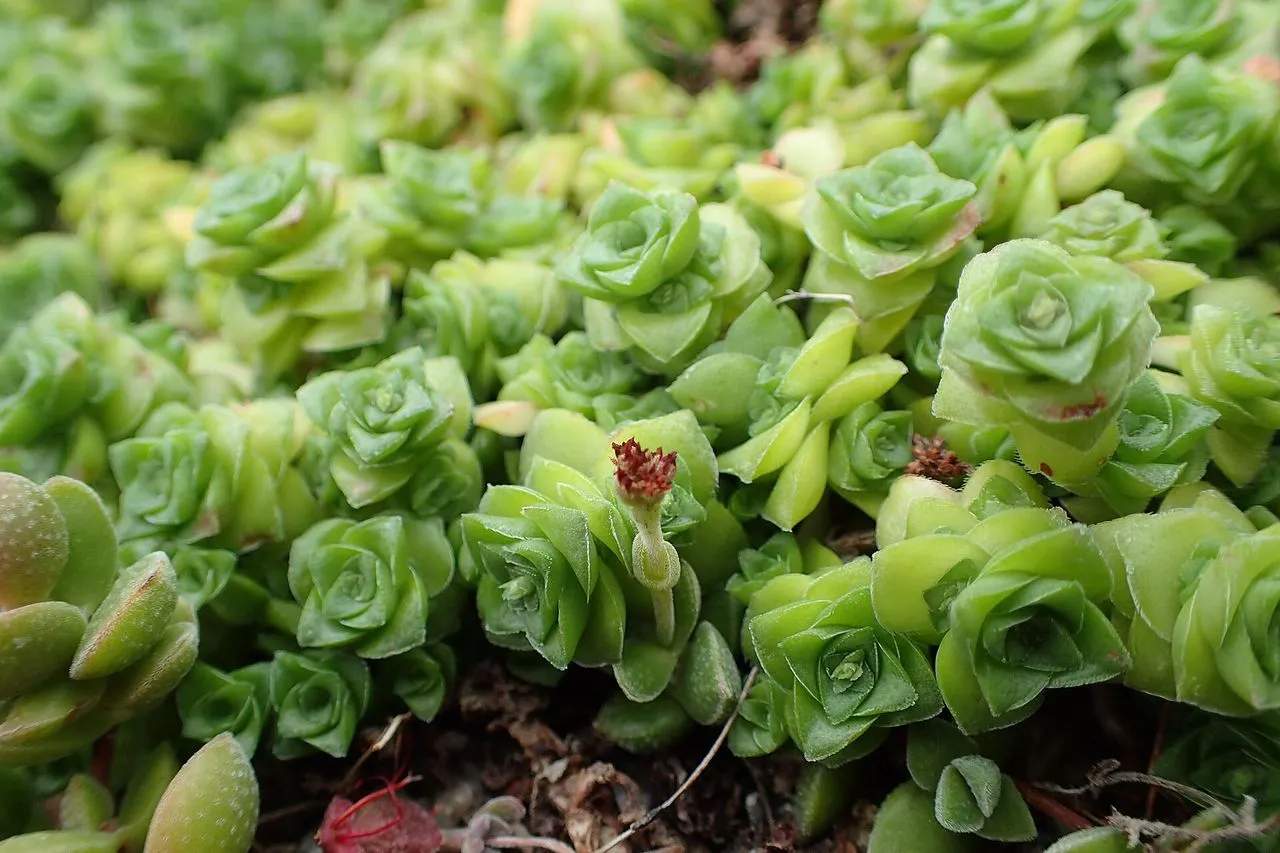
Crassula socialis Schönland is a small, cushion-forming southern-African leaf-succulent from the Eastern Cape. It forms dense mats of tiny rosettes connected by short rooting stolons, producing a cushion 3–8 cm tall and eventually 15–20 cm or more across. It is among the easiest of the true Crassula miniatures in cultivation.
Part of the Complete Crassula Guide.
Identification
- Tight stemless or short-stemmed rosettes, each 1.5–2.5 cm across, packed against one another to form a continuous cushion.
- Leaves opposite decussate, 4–8 mm long, ovate to almost rhomboid, glabrous, green with reddish-brown tips in strong light.
- Leaf margins have fine translucent hairs (cilia) visible with a hand lens.
- Small white stellate flowers in short terminal cymes; bloom sometimes covers the entire cushion in late winter or early spring.
The species is often confused with C. tecta (larger, with whitish surface scales), C. cornuta (more elongated leaves with conspicuous hyaline tips), and C. tenelli (looser, sprawling rather than cushion-forming). Among the group, C. socialis has the tightest cushion habit and the shortest internodes.
Cultivation
A forgiving miniature. Where it diverges from the pillar default:
- Substrate. 60–70% mineral, 30–40% loam-based compost. Tolerates slightly heavier substrate than C. pangolin or C. pyramidalis.
- Pot. Shallow pan 8–12 cm across. The plant roots shallowly and spreads outward faster than it grows down.
- Light. Bright but not hard midday sun through glass. Direct morning sun is ideal; afternoon summer sun burns the older leaves. Under low light the cushion loosens and the rosettes elongate.
- Water. Regular in summer, sparing in winter. Water when the surface is dry; in active growth, this usually means every 7–10 days. Avoid letting water sit on the cushion surface — pour at the edge.
- Temperature. 5°C–32°C. Not frost hardy. Handles cool dry winters (10°C–15°C) well.
Propagation
The easiest of any miniature Crassula. The rooting stolons connecting rosettes detach cleanly with their own roots attached, and each detached rosette establishes within a week when potted into fresh gritty mix. A single mature cushion can be broken into dozens of viable daughter plants in 15 minutes.
Stem cuttings also root easily. Leaf propagation works but is slower and less reliable than simple rosette division.
Seed is available through specialist societies. Germination is quick (within 2 weeks at 20°C) but seedlings take 2–3 years to cushion up.
Notes
The specific epithet socialis refers to the plant's cushion-forming, clonal habit, where many small rosettes grow together in a tight colony. This growth form is the plant's main ornamental appeal: a well-grown specimen looks like a tight green carpet studded with tiny white star-flowers in bloom.
C. socialis is the miniature Crassula most often recommended as a first purchase for growers wanting to move beyond C. ovata. It is hardy for the group, cheap, widely available, and responds quickly to correct culture.
Flowering can briefly obscure the foliage. Remove spent inflorescences at the base with fine scissors to tidy the cushion and prevent fungal problems in the dense leaf pack.
See also
- Crassula tenelli — looser, sprawling sibling in the miniature group.
- Crassula pangolin — scale-leaved cousin.
- Fairy Crassula — shade-tolerant alternative ground cover.
- Crassula cephalophora — rosette-forming miniature with compatible light and water needs.
Frequently Asked Questions
What light does this Crassula need?
Bright light is the default. Compact species and red-flushing cultivars need several hours of direct sun after gradual acclimation.
How should it be watered?
Water thoroughly, then allow the upper 3–4 cm of substrate to dry before watering again. In cool winter conditions, reduce watering sharply.
What substrate works best?
Use a free-draining mix with substantial pumice, grit, or perlite. Dense peat-heavy compost keeps the root zone wet too long.
How is it propagated?
Stem cuttings are the most reliable method for most Crassula. Leaf cuttings work on jade-type plants but are less useful for tight stacked miniatures.