| Question | Short Answer |
|---|---|
| What light does this Crassula need? | Bright light is the default. |
| How should it be watered? | Water thoroughly, then allow the upper 3–4 cm of substrate to dry before watering again. |
| What substrate works best? | Use a free-draining mix with substantial pumice, grit, or perlite. |
| How is it propagated? | Stem cuttings are the most reliable method for most Crassula. |
Crassula tenelli is a small southern-African mat-forming leaf-succulent, one of a group of dwarf Crassula that form low cushions or carpets of short stems studded with tiny overlapping leaves. The name is occasionally written as Crassula tenella, and the two spellings refer to the same plant in trade usage.
Part of the Complete Crassula Guide.
Identification
- Compact habit: stems 2–6 cm tall, spreading outward and rooting along the soil surface to form dense clumps.
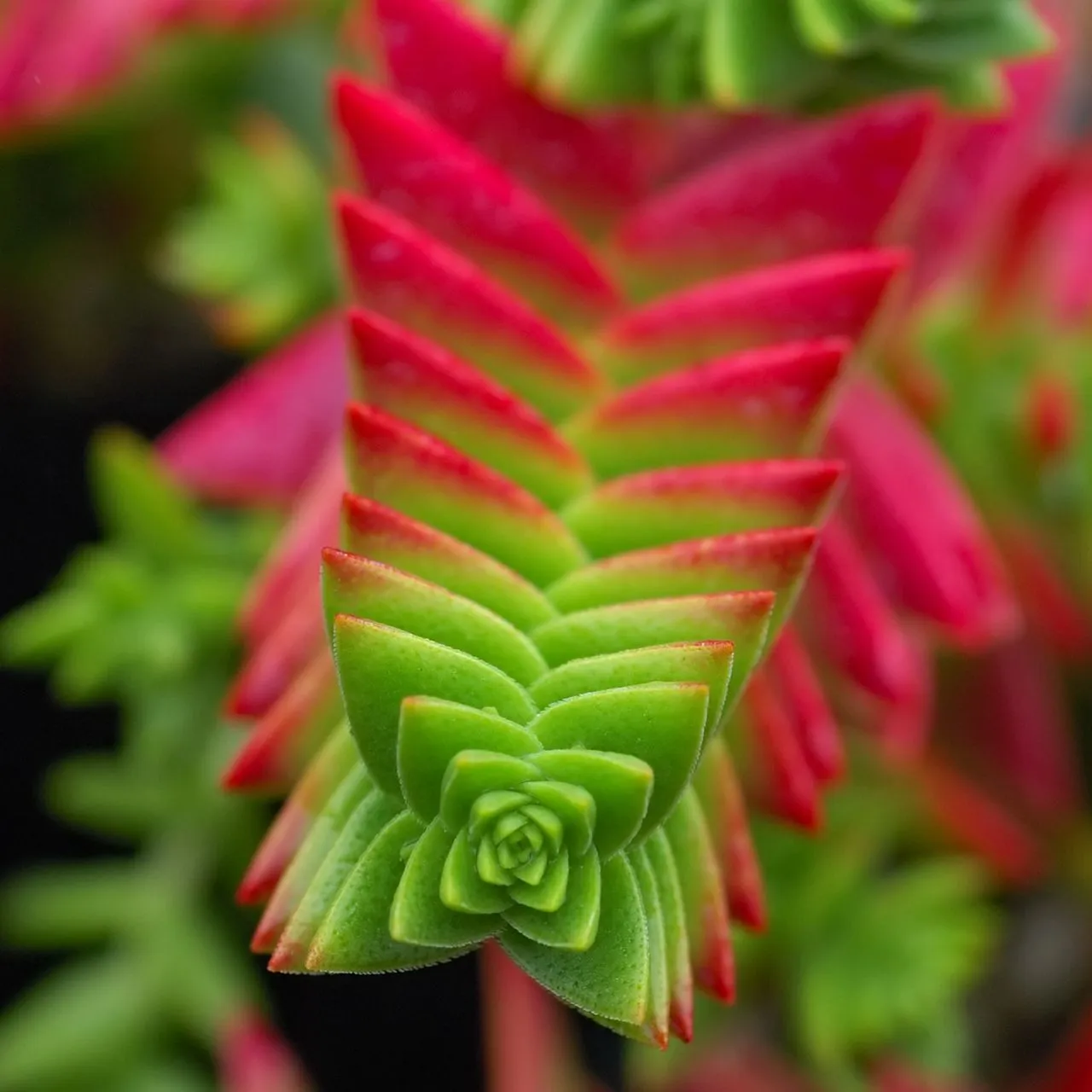
- Leaves opposite decussate (as in all Crassula), 3–6 mm long, fleshy, ovate to lanceolate, green with a reddish blush in strong light.
- Small cream or pink-white stellate flowers in short lateral clusters, most often in spring.
- Branches snap off cleanly when nudged; the detached pieces root on contact with damp substrate.
The species is easy to confuse with C. socialis, which has more rounded leaves and tighter rosettes, and with C. muscosa, which carries its leaves in four clearly ranked rows on thin wiry stems. A C. tenelli sitting beside a C. socialis under glass will look recognisably different within a few weeks: tenelli loose and sprawling, socialis tight and cushion-like.
Cultivation
Tougher than it looks, but unforgiving of overwatering. The pillar's default regime works with two adjustments.
- Substrate: 70% mineral (pumice, perlite, or 3 mm grit), 30% loam-based compost. Anything more organic holds water at the roots and rots the basal stems.
- Pot: small and shallow. The root system is fine and limited; a large pot stays wet too long. A 7–10 cm pan suits a mature clump.
Light: bright but not the hottest midsummer sun. Direct sun for 4–5 hours in morning or late afternoon produces a red-bronze leaf colour; afternoon summer sun through glass scorches. Indoors, a south-east or east window works well.
Water when the substrate is dry all the way down. In summer this is every 7–10 days; in winter every 4–6 weeks is enough if kept cool (10°C–15°C). Do not water into the crown of the mat; pour at the edge.
Frost kills the whole mat quickly. Below 5°C move it indoors or into a cold frame.
Propagation
Stem cuttings are by far the easiest method. Pinch off a 1–2 cm section with your fingers, lay it on the surface of dry gritty substrate, and mist lightly every 3–4 days. Roots appear at the base within 2 weeks and the cutting establishes within a month. A single 10 cm pan can be fully planted from a handful of cuttings and fills in within one season.
Leaf propagation is slow here. The leaves are small and often tear rather than detach cleanly. Stick with stem cuttings.
Notes
The specific epithet tenelli or tenella is the Latin diminutive of tener ("tender, delicate"), and matches the plant: small, fine-textured, and deceptively delicate in appearance. In cultivation it behaves more like a vigorous ground cover than a fragile miniature. Left to its own in a shallow pan it will fill the available area within one growing season and begin climbing up the pot edge.
It is sometimes sold in mixed-succulent fairy-garden plantings as a living carpet. This is a reasonable use if the other plants in the planting share its water regime; combined with summer-dormant species it will sulk as they are watered sparingly, or they will rot as it is watered adequately. Keep it with other small southern-African Crassulas (C. socialis, C. pangolin) or in a dedicated pan.
See also
- Crassula socialis — tighter cushion-forming sibling.
- Crassula muscosa — similar scale of plant, different leaf geometry.
- Crassula pangolin — another overlap-leaved miniature.
- Crassula cephalophora — rosette-forming companion for mixed miniature displays.
Frequently Asked Questions
What light does this Crassula need?
Bright light is the default. Compact species and red-flushing cultivars need several hours of direct sun after gradual acclimation.
How should it be watered?
Water thoroughly, then allow the upper 3–4 cm of substrate to dry before watering again. In cool winter conditions, reduce watering sharply.
What substrate works best?
Use a free-draining mix with substantial pumice, grit, or perlite. Dense peat-heavy compost keeps the root zone wet too long.
How is it propagated?
Stem cuttings are the most reliable method for most Crassula. Leaf cuttings work on jade-type plants but are less useful for tight stacked miniatures.