| Question | Short Answer |
|---|---|
| What light does this Crassula need? | Bright light is the default. |
| How should it be watered? | Water thoroughly, then allow the upper 3–4 cm of substrate to dry before watering again. |
| What substrate works best? | Use a free-draining mix with substantial pumice, grit, or perlite. |
| How is it propagated? | Stem cuttings are the most reliable method for most Crassula. |
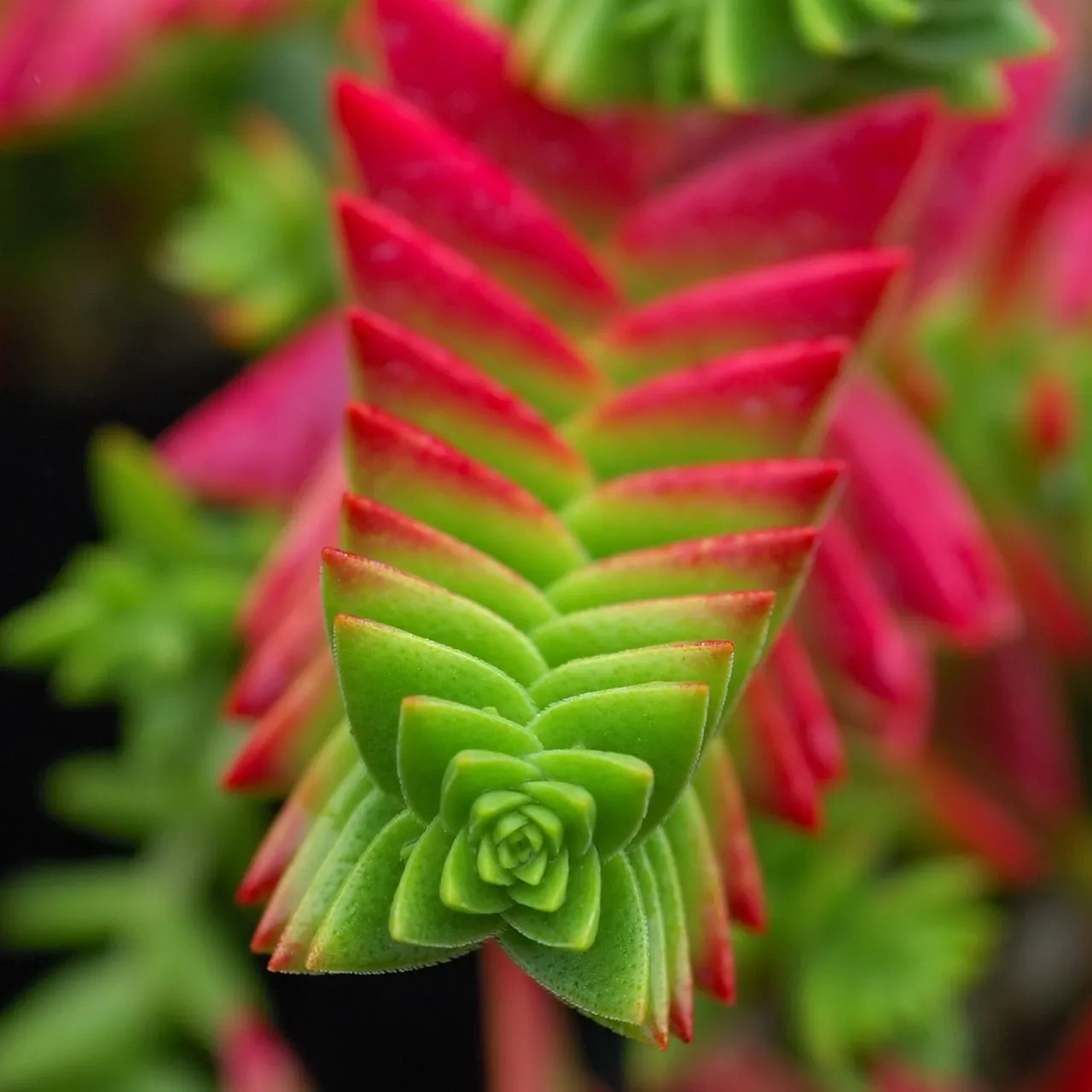
Crassula pangolin is a small southern-African leaf-succulent whose common name comes from its overlapping rhomboid leaves, which lie flat along short stems in a pattern reminiscent of pangolin scales. It is one of a tight group of miniature stacked Crassula favoured by specialist collectors.
Part of the Complete Crassula Guide.
Identification
- Compact branching habit, stems 5–15 cm tall, forming slow clumps.
- Leaves opposite decussate, 4–8 mm long, flattened rhomboid to almost diamond-shaped, grey-green with reddish-brown tips and margins.
- Leaves sit tightly appressed to the stem, giving the characteristic scaled appearance.
- Small white to cream stellate flowers in short terminal cymes, usually in spring.
The species can be confused with Crassula deltoidea and with miniature forms of C. rupestris, both of which share compact stacked habits. The diagnostic feature of C. pangolin is the combination of rhomboid flattened leaves (rather than the more rounded leaves of rupestris) with their tightly overlapping arrangement.
Kew's World Checklist records the name; taxonomic placement within the Crassula subgenus Pyramidella is stable.
Cultivation
The species is more demanding than a C. ovata but not difficult. Key points where it diverges from the pillar default:
- Substrate. Up to 75% mineral. Pumice and 3–5 mm grit with minimal organic matter. These stems rot quickly if the substrate stays damp.
- Pot. Small (6–9 cm) and shallow. A mature clump fits happily in a 10 cm pan. Oversized pots hold moisture longer than the roots can use it.
- Light. Very bright. Full sun with gradual acclimation outdoors in summer; supplemental lighting indoors in winter if natural light is poor. Leaf colour is a reliable indicator: good light produces deep grey-green foliage with red tips; poor light produces pale stretched stems and loss of the scaled appearance.
- Water. Sparse. Soak thoroughly when the substrate is bone-dry throughout, then let the pot dry out again. In summer this may be every 10–14 days; in winter every 4–6 weeks is enough.
- Temperature. Tolerates cool dry winters (5°C–10°C) well. Not frost hardy.
Propagation
Stem cuttings are straightforward. Snap a short piece off a healthy stem, let it callus for 5 days, and insert 1–2 cm into gritty mix. Roots appear within 3 weeks. The plant is so slow that even small cuttings produce visible growth only after several months; patience is the bigger requirement than technique.
Leaf propagation is not practical: the leaves are small and tightly appressed, and clean detachment without tearing is difficult. Division of mature clumps in spring is a reasonable alternative when you have a plant large enough to split.
Notes
Crassula pangolin is one of the species most often miskept as a desert plant that never needs water. It is a slow, drought-tolerant succulent, not an inert one. Plants watered once every two months in summer decline silently; the first sign is usually wrinkled basal leaves and arrested growth. A correctly watered plant adds one or two small leaf pairs per month at the stem tip in the growing season.
Mealybugs favour the overlapping leaf bases for the same reason they favour C. rupestris: the nooks between leaves are a comfortable refuge. Routine inspection with a hand lens at the start of each growing season catches infestations before they spread.
See also
- Crassula rupestris — larger stacked relative.
- Crassula socialis — mat-forming sibling in the miniature group.
- Crassula cephalophora — another compact species, similar culture.
- Crassula imperialis — close look-alike frequently circulating alongside pangolin in specialist collections.
Frequently Asked Questions
What light does this Crassula need?
Bright light is the default. Compact species and red-flushing cultivars need several hours of direct sun after gradual acclimation.
How should it be watered?
Water thoroughly, then allow the upper 3–4 cm of substrate to dry before watering again. In cool winter conditions, reduce watering sharply.
What substrate works best?
Use a free-draining mix with substantial pumice, grit, or perlite. Dense peat-heavy compost keeps the root zone wet too long.
How is it propagated?
Stem cuttings are the most reliable method for most Crassula. Leaf cuttings work on jade-type plants but are less useful for tight stacked miniatures.