| Question | Short Answer |
|---|---|
| What light does this Crassula need? | Bright light is the default. |
| How should it be watered? | Water thoroughly, then allow the upper 3–4 cm of substrate to dry before watering again. |
| What substrate works best? | Use a free-draining mix with substantial pumice, grit, or perlite. |
| How is it propagated? | Stem cuttings are the most reliable method for most Crassula. |
Crassula obvallata L. is a clump-forming rosette succulent native to the Eastern Cape and KwaZulu-Natal provinces of South Africa. It grows in rocky grassland and on dry slopes, forming dense low mats of basal rosettes from which short flowering stems rise in summer.
Part of the Complete Crassula Guide.
Identification
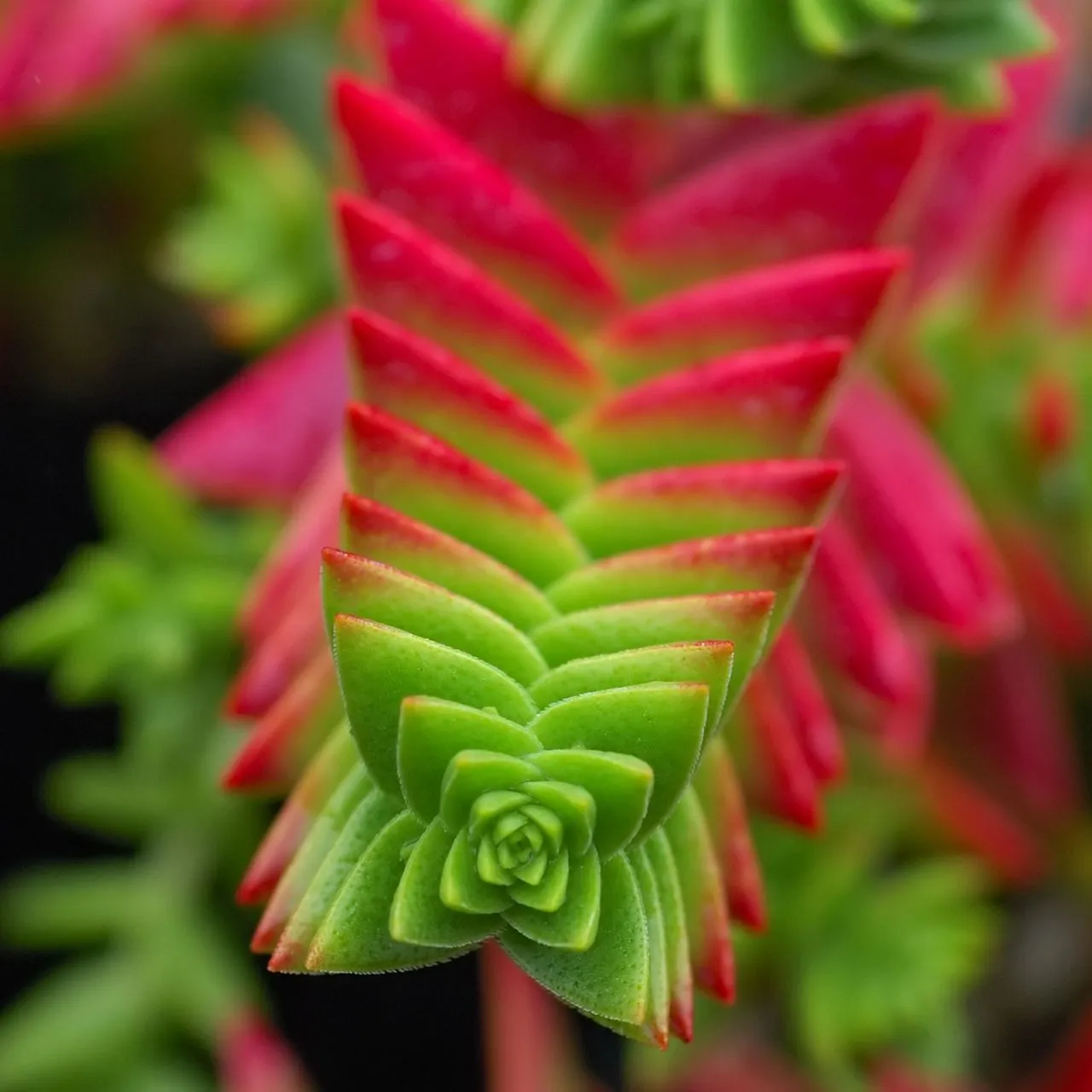
- Leaves. Ovate to obovate, 2–5 cm long, fleshy and slightly concave above. Arranged in compact rosettes at the soil surface, with new leaves added from the centre. Colour pale to mid-green, margins often tinged red in strong light.
- Rosettes. 5–10 cm across at maturity, forming tight clumps through short rhizomatous stolons. A single plant becomes a patch 20–30 cm across within 2–3 years.
- Inflorescence. A short upright scape 10–25 cm tall, bearing a dense rounded to flat-topped cluster of small white to cream star-shaped flowers. Produced in summer.
- Habit. Low mat-forming, clumping through stolons rather than through basal offsetting.
The species is less often seen in general succulent collections than the tree-form or stacked-column Crassulas, and is more a botanical-garden specimen than a houseplant. When it does appear it is usually mislabelled as "unnamed rosette Crassula".
Cultivation
Care follows the pillar defaults with adjustments for the mat-forming habit and grassland habitat.
Light: bright, with some direct sun. Tolerates slightly more shade than the miniatures or stacked-column species, but stays compact only in good light.
Substrate: the species tolerates a more moisture-retentive mix than the typical Crassula because its native grassland habitat includes seasonal rainfall rather than year-round drought. A 50/50 pumice and loam compost works well; pure mineral mixes are not necessary.
Water: moderate through spring and summer, reducing sharply in winter. The species experiences a cool dry winter rest in its native range and watering through cold winter weeks produces rot.
Minimum temperature 5 °C. Tolerates brief cold on dry tissue.
Propagation
Division is the easiest method. Lift a mature clump in spring, separate the individual rooted rosettes at the stolon, and pot each into a small gritty pan. Recovery is fast; new growth starts within 2–3 weeks.
Stem cuttings of the stolons also root readily. Seed is possible but slow, and offers no advantage over division.
Notes and Quirks
C. obvallata is sometimes treated as a synonym of Crassula lanceolata subsp. transvaalensis in modern African succulent literature, and the name's history is complicated. Plants labelled C. obvallata in the ornamental trade cover a range of closely related rosette-forming southern African species.
The flower clusters are the main ornamental feature and are large for the size of the rosette. A well-grown mature clump in full flower produces a carpet of white over several weeks in summer.
See also
- Crassula alpestris
- Crassula capitella
- Crassula muscosa
- Crassula socialis — another rosette-forming miniature, smaller and tighter in cushion habit.
Frequently Asked Questions
What light does this Crassula need?
Bright light is the default. Compact species and red-flushing cultivars need several hours of direct sun after gradual acclimation.
How should it be watered?
Water thoroughly, then allow the upper 3–4 cm of substrate to dry before watering again. In cool winter conditions, reduce watering sharply.
What substrate works best?
Use a free-draining mix with substantial pumice, grit, or perlite. Dense peat-heavy compost keeps the root zone wet too long.
How is it propagated?
Stem cuttings are the most reliable method for most Crassula. Leaf cuttings work on jade-type plants but are less useful for tight stacked miniatures.