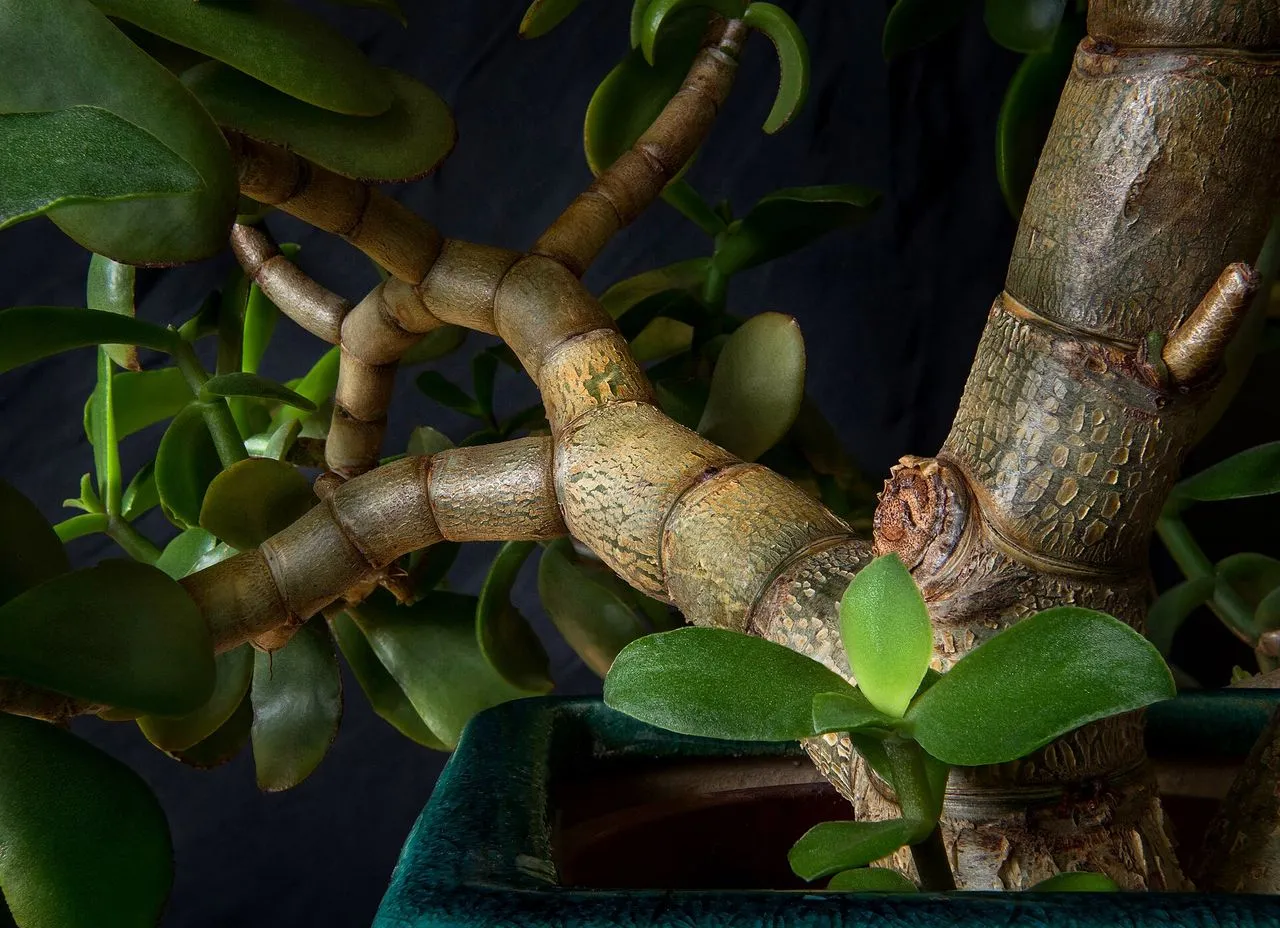
A leggy jade plant is showing a light problem. Crassula ovata is naturally shrubby, with opposite leaf pairs and a branching woody framework. When it receives enough light, the internodes stay short, leaves are thick, and the plant looks like a compact miniature tree. In insufficient light, stems lengthen, leaves space out, and branches lean toward the window.
The stretched growth cannot be compressed back into shape, but the plant can be reset. Correct the light first, then prune and root cuttings once new growth proves the plant has enough energy to respond. Part of the Complete Crassula Guide.
Low light and etiolation
Etiolation is the main cause of legginess. In low light, a jade extends its stems to search for better exposure. Internodes that should be tight become 2–6 cm apart, leaves get thinner, and the newest growth may be pale green instead of deep glossy green. The plant often leans because the brightest light arrives from one side of a window.
Watering changes cannot solve this. A jade in shade may stay alive for years, but it will not build the stout branching structure that makes the species attractive. Indoor plants need the brightest window available, usually south or west in the northern hemisphere, or a strong LED positioned close enough to deliver useful intensity for 12–14 hours a day.
Warm winter growth
Jade plants stretch especially badly when kept warm, watered generously, and under-lit during winter. The plant remains metabolically active because the room is 18–22 °C, but daylight is short and weak. The result is soft winter growth with long internodes and leaves that are poorly equipped for stronger summer light.
The prevention is seasonal restraint. In winter, keep the plant bright, cool if possible, and only lightly watered after the upper substrate has dried. Do not feed in midwinter unless the plant is under strong artificial light. Growth made at 10–15 °C in bright conditions is slower but denser than growth forced warm in shade.
Overfeeding under weak light
Fertiliser can worsen a leggy jade when light is limiting. Nitrogen encourages leaf and stem expansion, but the plant cannot build strong compact tissue without enough photosynthetic energy. The result is large soft leaves, floppy stems, and long gaps between leaf pairs. This is common in plants grown in rich houseplant compost and fed on the same schedule as tropical foliage plants.
Jade plants need modest nutrition. In a mineral mix, feeding once a month during active spring and summer growth at 25–50% label strength is enough. In compost-rich mixes, even less is needed. If a jade is stretching, stop feeding until light improves and new internodes are short.
Crowded windows and one-sided growth
Even a bright windowsill can produce legginess if the plant is shaded by blinds, curtains, other plants, or its own canopy. Jade branches grow toward the strongest light and abandon shaded lower leaves. A plant pressed against glass may have one compact sun-facing side and one sparse interior side.
Rotation helps, but it is not a substitute for adequate light. Turn the pot a quarter rotation every 1–2 weeks during active growth. Prune crossing branches that shade the centre. Keep neighbouring plants far enough away that the jade receives direct light on most branch tips, not just on the outermost leaves.
Pot size and unstable top growth
An oversized pot does not directly cause legginess, but it contributes to weak structure by keeping the root zone wet too long. A plant in a large heavy container may grow soft upper shoots while fine roots sit in cool damp compost. The canopy becomes top-heavy, branches bend, and lower leaves drop.
Use a pot only 2–4 cm wider than the root ball. A slightly snug pot is not a problem for C. ovata and is often preferred for bonsai-style shaping. The goal is not to starve the plant, but to keep the root zone drying predictably so growth is firm rather than lush and weak.
How to identify legginess
| Symptom | Meaning | Action |
|---|---|---|
| Internodes longer than 2–3 cm | Light is inadequate for compact growth | Increase light before pruning |
| Pale, thin, widely spaced leaves | Etiolation | Move to brighter window or LED |
| Branches leaning to one side | One-directional light | Rotate and improve exposure |
| Soft fast growth after feeding | Too much nitrogen for available light | Stop feeding temporarily |
| Bare lower stems with compact tips | Old shade damage plus improved light | Prune in stages after recovery |
Do not judge by height alone. A large old jade can be tall and still healthy if branches are stout and internodes are short. Legginess is spacing, weakness, and directionality.
Risk and severity
Legginess is not immediately fatal, but it increases future risk. Long weak stems break easily, shade their own lower leaves, and hold leaves farther from the trunk, making the plant top-heavy. A severely stretched jade in a wet pot is also more likely to rot because it is receiving too little light to use water efficiently.
Act soon when stems are bending, the plant cannot stand without support, or leaves are dropping from shaded lower branches. Wait to prune if the plant is pale, recently moved, or dormant; pruning works best when temperatures are 18–25 °C and the plant has started compact new growth. Professional help is unnecessary unless the plant is a mature bonsai specimen needing structural redesign.
Solutions
Improve light first
Move the jade to the brightest practical position. A south or west window is the default indoor target; outdoors, use morning sun first and acclimate over 10–14 days. If natural light is poor, use an LED grow light for 12–14 hours daily. Place it close enough that new growth shortens, but not so close that leaves bleach or overheat.
Wait for compact growth
Do not cut immediately after moving a weak jade. Let it produce at least one or two new compact leaf pairs. This confirms the new light is adequate and gives the plant energy reserves for back-budding. During this period, water only when the top 3–4 cm of substrate is dry.
Prune stretched stems
Cut leggy branches just above a leaf pair or visible node using clean bypass secateurs. Shorten each branch to the framework you want, usually leaving two or three leaf pairs on young branches. Large reshaping is safer in stages: remove no more than one third of the canopy at a time, then wait 4–8 weeks for new shoots.
Root the cuttings
Healthy leggy tips can become new plants. Take 5–10 cm cuttings, strip the lower leaves, let the cut end callus for 5–10 days in dry shade, then insert 2 cm into gritty substrate. Keep bright but out of harsh sun until roots form.
Prevention
Keep jade plants close to the light source, not across the room from a window. Rotate regularly, avoid winter feeding in weak light, and water less during low-light months. Prune annually in spring to maintain a branching framework: cut back to a leaf pair where you want new branches. Use mineral substrate and a correctly sized pot so the plant can dry within 5–10 days in active growth. A jade maintained this way becomes thicker and more tree-like each year instead of longer and weaker.
See also
- Crassula bonsai — pruning and shaping principles for jade plants.
- South vs east vs west window — choosing indoor light for succulents.
- Stem cutting method — rooting pruned jade stems safely.
- Crassula ovata — species profile with the compact, branching growth form a well-lit jade develops.
Frequently Asked Questions
Can a leggy jade plant become compact again?
New growth can become compact once light improves, but stretched internodes will not shorten. Prune or propagate the leggy sections after the plant is growing strongly.
Where should I cut a leggy jade plant?
Cut just above a healthy leaf pair or node. Jade plants back-bud from nodes below the cut when light and temperature are adequate.
Does fertiliser fix a leggy jade?
No. Fertiliser in low light usually makes growth softer and longer. Correct light first, then feed lightly during active growth if needed.
How much light does a jade plant need indoors?
A south or west window is best indoors, with 5–6 hours of bright light. East windows can work for survival but often produce looser growth.