| Question | Short Answer |
|---|---|
| What light does this Crassula need? | Bright light is the default. |
| How should it be watered? | Water thoroughly, then allow the upper 3–4 cm of substrate to dry before watering again. |
| What substrate works best? | Use a free-draining mix with substantial pumice, grit, or perlite. |
| How is it propagated? | Stem cuttings are the most reliable method for most Crassula. |
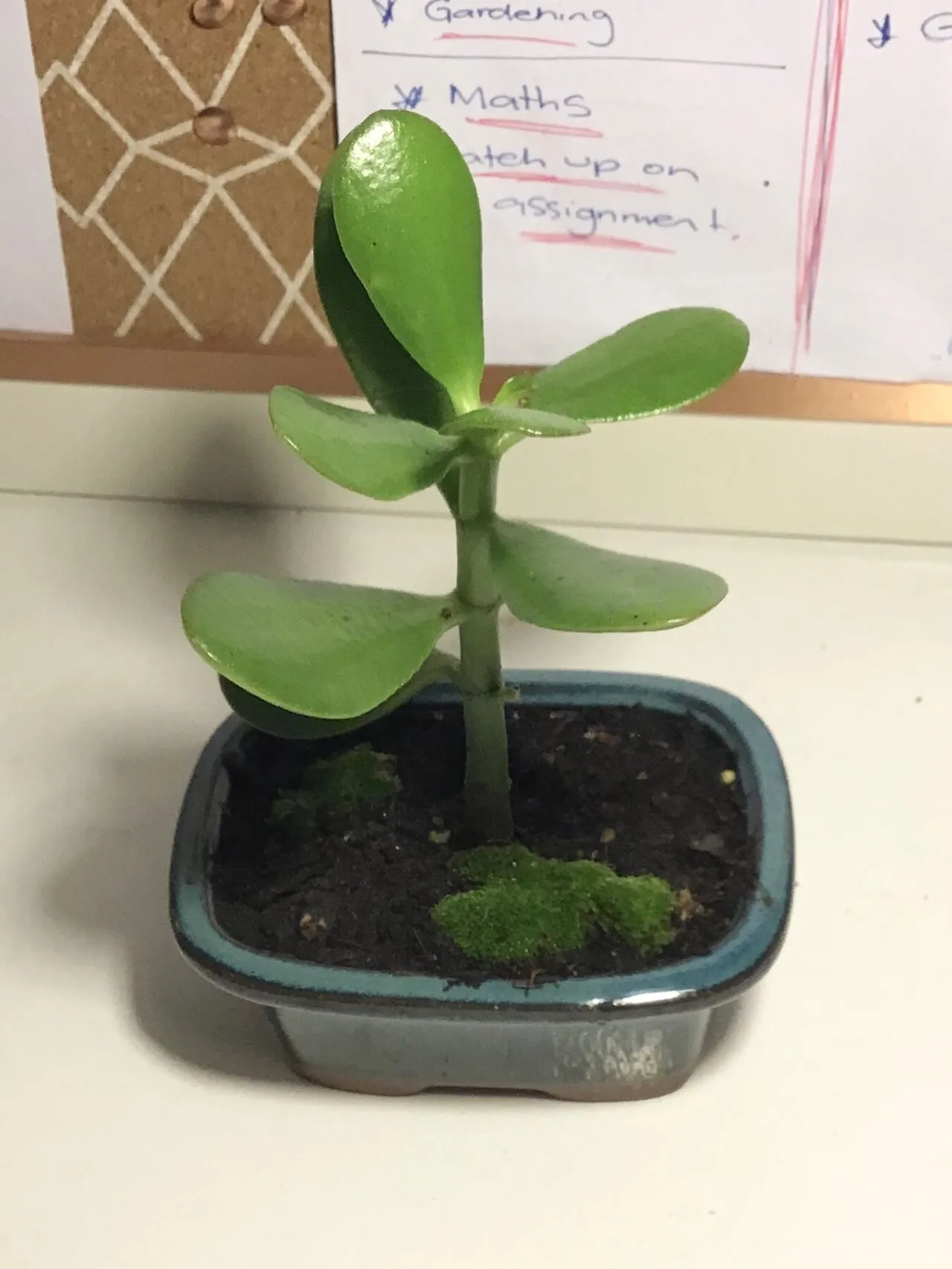
Crassula ovata (the jade plant) is the most commonly trained succulent bonsai, and with reason: its natural growth form already mimics a deciduous tree in miniature, its trunk thickens noticeably within a few years of regular pruning, and wounds heal cleanly. A jade bonsai can progress from a rooted cutting to a convincing tree-form specimen in five to seven years with modest effort.
Part of the Complete Crassula Guide.
Why Jade Is Different From Traditional Bonsai Subjects
Most bonsai theory is built around woody trees with narrow vascular tissue: maples, pines, elms. C. ovata is a leaf succulent with soft, water-filled stems that lignify only with age. Several standard bonsai practices either do not apply or need adjustment.
- Wiring is limited. Wire pressed into a succulent stem scars permanently and often kills the branch. Use wire only on mature, lignified stems (brown bark, visible woodiness), and only for a season or two before removal. For green stems, use directional pruning instead.
- Leaf reduction does not work the usual way. Jade leaves are fleshy and their size is determined more by water and feeding than by defoliation. Do not defoliate as you would a maple.
- The plant is not frost-hardy. Unlike a temperate bonsai, a jade bonsai cannot winter outdoors in most temperate climates. Keep it above 5°C year-round.
Style Selection
The natural growth of C. ovata suits informal upright, slanting, and clump styles. Tight formal upright shapes are achievable but require patience, since the trunk will not produce the rigid straight leader of a pine or spruce without multiple seasons of corrective pruning.
The cultivars 'Gollum' and 'Hobbit' are also trainable as bonsai, with the added visual interest of tubular leaves. They grow a little slower than the standard form but respond to the same techniques.
The Pruning Cycle
Prune in spring as the plant resumes active growth, and again in early autumn for a second flush if conditions are still warm. The rule:
- Identify the branches you want to keep.
- Shorten each new shoot back to 2–3 leaf pairs from the parent stem. Cut with clean bypass secateurs just above a leaf pair.
- Remove entirely any branches crossing the trunk, growing into the canopy centre, or sprouting below the intended nebari (root flare).
Jade back-buds vigorously from pruned nodes. A shoot cut back to two leaf pairs usually produces two new shoots from the remaining axils within a month, and these can themselves be shortened in the next cycle. This is how the ramification (fine branch structure) of a jade bonsai is built.
Trunk Thickening
The fastest way to thicken the trunk is to let the plant grow aggressively with minimal pruning for one or two seasons, then cut back hard. The unchecked foliage drives trunk expansion, and each hard prune-back resets the canopy to a proportion appropriate for the thicker trunk. This is called "sacrifice branch" pruning and is the same principle used with many woody bonsai subjects.
Expect 1–2 cm of trunk thickening per year in active growth on a healthy plant in a larger pot. Trunk growth effectively stops in a small pot regardless of feeding.
Substrate and Pot
Use a fast-draining bonsai mix with at least 60% mineral component: akadama, pumice, and small grit in roughly equal parts works well. Pure akadama holds too much water for C. ovata and can cause winter root rot.
Move to a bonsai pot once the tree has reached its intended trunk girth and ramification. Pot depth should be slightly more than half the trunk caliper at the base, with generous drainage holes.
Watering and Feeding
Water thoroughly when the substrate is dry 3 cm down. In full growth this may be every 3–4 days outdoors in summer; in winter as infrequently as once every 4 weeks if kept cool. Feed with a balanced liquid fertiliser at half strength every 3–4 weeks during spring and summer only. Stop feeding by early autumn to harden off growth for winter.
Wiring
If you must wire, use aluminium bonsai wire on lignified stems only, and check weekly. Jade stems expand quickly and wire left on for even a month can scar permanently. Remove wire as soon as the bend is set.
Common Problems
Black rot at the base after heavy winter watering is the most common failure of attempted jade bonsai. The fix is to lift the tree, cut well above the rot, and re-root the top as a large cutting. The lost work is painful but the tree is usually salvageable.
See also
- Crassula ovata — parent species.
- Gollum Crassula — tubular-leaved cultivar also used as bonsai.
- Crassula arborescens — silver-leaved alternative bonsai subject.
- Jade Plant Leggy — what low light does to a jade kept without the pruning and bright conditions bonsai training requires.
Frequently Asked Questions
What light does this Crassula need?
Bright light is the default. Compact species and red-flushing cultivars need several hours of direct sun after gradual acclimation.
How should it be watered?
Water thoroughly, then allow the upper 3–4 cm of substrate to dry before watering again. In cool winter conditions, reduce watering sharply.
What substrate works best?
Use a free-draining mix with substantial pumice, grit, or perlite. Dense peat-heavy compost keeps the root zone wet too long.
How is it propagated?
Stem cuttings are the most reliable method for most Crassula. Leaf cuttings work on jade-type plants but are less useful for tight stacked miniatures.