| Question | Short Answer |
|---|---|
| What light does this Crassula need? | Bright light is the default. |
| How should it be watered? | Water thoroughly, then allow the upper 3–4 cm of substrate to dry before watering again. |
| What substrate works best? | Use a free-draining mix with substantial pumice, grit, or perlite. |
| How is it propagated? | Stem cuttings are the most reliable method for most Crassula. |
Crassula arborescens (Mill.) Willd., the silver dollar jade or silver jade plant, is a shrubby succulent endemic to the Western Cape of South Africa, where it grows on rocky quartzite slopes in karroid scrub at low altitudes. It is the less common cousin of Crassula ovata and one of the most striking large-leaved species in the genus.
Part of the Complete Crassula Guide.
Identification
The silver dollar jade is easy to separate from a standard jade once you know what to look for.
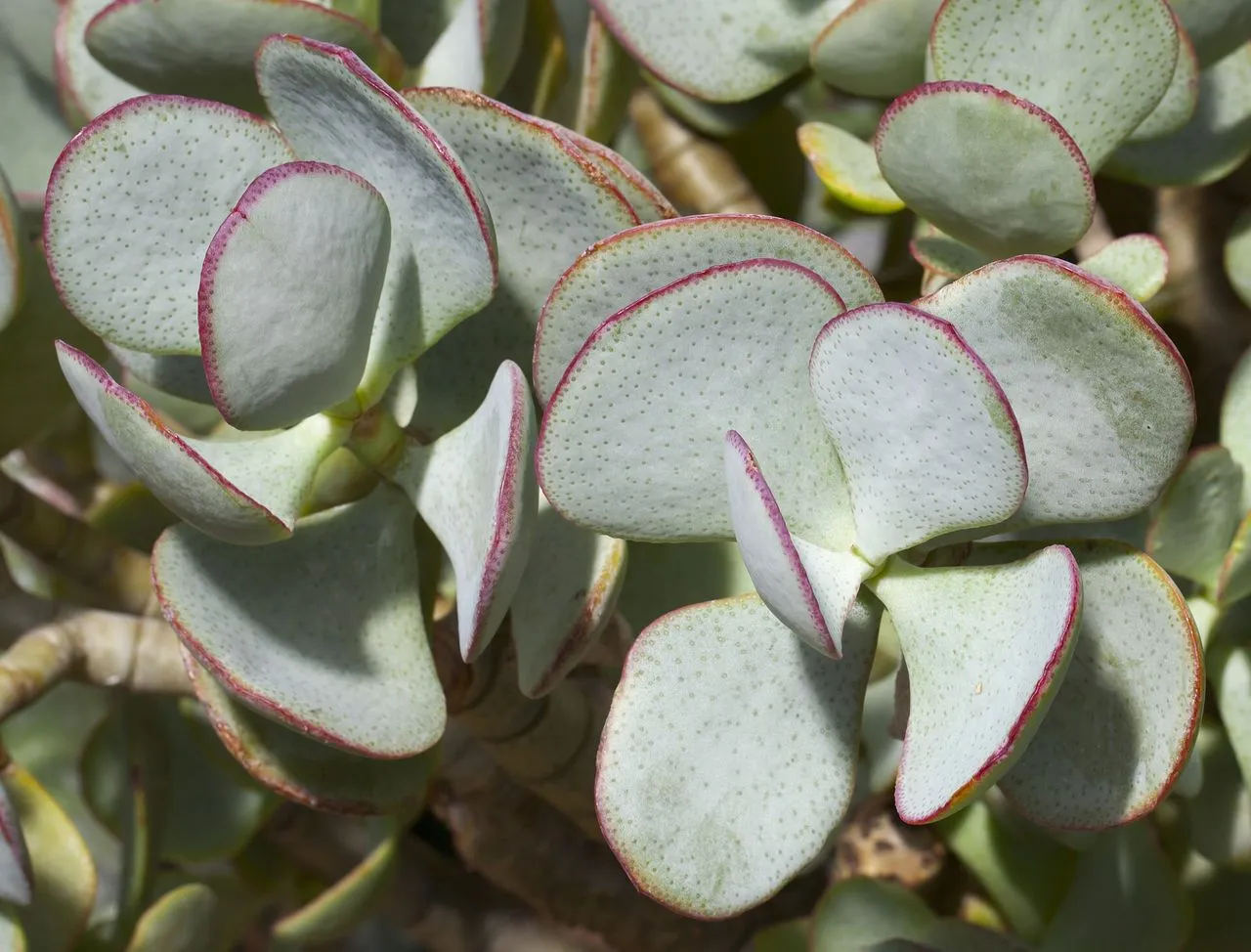
- Leaves. Almost perfectly circular, 3–5 cm across, much flatter than the obovate leaves of C. ovata. The surface is a pale blue-grey with a fine waxy bloom, often speckled with faint red dots on the upper face, and bordered with a sharp red margin in strong light.
- Stems. Thick, pale grey-green when young, brown and corky with age. Branches are stout and more rigid than those of C. ovata.
- Habit. A branching shrub eventually reaching 1–1.5 m in cultivation, slower-growing than the common jade.
- Flowers. Small star-shaped white to pale pink flowers in rounded clusters, produced on mature plants in winter. Indoor specimens flower rarely.
Two subspecies are usually recognised. C. arborescens subsp. arborescens has the rounded blue leaves described above. Subsp. undulatifolia has narrower, slightly wavy leaves with a more intense silver cast and is the form most often sold as "Ripple Jade".
Cultivation
Care matches the pillar defaults closely, with one worthwhile divergence: C. arborescens needs even more light than a standard jade to hold its silver cast. In shade the leaves revert toward a muddy green and the red margin disappears. Outdoor summer culture in full sun or a south-facing windowsill with supplementary lighting in winter are the two reliable options.
Substrate should be firmly on the mineral side, roughly 60–70% pumice or coarse grit. Heavy peat-rich mixes that a C. ovata tolerates will rot the roots of arborescens in a wet winter. Water less often than for the common jade, and not at all at temperatures below 8 °C. Minimum 5 °C, but the plant is happier kept above 8 °C in winter.
Propagation
Leaf and stem cuttings work, though leaf propagation is slower than for C. ovata. Stem cuttings of 8–10 cm, callused for a week and inserted into dry gritty mix, root reliably in spring and early summer. The subsp. undulatifolia ("Ripple Jade") is generally propagated only by cutting to preserve the wavy leaf form, which does not always come true from leaf.
Notes and Quirks
The leaf coating that gives this species its silver colour is a layer of epicuticular wax, not paint or powder, and it is fragile. Avoid rubbing the leaves; once the wax is removed from a leaf it does not regrow, and the leaf stays green until senescence.
Like C. ovata, C. arborescens is listed as toxic to cats and dogs by the ASPCA.
See also
- Crassula ovata
- Crassula ovata 'Gollum'
- Crassula 'Moonglow'
- Crassula bonsai — techniques for shaping tree-form jade and silver jade as miniature specimens.
Frequently Asked Questions
What light does this Crassula need?
Bright light is the default. Compact species and red-flushing cultivars need several hours of direct sun after gradual acclimation.
How should it be watered?
Water thoroughly, then allow the upper 3–4 cm of substrate to dry before watering again. In cool winter conditions, reduce watering sharply.
What substrate works best?
Use a free-draining mix with substantial pumice, grit, or perlite. Dense peat-heavy compost keeps the root zone wet too long.
How is it propagated?
Stem cuttings are the most reliable method for most Crassula. Leaf cuttings work on jade-type plants but are less useful for tight stacked miniatures.