| Question | Short Answer |
|---|---|
| What light does this Crassula need? | Bright light is the default. |
| How should it be watered? | Water thoroughly, then allow the upper 3–4 cm of substrate to dry before watering again. |
| What substrate works best? | Use a free-draining mix with substantial pumice, grit, or perlite. |
| How is it propagated? | Stem cuttings are the most reliable method for most Crassula. |
Crassula ovata (Mill.) Druce, the jade plant, money plant, or money tree, is the single most widely cultivated succulent in the world. It is a branching, evergreen shrub native to KwaZulu-Natal and the Eastern Cape of South Africa, where it grows on rocky hillsides and in thicket vegetation alongside Portulacaria afra. Older garden names Crassula portulacea and Crassula argentea both refer to this species and are treated as synonyms under current Kew taxonomy.
Part of the Complete Crassula Guide.
Identification
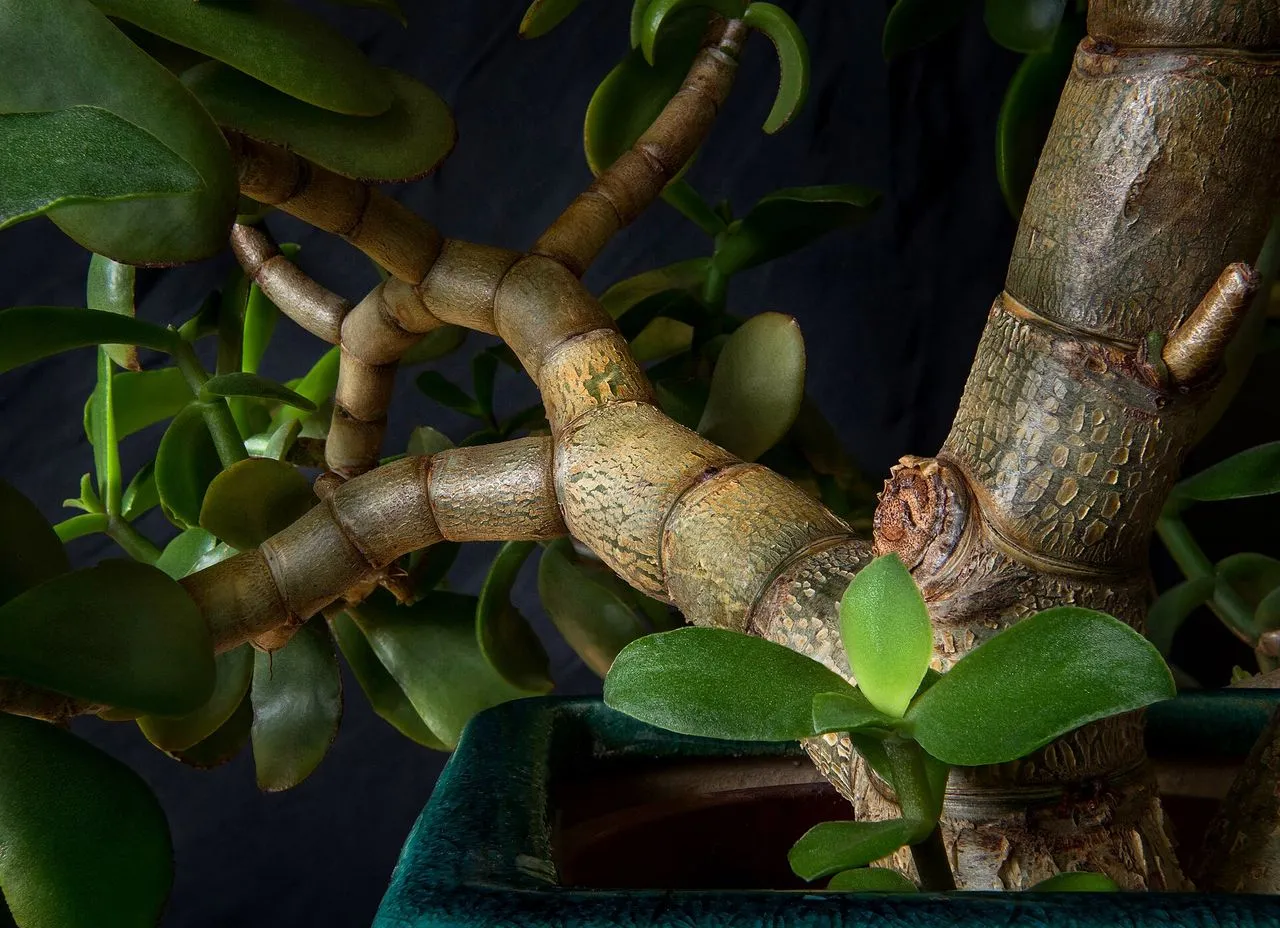
A mature specimen looks unmistakably tree-like: a stout brown trunk, smooth pale-grey bark that flakes in papery patches on older wood, and a rounded crown of thick, glossy, obovate leaves.
- Leaves. 3–7 cm long, fleshy, ovate to obovate, entire-margined, arranged in opposite decussate pairs. Dark glossy green in average light; margins flush red in strong sun from accumulated anthocyanin.
- Stems. Young stems are green and herbaceous; within a season or two they lignify and develop the characteristic thick grey-brown bark. The trunk thickens surprisingly fast under regular pruning.
- Flowers. Small star-shaped white to pale pink flowers in dense corymbose cymes, carried at branch tips from late autumn through midwinter in mature plants. Flowering requires a cool dry rest and is uncommon on indoor specimens kept warm year-round.
- Habit. Shrubby to small-tree, eventually 1–2 m tall in containers, taller in the ground in frost-free climates.
Confusion is mostly with Crassula arborescens (silver dollar jade), which has almost circular blue-grey leaves with a distinct red rim and darker red dotting on the leaf face. Portulacaria afra (elephant bush) is often mis-sold as jade but has much smaller leaves, a reddish-brown stem, and alternate leaf arrangement rather than decussate.
Cultivation
Treat C. ovata as the baseline for everything in the pillar guide; it is the species the pillar's defaults are written around. Bright light, free-draining mineral substrate, water when the top 3–4 cm reads dry, minimum 5 °C. In practice it is more forgiving than most of its relatives: it tolerates heavier compost mixes, recovers from short periods of neglect, and does not sulk after repotting.
Two things to watch specifically for C. ovata:
Light drives leaf colour and compactness. A jade plant with dull all-green leaves and long pale internodes is chronically under-lit. The solution is a brighter window or supplementary LED, not a different watering regime.
Winter rot is the usual cause of sudden death. Water sparingly from November to February, avoid cold draughts, and never let the pot sit in a saucer of standing water at temperatures below 10 °C.
Propagation
C. ovata is among the easiest succulents to propagate.
Leaf propagation works well: twist a healthy leaf off with its base intact, callus 3–7 days in shade, lay on damp gritty mix, and expect plantlets in 2–4 weeks.
Stem cuttings root even faster. A 5–10 cm tip cutting, lower leaves stripped, callused for 5–10 days, then inserted 2 cm into gritty mix will root within a month. Water propagation works too, an oddity for a succulent; the plant produces fine white roots in a glass of water in 2–3 weeks and transitions to mineral substrate if hardened off slowly.
Notes and Quirks
C. ovata is the default bonsai succulent. It back-buds strongly on cuts made just above a leaf pair, its trunk thickens quickly, and its natural habit already suggests a deciduous tree in miniature. Five years of disciplined spring pruning produces a convincing tree-form specimen.
Sap and leaves are listed as toxic to cats, dogs, and horses by the ASPCA, causing vomiting and ataxia. The toxin has not been fully characterised but the effect is well-documented. Keep out of reach of pets.
Several fixed mutations and selections of C. ovata exist as named cultivars, most famously 'Gollum' and 'Hobbit' with tubular leaves, and 'Hummel's Sunset' with golden-red variegation.
See also
Frequently Asked Questions
What light does this Crassula need?
Bright light is the default. Compact species and red-flushing cultivars need several hours of direct sun after gradual acclimation.
How should it be watered?
Water thoroughly, then allow the upper 3–4 cm of substrate to dry before watering again. In cool winter conditions, reduce watering sharply.
What substrate works best?
Use a free-draining mix with substantial pumice, grit, or perlite. Dense peat-heavy compost keeps the root zone wet too long.
How is it propagated?
Stem cuttings are the most reliable method for most Crassula. Leaf cuttings work on jade-type plants but are less useful for tight stacked miniatures.