| Question | Short Answer |
|---|---|
| What light does this Crassula need? | Bright light is the default. |
| How should it be watered? | Water thoroughly, then allow the upper 3–4 cm of substrate to dry before watering again. |
| What substrate works best? | Use a free-draining mix with substantial pumice, grit, or perlite. |
| How is it propagated? | Stem cuttings are the most reliable method for most Crassula. |
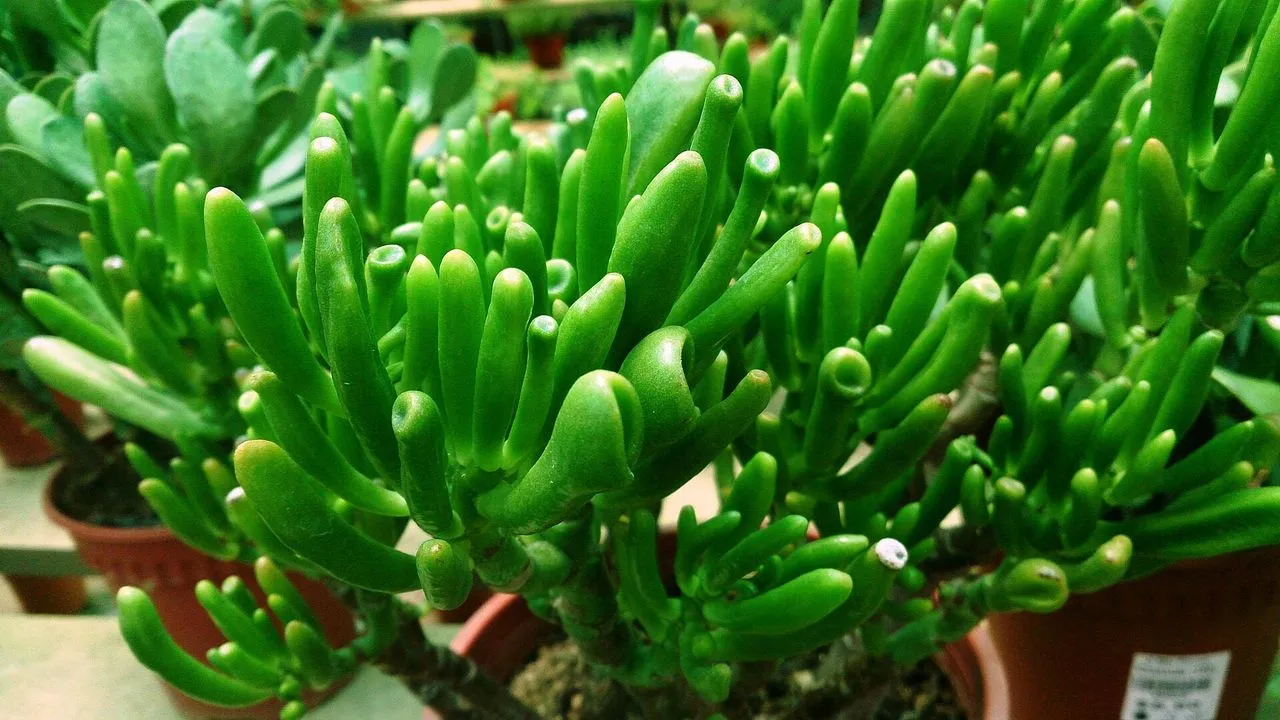
Crassula ovata 'Gollum' is a fixed tubular-leaved mutation of the jade plant, sometimes sold as the "finger jade," "Shrek's ears," or "ET's fingers." Its leaves form narrow green tubes with a flared, reddish, funnel-shaped tip, rather than the flat ovals of typical C. ovata. The cultivar is clonal and stable; plants grown from cuttings keep the form, and occasional reverted flat-leaved branches are the main maintenance issue.
Part of the Complete Crassula Guide.
Origin
'Gollum' is thought to have arisen as a sport of C. ovata in Californian collections in the mid-20th century, and its close relative 'Hobbit' (with partially curled rather than fully tubular leaves) arose from the same lineage around the same period. Both are now produced in volume for the houseplant trade, and you will find them in nearly every large garden centre.
Identification
- Woody trunk and branches identical to standard C. ovata; stems become gnarled and thickened with age.
- Leaves fleshy, 3–5 cm long, tubular along most of their length, opening out at the tip into a shallow funnel 1–2 cm across. The interior of the funnel flushes reddish in strong light.
- Opposite decussate leaf arrangement as in all Crassula.
- Flowers (when they appear on mature plants) are identical to typical C. ovata: small pinkish-white stars in dense terminal clusters in winter.
'Gollum' differs from 'Hobbit' mainly in the degree of leaf curling. 'Gollum' leaves are fully rolled into tubes; 'Hobbit' leaves are curled lengthwise but open along one side. A plant with both forms on the same specimen is chimeric and will usually stabilise to whichever form is dominant in the apical meristem.
Cultivation
Identical to standard C. ovata. The default pillar regime works without modification:
- Bright light, including direct sun for at least 4–5 hours a day.
- Free-draining mineral mix (50% pumice or perlite, 30% grit, 20% loam-based compost).
- Water thoroughly when the top 3 cm of substrate is dry; reduce sharply in winter.
- Protect from frost; 5°C lower limit.
The tubular leaves are slightly less efficient at photosynthesis per unit leaf mass than flat leaves, so 'Gollum' grows a little slower than a standard jade. In practice this is barely noticeable.
Propagation
Stem cuttings root as easily as on standard C. ovata. Take a 5–10 cm shoot in the growing season, strip the lower leaves, callus for 5–10 days, and insert into gritty substrate. Roots appear in 2–3 weeks.
Leaf propagation works and produces plantlets with tubular leaves from the start, confirming that the tubular-leaf trait is encoded in the vegetative cells and not only in the apical meristem. Success rate is similar to standard ovata: 60–80% of leaves eventually produce plantlets.
Water-rooting cuttings in a jar is also practical and a common casual propagation method for this cultivar.
Maintenance and Reversion
Occasional shoots on a 'Gollum' plant throw flat C. ovata-type leaves instead of tubes. This is a reversion of the chimera toward the parental form. Prune these branches out at the base as soon as they appear; left in place, the vigorous flat-leaved tissue eventually dominates and the plant loses its cultivar form.
Keep plants in good light and avoid heavy nitrogen feeding, both of which encourage reversions.
Notes
'Gollum' is a durable bonsai subject. The tubular leaves maintain miniature-scale appearance better than flat jade leaves on a small tree, and the trunk thickens at the usual jade-plant rate under regular pruning. See the Crassula bonsai page for shaping technique.
ASPCA toxicity applies as to all C. ovata: toxic to cats, dogs, and horses. Place out of reach of pets.
See also
- Crassula ovata — the parent species.
- Crassula bonsai — shaping technique applicable to 'Gollum'.
- Variegated Crassula — for readers after other fixed jade mutations.
Frequently Asked Questions
What light does this Crassula need?
Bright light is the default. Compact species and red-flushing cultivars need several hours of direct sun after gradual acclimation.
How should it be watered?
Water thoroughly, then allow the upper 3–4 cm of substrate to dry before watering again. In cool winter conditions, reduce watering sharply.
What substrate works best?
Use a free-draining mix with substantial pumice, grit, or perlite. Dense peat-heavy compost keeps the root zone wet too long.
How is it propagated?
Stem cuttings are the most reliable method for most Crassula. Leaf cuttings work on jade-type plants but are less useful for tight stacked miniatures.