| Question | Short Answer |
|---|---|
| What light does this Crassula need? | Bright light is the default. |
| How should it be watered? | Water thoroughly, then allow the upper 3–4 cm of substrate to dry before watering again. |
| What substrate works best? | Use a free-draining mix with substantial pumice, grit, or perlite. |
| How is it propagated? | Stem cuttings are the most reliable method for most Crassula. |
Crassula rupestris Thunb. is a column-forming succulent native to the Western Cape and southern Namibia. It grows on rocky cliff faces and in crevices in arid scrub, often alongside C. perforata but distinguishable by its thicker stems and more rounded fused leaves. Common names include buttons on a string, rosary vine, and bead vine.
Part of the Complete Crassula Guide.
Identification
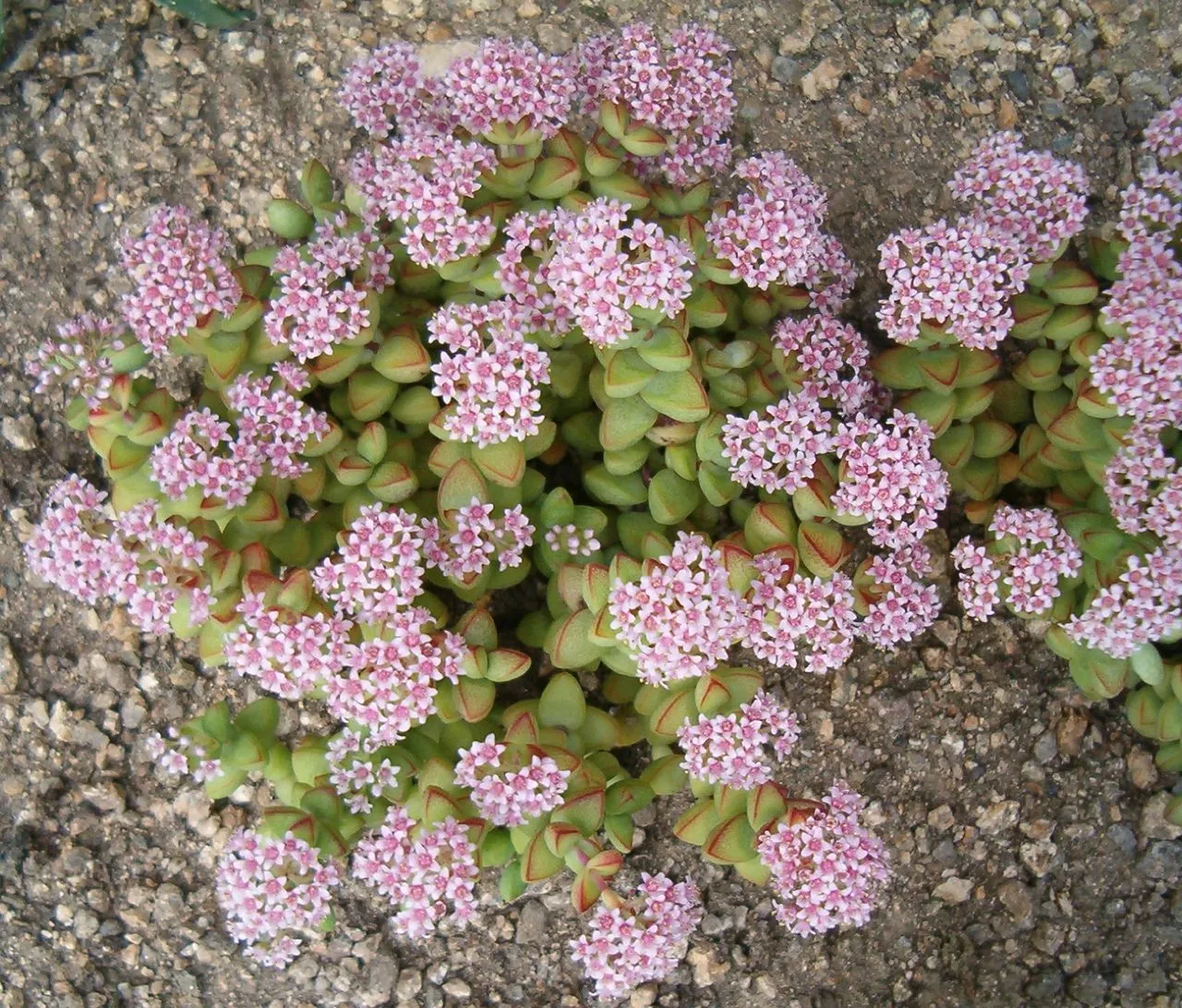
- Leaves. Ovate to rhombic, 1–2 cm long and wide, thick and fleshy, fused at the base around the stem. The fused bases create the appearance of beads strung on a wire. Colour blue-grey with a waxy bloom; margins and tips flush pink to red in strong light.
- Stems. Thicker and more rigid than C. perforata, 20–50 cm long, upright when young and lax with age. Mature stems lignify and turn grey-brown at the base.
- Flowers. Small star-shaped cream to pale pink flowers in flat-topped clusters at the stem tips, produced in winter.
- Habit. Upright to semi-sprawling shrublet, branching freely from the base, eventually forming a dense mounding clump.
Several subspecies are recognised, most notably C. rupestris subsp. commutata (formerly C. commutata), C. rupestris subsp. marnieriana, and the popular horticultural form 'Baby's Necklace' with tightly stacked pink-edged leaves.
Cultivation
Cultivation matches the pillar defaults closely.
Light: bright, with direct sun for at least part of the day. Full summer sun produces the most compact growth and strongest leaf colour. In low light the stems stretch, leaves separate, and the plant loses its signature beaded look.
Substrate: standard gritty mineral mix, around 60% pumice plus 40% loam compost. C. rupestris tolerates slightly heavier substrate than the smaller column-formers but is not as forgiving as C. ovata.
Water: let the substrate dry fully between soakings in the growing season. Reduce sharply in winter, when the species does most of its flowering and is otherwise near-dormant.
Minimum 5 °C. The plant tolerates brief cold on dry tissue but rots quickly if frozen wet.
Propagation
Stem cuttings root reliably. Take a 5–10 cm section, callus for a week, and insert into dry gritty mix; roots form within 2–3 weeks. C. rupestris also strikes well from loose leaves, though the fused-pair leaves must be separated carefully without damaging the basal connection.
The "shake a cutting in a tray of grit" trick described in the pillar guide works especially well for this species: one stem section plus its shed leaves produces an entire pot of plantlets within 2–3 months.
Notes and Quirks
C. rupestris and C. perforata are routinely confused in the trade. The structural difference is straightforward: C. rupestris has truly fused leaves (the pair wraps around the stem and meets on the far side) while C. perforata has leaves that are merely joined at their bases without wrapping. Stem thickness also differs; rupestris has stems about twice the diameter of perforata.
The cultivar 'Baby's Necklace' is a selection with especially compact tightly-packed leaves and pink margins, and is worth seeking out in preference to generic labelled stock.
See also
- Crassula perforata
- Crassula pagoda
- Crassula muscosa
- Crassula spiralis — closely related and often confused with C. rupestris forms in the trade.
Frequently Asked Questions
What light does this Crassula need?
Bright light is the default. Compact species and red-flushing cultivars need several hours of direct sun after gradual acclimation.
How should it be watered?
Water thoroughly, then allow the upper 3–4 cm of substrate to dry before watering again. In cool winter conditions, reduce watering sharply.
What substrate works best?
Use a free-draining mix with substantial pumice, grit, or perlite. Dense peat-heavy compost keeps the root zone wet too long.
How is it propagated?
Stem cuttings are the most reliable method for most Crassula. Leaf cuttings work on jade-type plants but are less useful for tight stacked miniatures.