| Question | Short Answer |
|---|---|
| What light does this Crassula need? | Bright light is the default. |
| How should it be watered? | Water thoroughly, then allow the upper 3–4 cm of substrate to dry before watering again. |
| What substrate works best? | Use a free-draining mix with substantial pumice, grit, or perlite. |
| How is it propagated? | Stem cuttings are the most reliable method for most Crassula. |
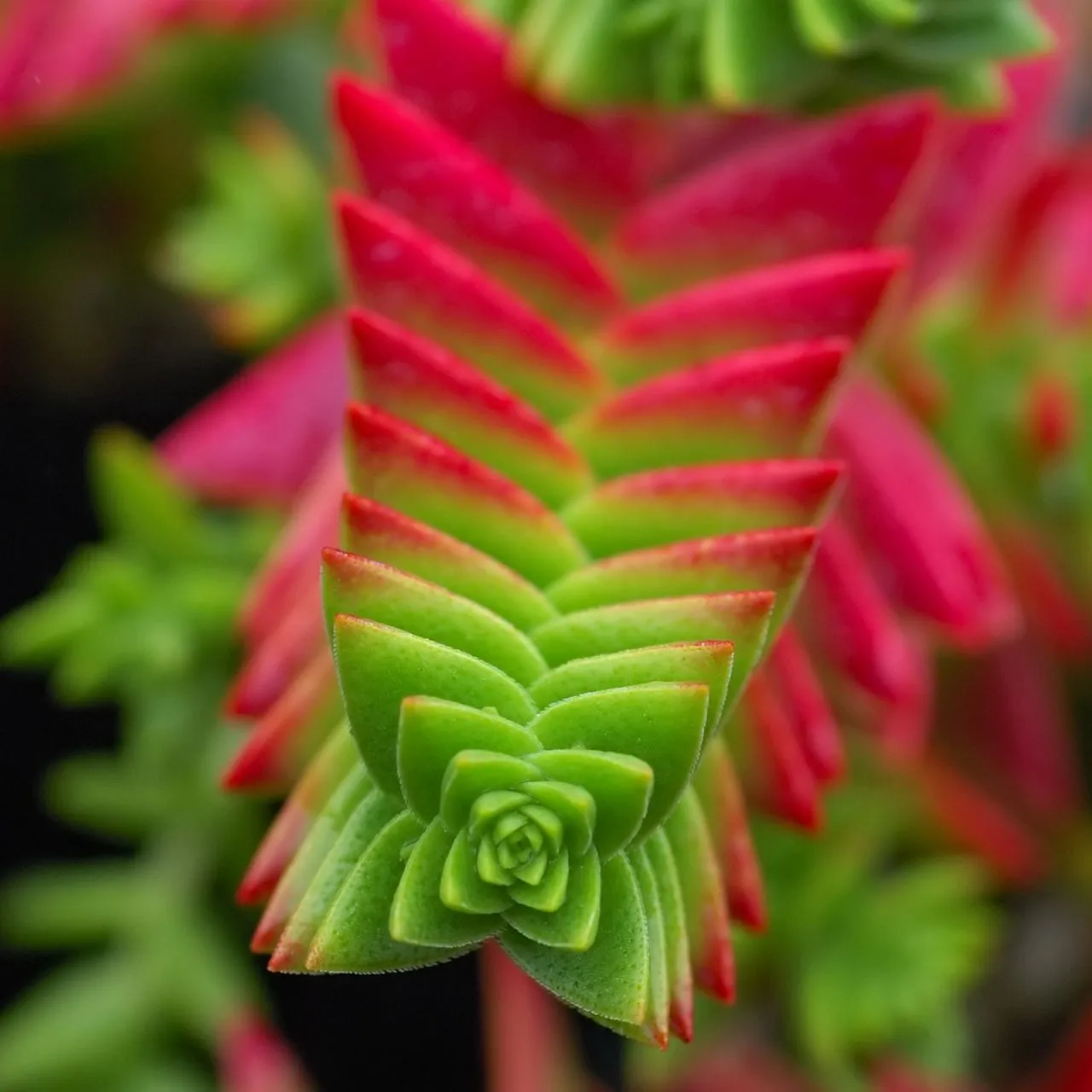
Crassula spiralis is a small South African leaf-succulent whose short stems carry leaves stacked in a tight clockwise or counter-clockwise spiral, giving a neatly twisted column when viewed from the side. It occupies rocky ground in the western Karoo and adjacent Northern Cape, rooting in shallow mineral pockets where summer rain is rare and winter moisture is brief.
Part of the Complete Crassula Guide.
Identification
Crassula spiralis is not one of the familiar book-species, and much of what is sold under this name in the trade is actually Crassula rupestris subsp. marnieriana or a closely related clone. Genuine C. spiralis has:
- Opposite decussate leaf pairs like all Crassula, but with successive pairs rotating in a consistent direction rather than 90° each time. The result is a gently spiralling column 5–12 cm tall.
- Small, thick, blue-green to grey leaves, ovate to almost rhomboid, 5–10 mm long, pressed closely against the stem.
- Clustered cream to pinkish stellate flowers on short lateral cymes in late summer.
The twist is noticeable but not extreme; if your plant looks like a tightly corkscrewed string of beads, it is almost certainly subsp. marnieriana. If the spiral is so loose you are not sure it is there, double-check against the genuine photographs in Court's Succulent Flora of Southern Africa.
Cultivation
Treat it as a small, sun-demanding Karoo species. The pillar's default Crassula regime applies with two tightenings:
- Substrate should run to 70% mineral grit rather than the standard 50%. These stems rot at the base in winter if the substrate is slow to dry.
- Light: full sun outdoors in summer, the brightest possible window in winter. The leaves redden at the tips in strong light, which is a healthy anthocyanin response.
Water lightly year-round. Even in active growth, a small clay pot dries in 2–3 days in summer; wait for it, then soak thoroughly. In cold winter months (below 10°C) withhold water almost entirely.
Frost kills leaves at −1°C and stems below −3°C. Bring inside or into a cold frame where winters freeze.
Propagation
Stem cuttings root easily. Cut a 3–5 cm section just below a leaf pair with sterile secateurs, let it callus for five days in dry shade, and insert the base into gritty mix. Roots appear in 2–3 weeks at 20°C–25°C. Whole rooted columns can be detached from clumping parent plants in spring without disturbing the main cluster.
Leaf propagation is slow and unreliable because the leaves are small and tightly appressed; the cut rarely takes clean callus. Do not rely on it.
Notes
The name Crassula spiralis is itself a point of taxonomic instability. Kew's World Checklist currently accepts the name as valid, but several authors have sunk it into C. rupestris as a subspecies or variety. In cultivation the names C. rupestris subsp. marnieriana, C. rupestris 'Tom Thumb', and C. spiralis are routinely swapped on labels. Unless you have a firm provenance, treat anything sold as C. spiralis as a probable rupestris form and grow it as one.
The species is not monocarpic. A flowering stem can be tipped back after bloom and the plant continues from the next node below. Flower stalks left in place dry out and invite mealybugs.
See also
- Crassula rupestris — the likely true identity of most trade "spiralis" plants.
- Crassula perforata — another stacked-column species sharing similar culture.
- Crassula socialis — small mat-forming sibling.
- Crassula pangolin — another compact stacked-scale collector's species with a similar care regime.
Frequently Asked Questions
What light does this Crassula need?
Bright light is the default. Compact species and red-flushing cultivars need several hours of direct sun after gradual acclimation.
How should it be watered?
Water thoroughly, then allow the upper 3–4 cm of substrate to dry before watering again. In cool winter conditions, reduce watering sharply.
What substrate works best?
Use a free-draining mix with substantial pumice, grit, or perlite. Dense peat-heavy compost keeps the root zone wet too long.
How is it propagated?
Stem cuttings are the most reliable method for most Crassula. Leaf cuttings work on jade-type plants but are less useful for tight stacked miniatures.