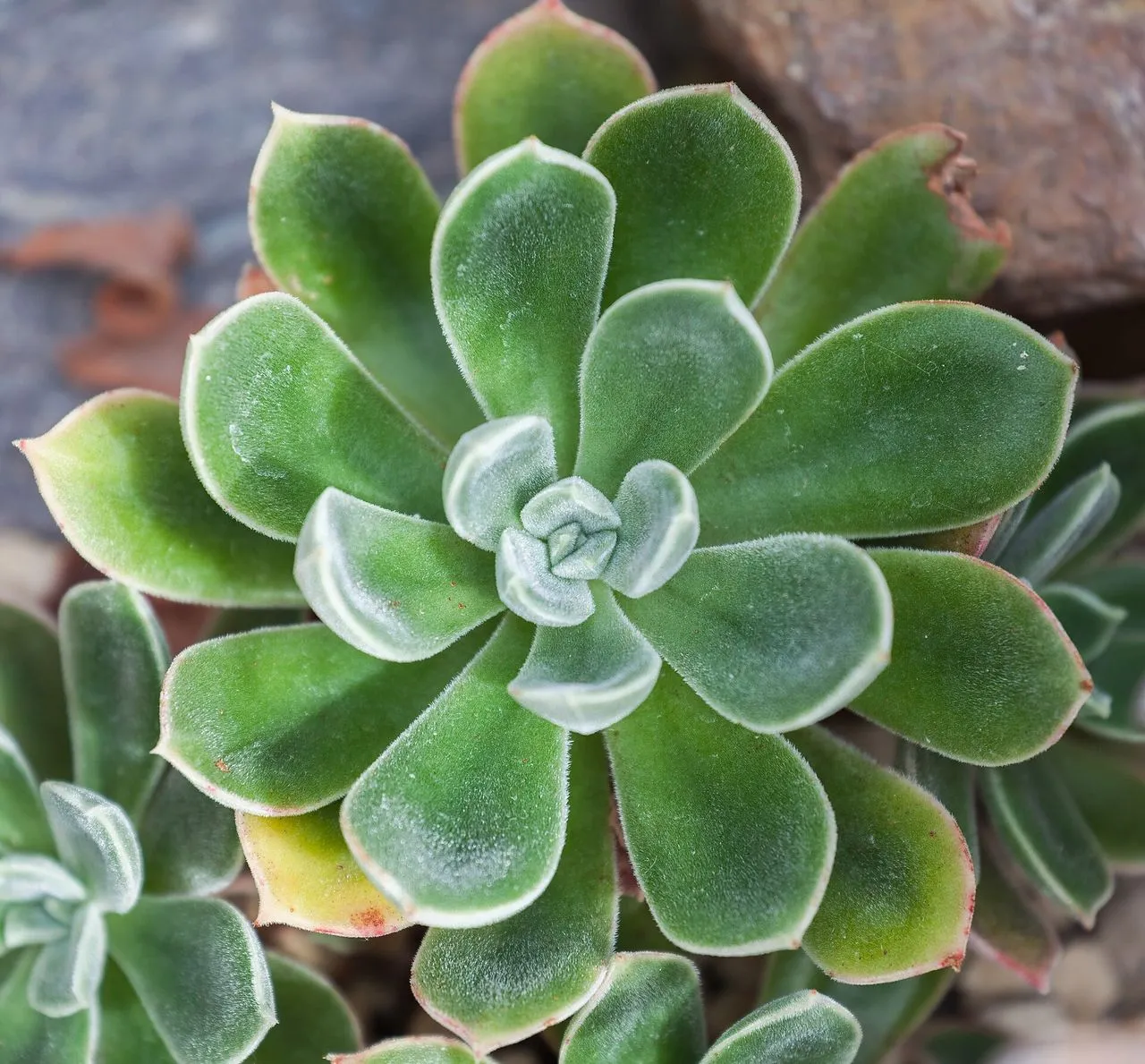
An Echeveria that grows well but never produces a flower scape is almost always in correctable conditions, not permanently incapable of bloom. The question "is my plant sterile?" arises quickly, but actual sterility is rare in ordinary cultivated Echeveria. The vast majority of non-blooming plants are either too young to have reached reproductive maturity, receiving insufficient light to build the energy surplus that flowering requires, or missing the seasonal temperature contrast that most species use as a cue for bud initiation. Identifying which of those applies and correcting it over one growing season resolves the problem for most plants.
Quick answer: an Echeveria that will not flower usually needs stronger light, more maturity, or a clearer cool winter rest. Do not force it with heavy fertilizer. Grow a tight, healthy rosette first; blooms follow stored energy, not stress alone.
How do you make an Echeveria bloom indoors?
Indoors, light is usually the missing piece. Put the plant in the brightest safe window you have, or use a full-spectrum LED for 12 to 14 hours a day. If natural light is weak, this GE full-spectrum LED grow light search is a practical starting point for comparing indoor plant lights. As an Amazon Associate, we earn from qualifying purchases, at no extra cost to you.
Keep the winter rest boring: bright, cool, and dry. A plant that sits warm and damp all winter may keep growing leaves, but it often skips the seasonal signal that sets up spring flowers.
The exception is a mature, correctly grown plant that consistently skips bloom year after year — a pattern occasionally seen in some complex polyploid hybrids. That is the outlier, not the default assumption to reach for first.
Part of the Complete Echeveria Guide.
Maturity: the age before first bloom
The most common reason a young Echeveria does not flower is that it has not yet reached reproductive maturity. A leaf-propagated rosette typically takes one to three years from the first appearance of the leaf bud to its first bloom, depending on species and growing conditions. A large cultivar such as Echeveria 'Afterglow' or E. gibbiflora derivatives needs longer than a compact species such as E. elegans or E. pulidonis, because a longer scape carrying more flowers requires proportionally greater stored photosynthate to produce and sustain.
An offset separated from a mature parent starts with an advantage: it already has a root system and some stored reserves from the parent. A well-grown offset from a compact species can bloom in its first full growing season after separation. A leaf propagation of the same species may take two full outdoor seasons to reach the same threshold.
The diagnosis here is straightforward. If the rosette is compact, firm, correctly coloured, and under two years old, no intervention is needed beyond patience and continued strong-light cultivation. The plant is healthy and has not yet accumulated the resources to invest in reproduction. One or two full growing seasons in high light will bring it to first bloom.
Insufficient light
Low light is the most common correctable cause of non-flowering in established Echeveria. Producing a flower scape is energetically expensive. The plant must accumulate enough stored carbohydrate to build a lateral scape from scratch, develop and open multiple buds, synthesise floral pigment and nectar, and maintain the whole structure for the full bloom period. A rosette surviving on a dim windowsill can maintain vegetative growth because leaves are cheaper to produce than reproductive structures, but it cannot build the surplus those structures require.
The diagnostic signs of light-limited non-flowering are visible in the rosette itself before the skipped bloom season becomes obvious: growth that is slightly looser than the cultivar's normal tight form, colouration that is greener or paler than expected, and sometimes a subtle lean toward the light source. A plant that is beginning to stretch toward the window is already in a light deficit significant enough to suppress bloom.
The indoor threshold for most cultivated species is five to six hours of direct bright light per day, or a strong full-spectrum grow light running 12 to 14 hours daily. A room that appears comfortably bright to human eyes can still deliver less than 5% of the light intensity of direct outdoor sun. Outdoor plants fail to flower in shaded patio positions, under deep eaves, or when crowded by taller plants. The light acclimation protocol covers moving a shaded plant safely into a stronger position over 7 to 14 days.
Missing seasonal temperature shift
Many Echeveria species originate from Mexican highland habitats that experience a pronounced cool, dry winter followed by a warmer, wetter active growing season. Flower bud initiation in most cultivated species is partly triggered by the transition from that cool rest phase to actively growing spring conditions. A plant kept at a uniform 20–22 °C year-round with consistent watering may have adequate light and nutrition but still fail to bloom because it never receives the seasonal contrast that cues reproduction.
The effective winter rest does not require temperatures that would damage the plant. Keeping tender Echeveria at 8 to 12 °C from November to February — bright, dry, and with watering reduced to once every two to four weeks — is sufficient for most species to register the seasonal shift. The return to normal watering and warmer growing conditions in spring then acts as the trigger for scape development in mature rosettes.
This is the cause most often overlooked in heated indoor collections. A living room maintained at 20 °C year-round provides adequate survival conditions but insufficient seasonal contrast for reliable annual bloom. Even a difference of 5 to 8 °C between winter and summer growing temperatures, combined with proportionally reduced winter watering, can restore the flowering response in a previously non-blooming mature plant. The indoor-outdoor gap is most apparent in climates where Echeveria are moved outdoors for summer and bloom reliably there but never flower when kept indoors year-round — the outdoor plant is receiving both the light and the temperature differential that its indoor equivalent lacks.
Over-fertilisation with nitrogen
Echeveria are light feeders. High-nitrogen fertiliser applied frequently or at full strength produces exactly the wrong result for bloom: abundant, soft leaf growth at the direct expense of reproductive investment. Nitrogen drives vegetative cell expansion and chlorophyll production. At moderate levels under strong light this supports compact, healthy growth; in excess it produces soft, open rosettes with pale expanded leaves — growing faster but no closer to flowering.
The diagnostic sign is a plant that grows visibly and vigorously but with unusually large, soft, pale green leaves rather than the firm, compact, stress-coloured growth that characterises a well-grown specimen. The plant looks productive but the energy is all going into leaves. Excess nitrogen also reduces cell-wall strength, making tissue more vulnerable to rot, aphids, and mealybugs — a secondary cost on top of suppressed bloom.
The correct approach is quarter-strength balanced fertiliser once a month or less during active high-light growth, and none at all during the winter rest. If the substrate has been in use for more than two years, repotting into fresh mineral mix with 20% loam-based compost is more useful than increasing fertiliser concentration, because exhausted compacted substrate cannot transfer nutrients to roots effectively regardless of what is added to it.
Stress, pests, and root restriction
A plant under active stress defers flowering as a metabolic priority — survival before reproduction. Root rot, repeated severe drought, heat stress above 38 °C, and recent beheading or repotting all redirect resources away from reproductive structures. A plant in recovery should be expected to skip one or two flowering seasons. This is not a problem; it is the plant's correct resource allocation.
Root mealybugs are particularly worth ruling out in unexplained non-blooming cases. The rosette can look merely stalled — no visible pests above the substrate, no dramatic yellowing, but no scape and minimal new growth despite apparently correct watering and care. The plant is sustaining a defence response against a pest that remains invisible at the surface. Unpotting to inspect the root ball rules this out or confirms it. The inspection and treatment protocol is in Echeveria mealybug treatment.
Severe rootbound conditions in exhausted substrate can also suppress bloom. A plant that has not been repotted in three or more years, with roots forming a dense hydrophobic mass, may need a substrate refresh before it can flower. Healthy roots should occupy the pot without filling every visible space; there should still be substrate between root strands.
Monocarpic confusion: why the rosette does not die
A persistent source of confusion is whether Echeveria die after flowering, as Sempervivum does. They do not. Echeveria are polycarpic — the flower scape is a lateral structure that arises from beside the rosette, not from the growing point, and the rosette continues living and re-blooms in subsequent years. The scape dies; the rosette does not. This is a fundamental structural difference: Echeveria flowering does not consume the meristematic tissue at the rosette centre.
Collectors moving from Sempervivum sometimes misread a healthy post-bloom Echeveria rosette — slightly looser, slightly paler during recovery — as a plant beginning a monocarpic decline. It is not. The full genus comparison is in the monocarpic vs polycarpic guide. The detailed post-bloom care routine, including scape removal timing and what normal rosette recovery looks like, is covered in Echeveria bloomed — now what?.
The reverse confusion also occurs: a collector who has seen an Echeveria bloom once assumes it will not bloom again. It will, given the same conditions that produced the first scape. A mature, well-grown Echeveria can bloom annually for many years. The question of whether it does is almost entirely a function of light and seasonal rhythm.
How to identify the cause
| Sign | Most likely reason | What to check |
|---|---|---|
| Compact small rosette, plant under 2 years old | Immaturity | Age since propagation or offset separation |
| Leggy, pale, leaning toward window | Insufficient light | Window orientation, hours of direct sun per day |
| Compact and healthy, warm year-round indoors | Missing winter rest | Seasonal temperature and watering records |
| Large, soft, pale green leaves despite vigorous growth | Excess nitrogen fertiliser | Feeding schedule and fertiliser nitrogen content |
| Stalled growth with slight wrinkling after watering | Pest or root stress | Root ball and leaf axils under magnification |
| Mature plant, bloomed once, rosette looks slightly open | Post-bloom recovery | Normal; resume care and expect next season's scape |
Growth quality tells the diagnosis. A firm, compact, correctly coloured rosette in strong light that is over three years old and has never flowered is the only case in which questioning the cultivar's bloom potential is justified.
Risk and severity
Act immediately only when failure to flower accompanies other symptoms of active decline: wrinkling after watering, yellowing mushy lower leaves, white cottony residue in leaf axils, or a stem that yields to gentle pressure. Those are health problems suppressing bloom as a secondary effect, not primary flowering problems.
Wait if the plant is young, compact, and growing well — or if it has recently been repotted, beheaded, moved between light environments, or treated for pests. A missed season following any of those events is normal and requires no intervention beyond continuing correct care.
Solutions
Improve light for one full growing season
Move the plant to a south-facing window, an outdoor summer position beginning in bright shade, or under a full-spectrum grow light running 12 to 14 hours daily. Use the light acclimation protocol for any plant that has been growing in dim conditions — shade-grown tissue burns easily in direct sun. Compact new growth and returning stress colouration confirm that light is now adequate. Bloom typically follows after one full season at the improved light level.
Create a seasonal winter rest
From late autumn through winter, keep the plant bright, cool (8 to 12 °C), and drier. Water only when the substrate is fully dry and leaves begin to show the first hint of flexibility — not on a fixed weekly schedule. In spring, increase watering as days lengthen and temperatures rise. The seasonal contrast between the cool-dry phase and the warm-active phase is the trigger; the exact temperatures matter less than the consistent difference between them.
Correct the fertiliser regime
During active growth, use a dilute balanced fertiliser at quarter-strength, once monthly at most. Do not feed during the winter rest at all. If the substrate is exhausted, repot into fresh mineral mix rather than escalating fertiliser concentration. A healthy root environment delivers nutrients efficiently; nutrients applied to compacted or degraded substrate are largely wasted.
Inspect roots and repot if needed
If a mature plant has not been repotted in two or more years and has never flowered despite correct light and seasonal care, unpot and inspect the roots. Trim dead or mushy roots with a sterile blade, check carefully for white waxy residue or moving insects that indicate mealybugs, and repot into a correctly sized container with fresh mineral mix. Allow the plant to settle for two to four weeks before resuming normal watering.
Prevention
Grow for compact health before expecting bloom. Consistent strong light, a mineral substrate that dries completely between waterings, a wet-dry watering rhythm, and a seasonal temperature difference are the four conditions in which flowering is a natural annual outcome for a mature plant. Treating Echeveria like tropical houseplants — constant warmth, regular light watering, dim interior positions, and high-nitrogen feeding — reliably suppresses bloom across successive seasons.
For indoor growers without outdoor access, a full-spectrum LED grow light is the single most effective investment. One season under a correctly positioned grow light commonly converts a non-blooming indoor plant into a reliably flowering one, because it addresses both the light intensity and the extended photoperiod that outdoor summer conditions provide naturally. The beginner's guide to succulents covers the light, substrate, and watering fundamentals that underpin successful cultivation for both compact growth and bloom.
See also
- Echeveria stress coloring — the same high-light conditions that produce compact growth also intensify pigment and signal bloom readiness.
- Echeveria stretched and leggy — low-light etiolation is the most common reason a mature plant fails to flower; treating etiolation and treating non-blooming are the same problem.
- Echeveria bloomed — now what? — post-bloom rosette care, scape removal, and what to expect during the recovery period before the next season's bloom.
Quick answer: what does an Echeveria need?
Echeveria needs strong light, fast-draining soil, and deep but infrequent watering. The usual problems come from weak indoor light, pots that stay wet too long, or watering on a fixed schedule instead of checking the mix first.
Soil matters more than the calendar
Watering advice only works if the potting mix dries in a reasonable time. If your Echeveria stays damp for a week or more, move it into a grittier mix and a pot with a drainage hole. A succulent soil mix for Echeveria is a safer bet than general houseplant soil. As an Amazon Associate, we earn from qualifying purchases, at no extra cost to you.
If the rosette is stretching
A stretched Echeveria is asking for more light. Move it closer to a bright window or use a grow light. The stretched stem will not shrink back, but new growth can come in tighter once the plant gets enough light.
FAQ
How often should I water Echeveria?
Water when the soil is dry all the way through, not on a weekly schedule. In bright heat that may be often. Indoors in winter, it may be much less.
Can Echeveria live indoors?
Yes, but only with very bright light. A dim shelf will usually lead to stretching, pale growth, and a weaker plant.