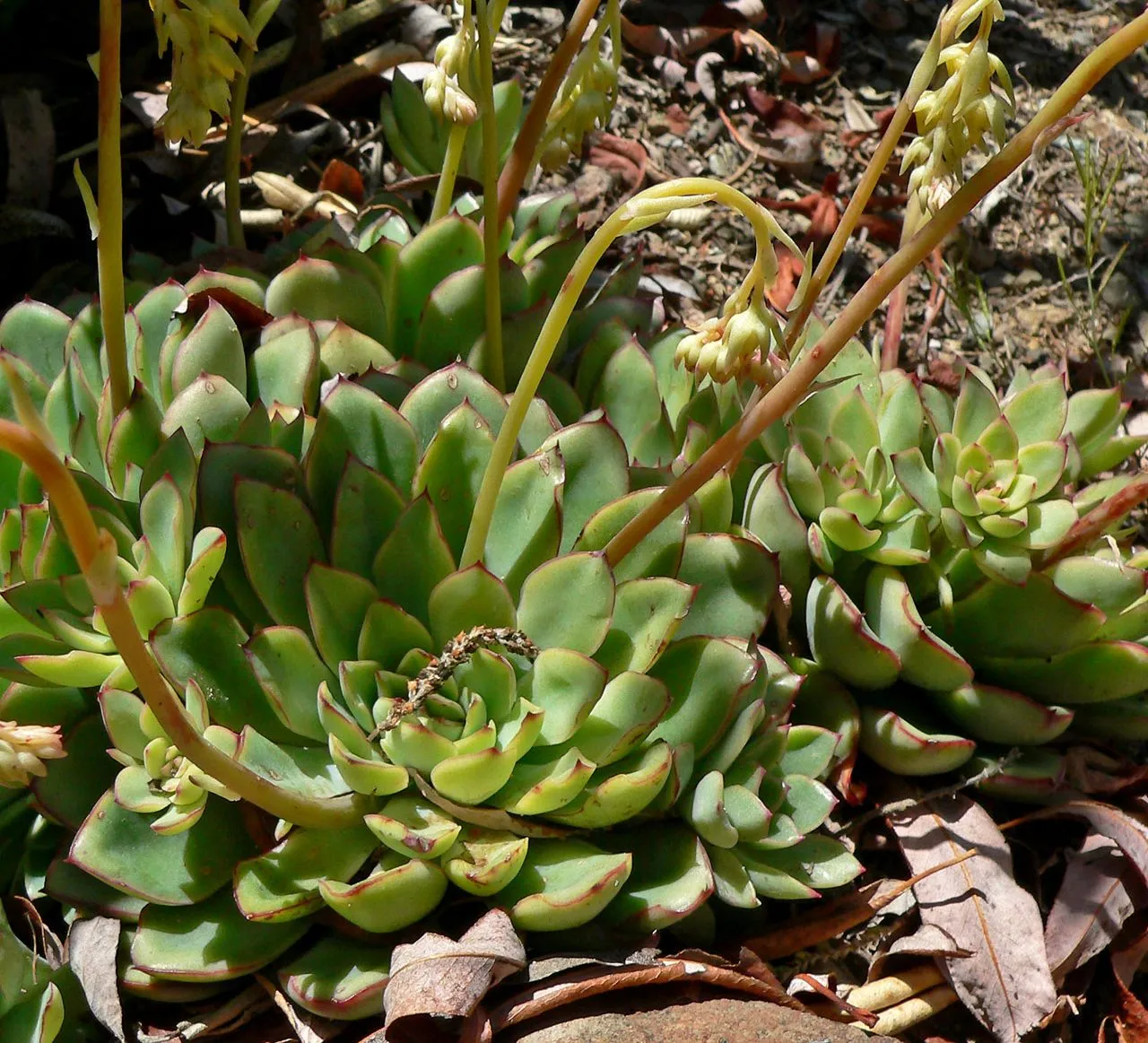
Yellow leaves on Echeveria mean different things depending on where the yellow appears and how the tissue feels. One yellowing basal leaf can be ordinary rosette turnover; six yellow, translucent leaves after a wet week is a root problem. Treating every yellow leaf as drought is the classic mistake, because the most dangerous form of yellowing is caused by too much water, not too little.
The useful rule is simple: diagnose texture before acting. Papery yellow-brown leaves are spent. Soft wrinkled yellow leaves are water depletion. Mushy or glassy yellow leaves are waterlogged tissue and possible rot. Pale new growth with a loose rosette is usually light-related. Part of the Complete Echeveria Guide.
Normal basal senescence
Every healthy Echeveria sheds old leaves from the base as the crown produces new leaves from the centre. The oldest leaves lose chlorophyll, yellow, then dry to tan or brown. This is controlled resource withdrawal: the plant reclaims water, nitrogen, and mobile nutrients before discarding tissue that is shaded by newer leaves above it.
Normal yellowing stays low on the stem. It affects the oldest one or two whorls, not the crown. The leaf becomes thinner, then papery, and eventually detaches with a gentle downward pull. The rosette remains compact, the centre leaves remain firm, and the plant continues normal growth. No treatment is required beyond removing fully dry leaves so they do not trap moisture against the stem.
Over-watering and root rot
Pathological yellowing most often begins with excess water around the roots. Echeveria roots need an oxygenated wet-dry cycle. In a peat-heavy mix, an oversized pot, a saucer holding water for more than 30 minutes, or a cool room below 15 °C, the substrate can stay wet long enough to suffocate fine roots. Damaged roots stop regulating water uptake, and the leaves turn yellow, translucent, and mushy.
This yellow is wetter than senescence. Affected leaves may feel inflated before they collapse. They often yellow in a cluster, sometimes on one side of the rosette where the pot stayed wet. If the stem base is soft or smells sour, rot has moved beyond the roots. Root inspection is mandatory: healthy roots are pale tan to white and firm; dead roots are black, hollow, slimy, or detach as empty sheaths.
Under-watering and depleted stored water
Drought can also yellow lower leaves, but the texture is different. A dehydrated Echeveria draws water from older leaves to protect the growing centre. Those lower leaves turn dull yellow-green, wrinkle lengthwise, feel flexible rather than mushy, and may curl inward as water pressure drops. The substrate is dry through the full depth of the pot, and the roots are usually firm rather than black.
Chronic underwatering is common in tiny nursery pots, unglazed terracotta in hot wind, and mineral mixes that drain in minutes under summer sun. The fix is not daily misting. A dehydrated root ball needs one thorough soak until water exits the drainage holes, then complete drainage and a return to the normal dry-down cycle. Leaves already sacrificed will not recover, but the centre should firm within 48 to 72 hours.
Low light and chlorophyll loss
Yellowing can be part of etiolation when the plant is receiving less light than it needs. In low light, new leaves are thinner, greener-yellow, and spaced farther apart. The rosette opens, internodes become visible, and the older lower leaves are shaded by the stretched crown. Those shaded leaves yellow and drop because they no longer repay their maintenance cost.
This pattern is slower than rot. The plant may look otherwise hydrated, but the geometry changes: a flat, tight rosette becomes loose, taller, and pointed toward the window. Indoor Echeveria usually need a south-facing window or a grow light providing roughly 12 to 14 hours of bright light. Sudden full sun is not the answer; step light up over 7 to 14 days to avoid sunburn.
Nutrient exhaustion and hard-water pH drift
Echeverias are not heavy feeders, but a plant kept for years in the same inert or exhausted substrate can develop pale yellow new growth. This is most visible on actively growing plants that otherwise have good light and a correct wet-dry watering rhythm. The leaves are firm, not mushy, and the roots look alive. The issue is usually depleted nitrogen, low available micronutrients, or pH drift from hard tap water.
Do not diagnose nutrient deficiency until root rot is excluded. Fertiliser cannot rescue dead roots, and adding feed to a saturated pot worsens osmotic stress. If the root system is healthy, refresh the top 2 cm of substrate or repot into a mineral mix with 20% loam-based compost. Feed at quarter strength during active growth only, and use rainwater or reverse-osmosis water if the tap water leaves white crust on the pot.
How to identify the cause
| Pattern | Texture | Location | Most likely cause |
|---|---|---|---|
| Yellow-brown, dry, papery | Thin and crisp | Oldest basal leaves only | Normal senescence |
| Yellow, translucent, mushy | Wet or glassy | Several leaves, often lower | Over-watering or root rot |
| Yellow-green with wrinkles | Soft, flexible, not wet | Lower leaves first | Under-watering |
| Pale yellow new leaves | Firm but thin | Crown and new growth | Low light or nutrient shortage |
| Yellow with white cotton in axils | Variable | Leaf bases and hidden crevices | Mealybug feeding |
Always inspect the growing point. If the centre is firm and compact, the plant is usually recoverable. If the centre is soft, brown, or wet, the rosette crown has rotted and normal recovery is unlikely.
When to act immediately
Act the same day if yellow leaves are mushy, translucent, spreading upward, or accompanied by a soft stem base. Remove the plant from its pot and inspect the root system before adding any water. Delay is what allows root rot to cross into the stem.
Wait and observe when only one or two lowest leaves are yellowing dry and papery. That process should finish within 7 to 14 days. Professional help is rarely needed for a single houseplant, but a valuable collection with repeated yellowing across many pots may need substrate, irrigation, and pest assessment as a system rather than plant-by-plant guessing.
Solutions
If the leaves are papery
Do nothing until the leaves detach. Pull them away only when they release with light pressure. Keep watering based on substrate dryness, not on the presence of yellow leaves. A healthy mature rosette can lose one to three basal leaves per month during active growth.
If the leaves are mushy
Unpot the plant, remove all old substrate, and cut away black or hollow roots with a sterile blade. If the stem base is firm, leave the plant bare-root in bright shade for five to seven days, then pot into fresh dry mineral mix. Do not water for another week. If the stem is soft, cut above the rot into clean tissue and re-root the top as a cutting.
If the leaves are wrinkled
Soak once thoroughly, then allow full drainage. Recheck after 48 hours. If the plant remains wrinkled despite moist substrate, roots may be dead from a previous dry spell and the plant must be treated like a cutting until new roots form.
If new growth is pale
Increase light gradually and refresh the substrate if the plant has not been repotted for more than two years. Feed only during active growth at quarter strength. Correct light first; fertilised low-light plants stretch faster.
Prevention
Use a pot only 2 to 4 cm wider than the root ball, with an open mineral mix that dries within 24 to 72 hours. Water thoroughly, then wait until the top 3 to 4 cm of substrate is dry before watering again. Empty saucers within 30 minutes. Keep winter plants cooler and drier, but not bone-dry for months. Inspect leaf axils monthly for mealybugs, and rotate indoor pots so the rosette does not lean into one-sided light.
The preventive habit that matters most is refusing to water automatically. Yellow leaves are a symptom, not a watering instruction. Texture, distribution, root condition, and light history decide the next step.
See also
- Echeveria losing bottom leaves — separate normal lower-leaf turnover from disease.
- Root rot diagnosis — the broader succulent root-rot recovery procedure.
- Beginner's guide to succulents — substrate, drainage, and watering fundamentals that prevent yellowing.
Frequently Asked Questions
Are yellow bottom leaves normal on Echeveria?
Yes, if only the lowest one or two leaves turn yellow-brown, dry to a papery texture, and detach cleanly. That is basal senescence, not disease.
Why are my Echeveria leaves yellow and mushy?
Mushy yellow leaves indicate excess water in the tissue and possible root rot. Unpot the plant, remove black or wet roots, and re-root dry before watering again.
Can yellow Echeveria leaves turn green again?
A leaf that has fully yellowed will not return to green. The goal is to correct the cause so new centre growth emerges firm, compact, and correctly coloured.
Should I remove yellow leaves from my Echeveria?
Remove only leaves that detach with light pressure or are fully dry. Cutting partly yellow succulent leaves creates wet wounds that invite rot.