| Question | Short Answer |
|---|---|
| How do you identify Echeveria shaviana? | The safest character is the strongly undulate, frilly leaf margin. |
| How big does Echeveria shaviana get? | Mature rosettes are usually 8 to 15 cm across and remain compact when light is adequate. |
| Can Echeveria shaviana be propagated from leaves? | Yes. |
| Why is my Echeveria shaviana losing its frills? | Warm shade, too much water, and heavy feeding produce greener, flatter leaves. |
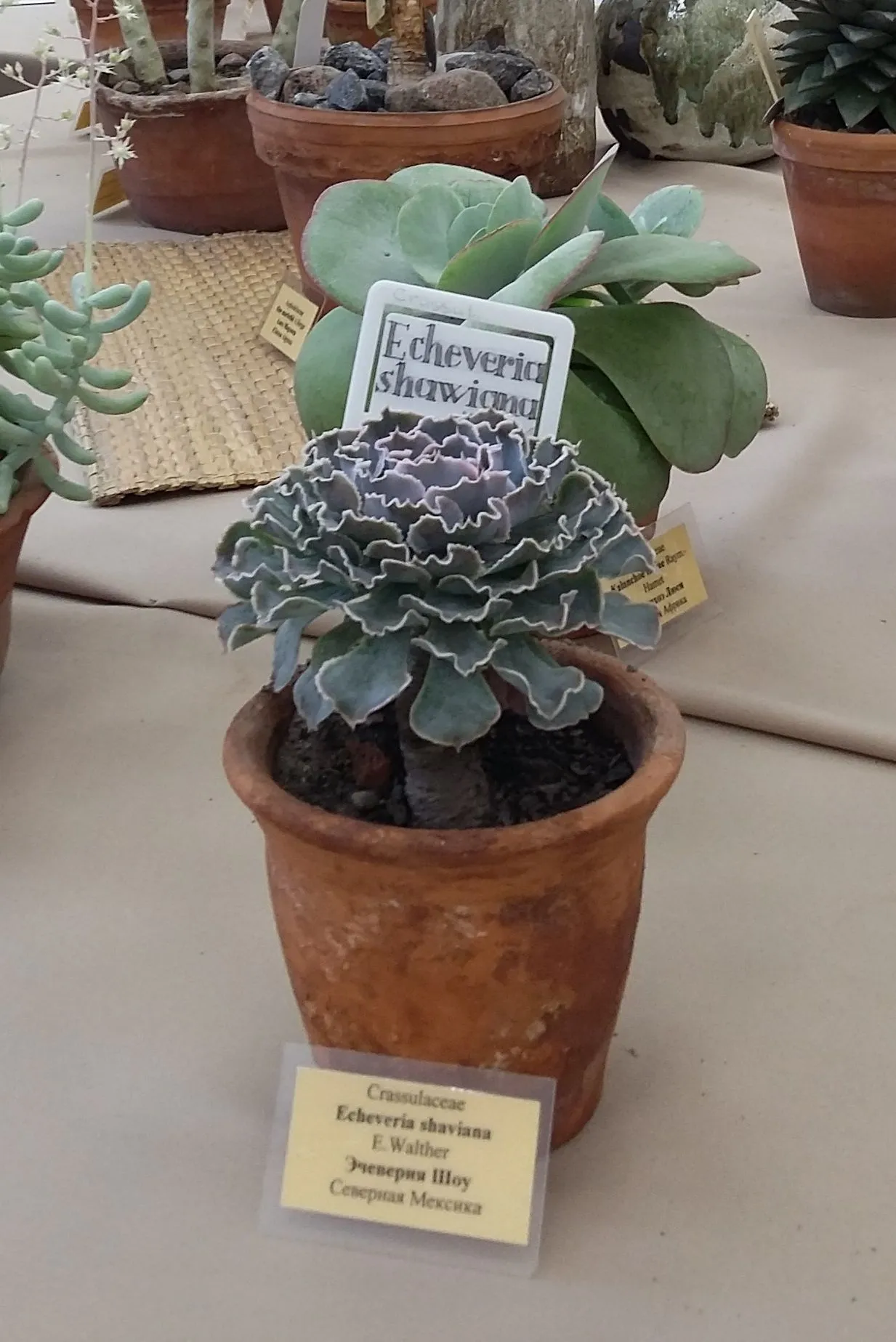
Echeveria shaviana, often sold as Mexican Hens, was described by Eric Walther in 1958 and named for Robert Shaver. It is native to Nuevo León and Tamaulipas, Mexico, where it grows on limestone outcrops at about 1,800 m to 2,500 m, and it is recognised by compact 8 to 15 cm rosettes of lavender-pink to grey-mauve waxy leaves with strongly undulate, frilly margins.
In habitat, E. shaviana is a highland limestone species rather than a lowland desert plant. The roots work through shallow mineral pockets, rock fissures, and gritty organic debris that dries quickly after summer rain. Cool nights, bright exposure, and lean alkaline rock all help explain its compact form and waxy, pastel leaf surface in cultivation. Plants grown warm, shaded, and too wet usually lose the crisp frilling and stretch into a softer, greener rosette.
Part of the Complete Echeveria Guide.
Identification
E. shaviana is compact, stemless, and slow to clump. A young plant sits as a single tight rosette, while older specimens may form a small group of offsets around the base rather than a spreading mat. Mature rosettes are usually 8 to 15 cm across in cultivation. The outline is flatter than a ball-shaped E. elegans, but not loose or cabbage-like when light is adequate.
The leaves are the whole story. They are spoon-shaped to obovate, coated in a waxy bloom, and coloured lavender-pink, grey-mauve, or silvery lilac depending on light and temperature. The diagnostic feature is the margin: the edge is strongly undulate, giving each leaf a ruffled or frilly line. On well-grown plants, the waves continue around much of the leaf edge instead of appearing only as a slight ripple near the tip.
Do not identify the species by colour alone. Many hybrids can turn pink or lilac under stress, and some selected clones are much brighter than wild-type material. The safer test is margin shape. E. shaviana has wavy, frilled margins. Echeveria lilacina has smooth margins, a tighter, more evenly symmetrical rosette, and usually a paler, ghostly lavender-grey cast. If the plant is pale and smooth-edged, it is closer to E. lilacina than to E. shaviana.
Flowering usually comes in summer. The inflorescence rises from the side of the rosette and carries pink-coral flowers, sometimes with warmer orange tones inside the tube. Flowering does not end the rosette. A healthy plant can bloom again in later seasons if it is kept compact, dry enough in winter, and not over-fed.
Several names circulate in nurseries. 'Pink Frills' is selected for intensified edge frilling and stronger pink colour on the margins. 'Truffles' tends toward bronze-toned leaves under bright light. 'Mexican Hens' is used both as a common name and, in some shops, as a loose trade label. Treat plants with unusually broad, heavily curled, or saturated leaves as possible E. shaviana hybrids unless the nursery gives clone history.
Cultivation
Give E. shaviana bright light, but acclimate it with some patience. Outdoors, morning sun with light afternoon shade suits hot climates. Indoors, use the brightest east, south, or west window available, aiming for four to six hours of direct sun after acclimation. The rosette should stay tight and the new leaves should keep their wavy edges. If the centre opens flat and the new leaves turn greenish, the plant needs more light.
The waxy surface marks easily. Avoid touching the leaves while moving the plant, and water the substrate rather than the rosette. A few droplets are not a disaster in warm moving air, but water trapped between frilled leaves dries more slowly than it does on a smooth-leaved species. In cool weather that can turn into fungal spotting or a soft crown.
Water deeply, then let the root zone dry. In spring and early summer growth, a single rosette in a 9 to 10 cm terracotta pot may need water every 7 to 12 days in warm weather. Use a cue, not the calendar: water when the top 3 to 4 cm of substrate is dry and the lowest leaves have lost a little firmness. In winter, water lightly every 3 to 5 weeks if the plant is cool and bright. If your broader watering habits are still developing, the beginner's guide to succulents gives the baseline method, but E. shaviana should be kept on the drier side in cold weather.
Use a mineral-forward mix. A good target is 60% to 75% pumice, lava grit, coarse perlite, or 3 to 6 mm crushed rock, with the remainder made up of peat-free loam-based compost. Limestone grit is acceptable in small amounts, matching the species' limestone habitat, but do not use fine powder that compacts into a paste. The test is drying time: after a full watering, the pot should not remain damp for more than two days in normal indoor conditions.
Pot size should stay modest. A single rosette grows well in an 8 to 10 cm pot. A mature clump can move to 12 cm once offsets press against the rim. Terracotta is useful because it shortens the wet period after watering and gives the compact rosette some weight against tipping. Avoid deep decorative containers unless the root ball actually fills them.
Temperature tolerance is typical for a highland soft echeveria. Steady growth is easiest between 8 °C and 28 °C. Dry established plants may tolerate brief dips near 0 °C, but I would not use this species as a frost-hardy garden plant. Keep it dry below 5 °C. In summer heat above 32 °C, provide moving air and light shade during the harshest part of the afternoon, especially for plants in small pots that heat quickly.
Feeding should be restrained. One dilute, low-nitrogen feed in spring is enough for a plant in fresh mix. Heavy feeding makes the leaves larger, flatter, and less cleanly ruffled, which works against the natural character of the species. If the rosette is compact and the margins are crisp, do not push it for faster growth.
Propagation
Leaf propagation works well when leaves are removed cleanly. Choose mature lower leaves in spring or early summer, before the plant slows in heat or winter rest. Twist sideways until the whole leaf base comes away intact. A torn base is the main reason for failure. Let the leaves callus for 4 to 6 days, then lay them on barely damp pumice in bright shade at 21 °C to 25 °C.
Under those conditions, expect roughly 80% success, with roots and early plantlets appearing in 4 to 6 weeks. Keep the tray dry from above. I prefer to moisten one edge of the pumice and let humidity move through the tray rather than wetting the leaf bases directly. Once each new rosette is 1 to 2 cm wide and the old leaf begins to shrivel, pot it into the adult mix.
Offset division is faster, but only mature plants provide enough material. Wait until an offset has its own small root nubs or is at least one third the width of the parent rosette. Remove it with a clean blade, keeping a small heel of tissue attached if possible. Let the wound dry in shade for 4 to 7 days, then set the offset into dry mineral mix. Begin light watering after it resists a gentle nudge, usually after 2 to 3 weeks in warm conditions.
Seed is possible, but it is not the right method for preserving a selected plant such as 'Pink Frills' or 'Truffles'. Seedlings vary in colour, margin strength, and rosette shape. Use vegetative propagation for named clones and for any plant you are keeping as a reference specimen.
Notes
The biggest trade problem is the name. E. shaviana is a frequent parent in frilled hybrids, so the label appears on plants that are larger, brighter, or more dramatically curled than the species. A hybrid can be worth growing, but it should not be used as a species reference. Check the rosette diameter, the compact stemless habit, and the evenly wavy margins before trusting a label.
Mealybugs hide at the base of old leaves and between offsets. Inspect before the clump gets dense, because treatment is easier while air still moves through the crown. Aphids may gather on summer flower scapes; remove them early so the flowers do not distort. Avoid oil sprays on plants in strong sun, since residues can mark the waxy bloom.
E. shaviana is not known as a serious toxicity risk to pets, but fallen leaves and gritty substrate are still better kept away from animals that chew houseplants. The greater practical risk is cultural: too much organic compost, too little light, and water sitting in the frilled centre. Keep those three points under control and the plant remains compact, slow, and recognisably itself.
See also
- Complete Echeveria Guide — genus-level substrate, light, and propagation principles.
- Echeveria elegans — a smooth, blue-white rosette useful for comparison with frilled E. shaviana margins.
- Echeveria runyonii — a sculptural glaucous species often grown beside frilled cultivars in collections.
Frequently Asked Questions
How do you identify Echeveria shaviana?
The safest character is the strongly undulate, frilly leaf margin. Colour alone is unreliable because many hybrids turn pink or lilac.
How big does Echeveria shaviana get?
Mature rosettes are usually 8 to 15 cm across and remain compact when light is adequate.
Can Echeveria shaviana be propagated from leaves?
Yes. Cleanly removed leaves root well, with about 80 percent success under bright shade at 21 °C to 25 °C.
Why is my Echeveria shaviana losing its frills?
Warm shade, too much water, and heavy feeding produce greener, flatter leaves. Brighter light and restrained feeding keep margins crisp.