| Question | Short Answer |
|---|---|
| Is Echeveria elegans good for beginners? | Yes. |
| How big does Echeveria elegans get? | Typical cultivated rosettes are 5 to 8 cm across, though ideal plants can reach about 15 cm. |
| How do you propagate Echeveria elegans? | Leaf propagation is extremely reliable, with roots and plantlets often appearing within three weeks. |
| Is Echeveria elegans cold tolerant? | Dry plants tolerate 0 °C and brief −2 °C exposure with only cosmetic tip damage. |
Echeveria elegans Rose, the Mexican snowball, is the species most new collectors meet first. It was described by Joseph Nelson Rose in 1905 from material collected near Pachuca, Hidalgo, and has been in continuous cultivation ever since.
The species occurs naturally on limestone cliffs in the states of Hidalgo and Guanajuato at 1,900 m to 2,400 m, where it forms dense clonal mats that carpet near-vertical rock. Those high-elevation, low-nutrient origins explain why it shrugs off conditions that kill many of its relatives.
Part of the Complete Echeveria Guide.
Identification
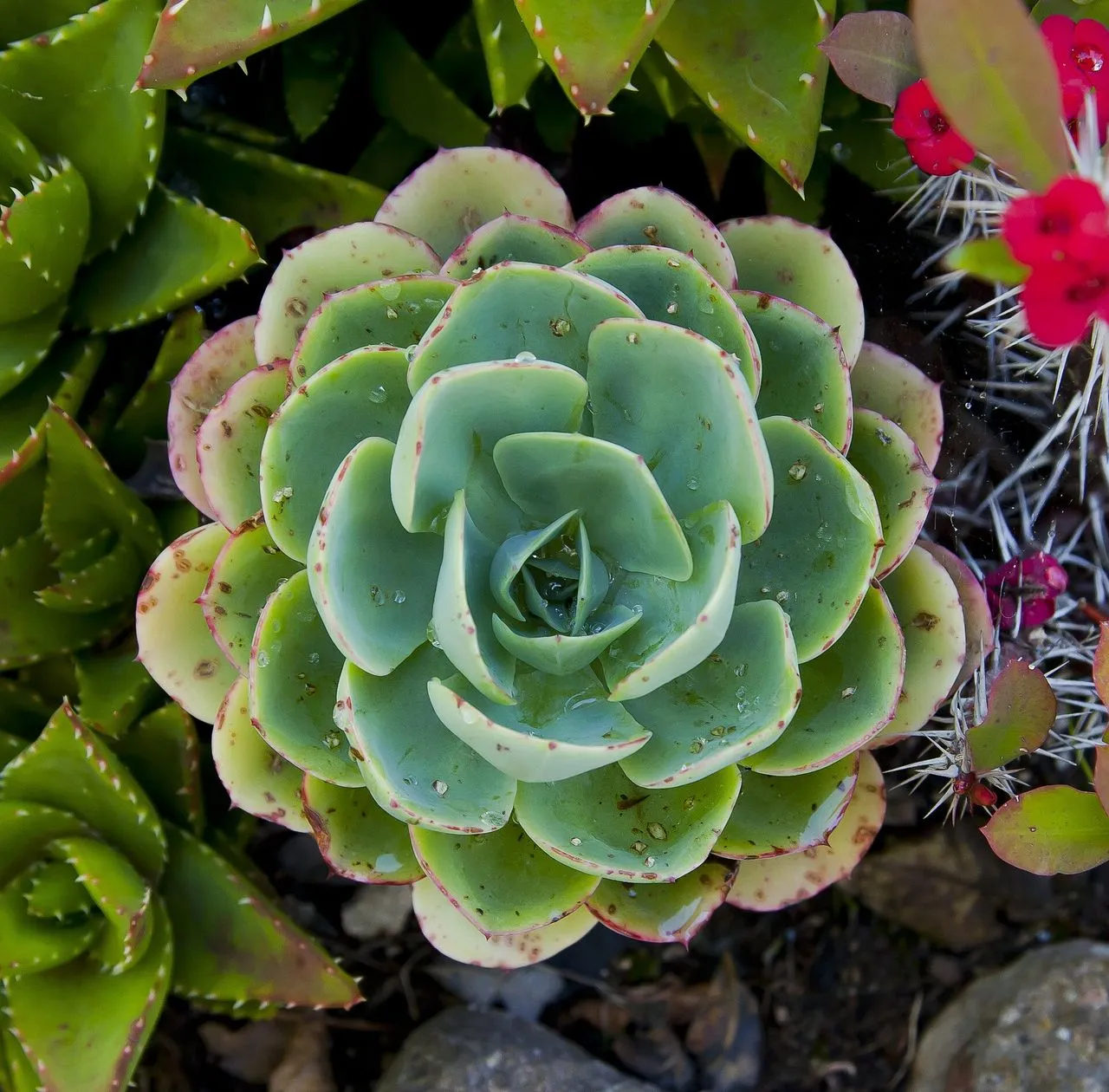
- Rosette. Tight, almost spherical, typically 5–8 cm across in cultivation (up to 15 cm in ideal conditions).
- Leaves. Obovate-spathulate, 2–4 cm long, pale blue-green to almost white, covered in a light waxy bloom. The leaf tip carries a small translucent terminal mucro (a short point), which is the single most reliable identification character.
- Offsets. Prolific. A healthy plant forms tight clumps within two or three seasons, each offset a near-perfect clone.
- Inflorescence. A lateral scape 15–25 cm tall bearing a cincinnus of 5–15 pink-red tubular flowers with yellow-orange interiors, typically in late winter to spring.
Confusion points. E. elegans is frequently sold as E. 'Elegans Blue', E. 'Albicans', or misidentified as E. lilacina. The key separator from Echeveria lilacina is leaf colour: E. elegans is blue-white, E. lilacina is pale lavender-pink. If the rosette looks pink rather than blue-white, it is probably not E. elegans.
Cultivation
Care follows the genus defaults with two species-specific adjustments. First, E. elegans is more shade-tolerant than most Echeveria. A bright east-facing window or a few hours of morning sun is enough; in very strong midday sun the thin wax bloom scorches, leaving permanent brown freckles. Second, it is among the more cold-tolerant soft echeverias. Dry plants at 0 °C take it without damage, and brief exposure to −2 °C causes only cosmetic leaf-tip damage. Keep substrate bone-dry whenever temperatures drop below 5 °C.
Water is the usual limiting factor. The tight rosette funnels water directly onto the growth point, so water the substrate around the plant, never the crown. In summer growth, water thoroughly once the top 3–4 cm of mix dries; in winter, a single watering a month is usually plenty.
Propagation
This is one of the easiest species to propagate, and it makes a good teaching plant for the methods described in the pillar. Leaf propagation has near-100% success: a healthy leaf detaches cleanly with a gentle sideways twist, calluses in three or four days, and produces roots and a plantlet within three weeks on lightly damp pumice. Offset division is faster still. Because the species forms dense clumps, a mature plant will yield five to ten rooted offsets per year simply by teasing them from the mother.
Seed is rarely worth the effort. E. elegans is self-incompatible, and seed-grown plants segregate visibly; named clones should be kept by vegetative propagation only.
Notes
The species is polycarpic — flowering does not kill the rosette, unlike the superficially similar Sempervivum. Individual rosettes can live a decade or more and flower every spring. Aphids frequently appear on the flower scapes and are the most common pest problem on this species; a strong water rinse usually clears them.
Two horticultural forms circulate under the E. elegans name: the typical blue-white "Pachuca" form and a smaller, tighter, greener form sometimes sold as E. elegans 'Kesselringiana'. Both are fine garden plants; the differences are slight.
For identification in a cluttered collection, the two reliable characters are the terminal mucro on each leaf and the consistent blue-white cast. A rosette labelled E. elegans that lacks the mucro or that reads greenish or pinkish under neutral light is almost certainly a hybrid or a differently named species sold under a popular label. Commercial tissue-culture propagation since the 2000s has flooded the market with mixed clones, and the name has become a catch-all in many garden centres.
Finally, E. elegans is an excellent starter plant because it tolerates a range of errors that would kill less forgiving species: a missed winter watering, a move into stronger light without much acclimation, a month of slightly too-heavy substrate. Most beginners can keep one alive through a full year of trial and error, and what they learn on it transfers cleanly to harder species in the genus.
See also
- Echeveria lilacina — the lavender-toned lookalike.
- Echeveria pulidonis — similar size, red-margined leaves instead of blue-white.
- Echeveria 'Perle von Nürnberg' — a hybrid with E. elegans as one parent.
Frequently Asked Questions
Is Echeveria elegans good for beginners?
Yes. It tolerates missed watering, modest shade, and minor substrate mistakes better than many harder echeverias.
How big does Echeveria elegans get?
Typical cultivated rosettes are 5 to 8 cm across, though ideal plants can reach about 15 cm.
How do you propagate Echeveria elegans?
Leaf propagation is extremely reliable, with roots and plantlets often appearing within three weeks. Mature clumps also yield five to ten rooted offsets per year.
Is Echeveria elegans cold tolerant?
Dry plants tolerate 0 °C and brief −2 °C exposure with only cosmetic tip damage. Keep the substrate bone-dry below 5 °C.