| Question | Short Answer |
|---|---|
| How big does Echeveria 'Perle von Nürnberg' grow? | A mature rosette is usually 12 to 18 cm across, with 20 to 30 broad obovate leaves. |
| Why is 'Perle von Nürnberg' turning grey-green? | Low indoor light reduces the violet-pink pigmentation. |
| Can 'Perle von Nürnberg' be propagated from leaves? | Yes. |
| Is 'Perle von Nürnberg' cold hardy? | No. |
Echeveria 'Perle von Nürnberg' is a hybrid produced by the German nurseryman Richard Graessner of Perleberg in the 1930s from a cross of E. gibbiflora 'Metallica' and E. elegans. It is probably the single most widely grown named Echeveria cultivar in the world, and the one most often misidentified.
Part of the Complete Echeveria Guide.
Identification
- Rosette. 12 to 18 cm across, flat to slightly open, with 20 to 30 leaves.
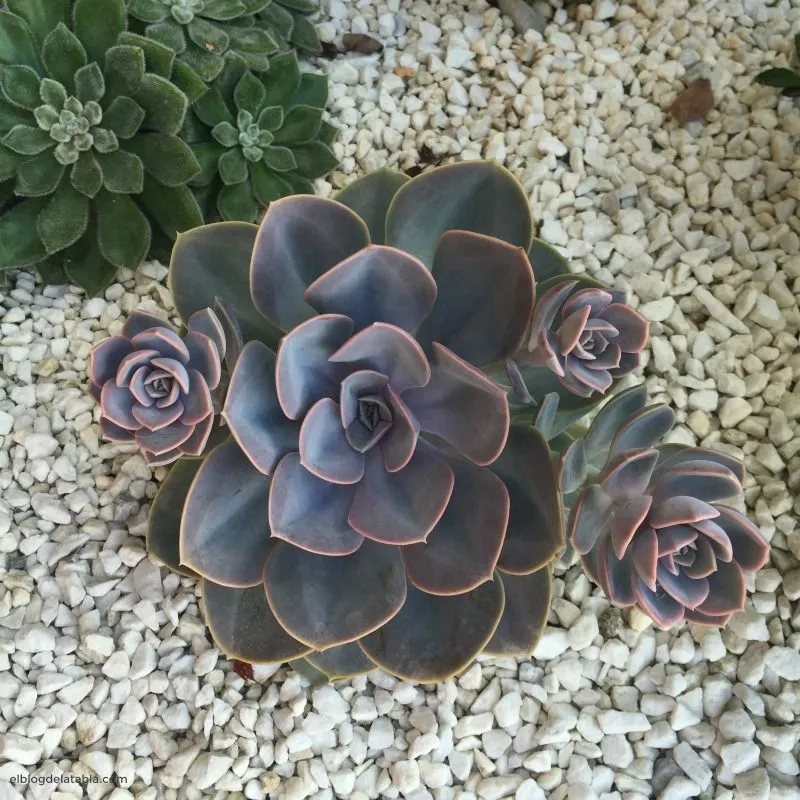
- Leaves. Obovate, 6 to 10 cm long, with a broad rounded blade and a short mucro at the tip. The leaf carries a fine even farina that turns from greyish-lavender through dusty pink to pronounced violet-pink with strong light and cool nights.
- Inflorescence. A single arching scape 30 to 50 cm tall bearing coral-pink bell-shaped flowers with yellow interiors in late spring into summer.
Two cultivars are sold as 'Perle von Nürnberg' but are not this clone. E. 'Afterglow' has wider pinker leaves and a considerably larger rosette (to 30 cm). E. 'Dusty Rose' is smaller, bluer, and has a denser farina. The authentic 'Perle von Nürnberg' sits between the two, with medium size and the trademark dusty violet-pink tone.
The species lineage shows in the morphology. The flat, spoon-shaped blade and short mucro come from E. elegans; the larger size, the leaf length, and the pink-purple pigmentation come from E. gibbiflora 'Metallica'.
Cultivation
Cultivation follows the pillar defaults. One species-specific note: leaf colour depends strongly on light intensity and temperature differential. In low indoor light this cultivar pales to dull grey-green; outdoors in strong light with a 10 °C day-night differential, the leaves flush to their full violet-pink. If the colour is what you are after, move the plant outdoors for summer, acclimating carefully to avoid sunburn on the farina.
Water on the standard genus schedule. The cultivar is slightly more vigorous than E. elegans and wants marginally more water during growth, but it is equally intolerant of winter wet. 'Perle von Nürnberg' is not cold-hardy; protect below 2 °C.
The cultivar is prone to leggy growth indoors because it responds to low light by elongating internodes faster than many Echeveria. A bare stem with leaves clustered only at the top is the usual sign — correct by beheading (see Propagation).
Propagation
Leaf propagation is reliable at 60 to 80 percent success. The leaves are thicker than E. elegans and take a week to ten days to callus properly. Once calloused, place base-down on damp mineral mix; plantlets appear in four to six weeks. The progeny come true — this is a single clone worldwide, not a seed strain, so every vegetatively propagated plant is genetically identical to every other.
Offset production is moderate. A mature rosette produces two to four offsets per year, usually appearing from the lower axils. Separate when each is a third the size of the parent.
Beheading is the usual correction for etiolated plants and is an efficient bulk propagation method. Cut the rosette off with 3 cm of stem, callus ten days, root on dry pumice. The leftover stem normally produces three to six new rosettes along its length within three months.
Do not attempt seed propagation. F2 seedlings from a hybrid cross do not replicate the parent; they segregate into a range of E. gibbiflora × E. elegans backcrosses, some vaguely resembling the parent, most not.
Notes
The cultivar name follows ICN Cultivated Plant Code conventions and should be written in single quotes without italics: Echeveria 'Perle von Nürnberg'. "Perle Von Nurnberg", "Perle von Nuremberg", and "Pearl of Nuremberg" are all common but informal variants.
The cultivar was introduced well before the modern Korean hybrid boom and has therefore been in continuous vegetative propagation for close to a century. Cultivar stability is excellent; any rosette that obviously deviates from the type (dramatically different leaf shape, pronounced margin colour, heavy farina) is a different hybrid being sold under the popular name.
A practical point for anyone buying this cultivar by mail order: the pink-purple colour photographs especially well, which means many online listings are edited to exaggerate the violet tone. A plant grown in average indoor light will look duller than the photograph suggests. This is a property of the cultivar, not a defect in the specimen you received; move the plant to brighter light with cooler nights and the colour will return.
See also
- Echeveria elegans — one of the two parent species.
- Echeveria gibbiflora — the other parent.
- Echeveria 'Afterglow' — a larger, pinker hybrid often confused with it.
Frequently Asked Questions
How big does Echeveria 'Perle von Nürnberg' grow?
A mature rosette is usually 12 to 18 cm across, with 20 to 30 broad obovate leaves.
Why is 'Perle von Nürnberg' turning grey-green?
Low indoor light reduces the violet-pink pigmentation. Stronger light and a 10 °C day-night difference restore colour after acclimation.
Can 'Perle von Nürnberg' be propagated from leaves?
Yes. Leaf propagation is reliable at 60 to 80 percent if the thicker leaves callus for a week to ten days.
Is 'Perle von Nürnberg' cold hardy?
No. Protect it below 2 °C, and avoid winter wet even above that threshold.