| Question | Short Answer |
|---|---|
| How large does Echeveria gibbiflora grow? | Mature outdoor rosettes reach 25 to 40 cm across, while indoor plants are often 15 to 25 cm. |
| Why is Echeveria gibbiflora important in hybrids? | It contributes large leaf size, pink-purple pigmentation, and frilly or carunculate forms to many modern garden hybrids. |
| How do you propagate Echeveria gibbiflora? | Leaves work at 60 to 80 percent but are slow. |
| Does Echeveria gibbiflora die after flowering? | It is not strictly monocarpic, but heavy flowering can exhaust a rosette. |
Echeveria gibbiflora DC. is one of the original species that Augustin Pyramus de Candolle used to describe the genus in 1828. It is among the largest species of Echeveria, forms the backbone of the genus taxonomically, and is the seed parent of a significant share of modern garden hybrids, including E. 'Perle von Nürnberg', E. 'Morning Light', E. 'Afterglow', and most of the frilly-leaved selections.
It grows in the central Mexican highlands from Michoacán through the Valley of Mexico into Oaxaca at elevations of 1,500 m to 2,700 m, typically on rocky slopes with seasonal dry winters and summer rains.
Part of the Complete Echeveria Guide.
Identification
- Rosette. Large — 25 to 40 cm across in mature outdoor plants; 15 to 25 cm indoors. Flat to slightly cupped, carried on a distinct stem 10 to 30 cm tall in older specimens.
- Leaves. Broadly obovate to spathulate, 10 to 20 cm long, 5 to 10 cm wide, with a short abrupt tip. The leaf colour is grey-green to pinkish-purple depending on clone, with a fine glaucous bloom.
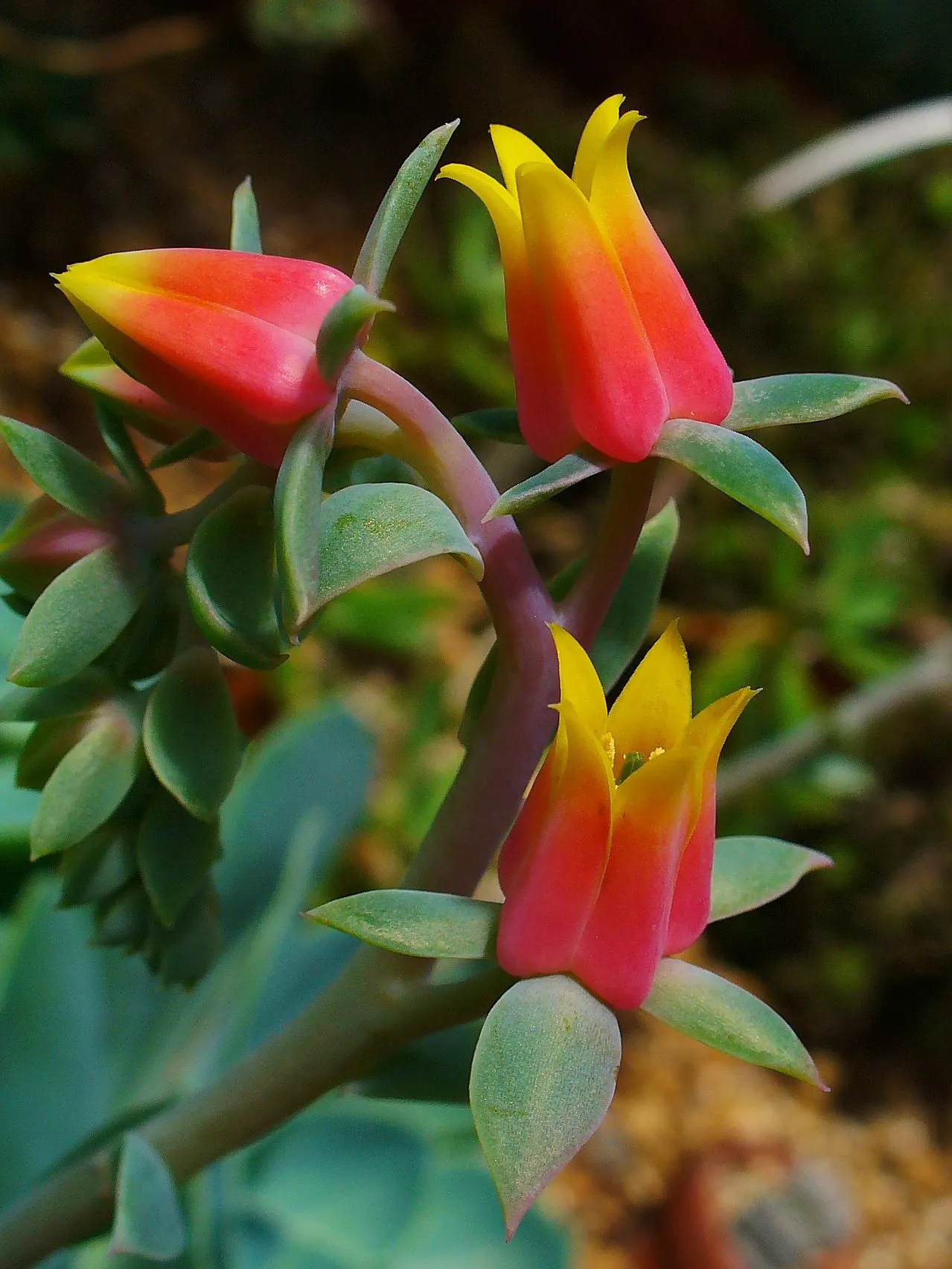
- Inflorescence. Very tall — a branching panicle 50 to 100 cm in height, carrying dozens of pendent orange-red tubular flowers with yellow interiors, in autumn. The autumn flowering is diagnostic; most Echeveria flower in spring.
The species name gibbiflora refers to the gibbous (hunched) shape of the flowers. Several long-recognised horticultural selections have been treated both as cultivars of E. gibbiflora and as separate taxa:
- E. gibbiflora 'Metallica' — purple-suffused leaves, a parent of E. 'Perle von Nürnberg'.
- E. gibbiflora 'Crispata' — with frilled leaf margins, a foundation cultivar for the "wavy-edge" hybrid line.
- E. gibbiflora 'Carunculata' — with raised warty bumps on the leaf surface, genetically stable and parent of the bumpy "Carunculata"-type hybrids.
Cultivation
Cultivation largely follows the pillar defaults, but scale matters. The sheer size of a mature rosette makes it more demanding of pot space, more sensitive to being top-heavy, and slower to respond to changes in care. Two species-specific notes.
Light. Tolerates and benefits from strong direct sun outdoors during the growing season. Indoor plants under glass rarely develop full leaf coloration and tend to etiolate within a year.
Watering. The large leaf mass holds considerable stored water and the plant tolerates longer dry intervals than the smaller species. In summer, water thoroughly and allow the top 5 cm to dry fully before the next soak. In winter, reduce to once every five or six weeks in cool conditions. Over-watering a large E. gibbiflora causes rapid basal leaf collapse; the size that makes it striking also makes it harder to recover when it rots. For lower-leaf drop patterns common in larger species, see Echeveria losing bottom leaves.
Not cold-hardy. Protect below 2 °C; established outdoor plants in Mediterranean climates survive brief light frosts if dry, but the leaves scar.
Propagation
Leaf propagation is reliable but slow at 60 to 80 percent success. The leaves are large and fleshy; callus for seven to ten days to avoid rot. Plantlets appear in six to eight weeks; three to four years to a mature rosette.
Offset production is sparse to absent in many clones. The species frequently remains solitary until flowering, after which the flowered rosette may die (see Notes) and offsets emerge from the stem. This behaviour is the main reason E. gibbiflora is propagated in commerce by seed or by beheading rather than by division.
Beheading is the standard commercial method for keeping the named cultivars ('Metallica', 'Carunculata', 'Crispata') in production. Cut the rosette off, callus ten days, re-root. The cut stem reliably produces several new rosettes.
Notes
E. gibbiflora is not strictly monocarpic but heavy flowering frequently exhausts an individual rosette, especially in indoor culture where the plant does not rebuild reserves quickly. Cut the scape early if you want to preserve the specimen rosette; let it flower if you want seed or new offsets.
The species is self-incompatible and hybridises readily with almost every cultivated Echeveria. If you want to keep seed lines clean, flowering plants must be isolated or hand-pollinated.
See also
- Echeveria 'Perle von Nürnberg' — E. gibbiflora 'Metallica' × E. elegans hybrid.
- Echeveria 'Afterglow' — hybrid with E. gibbiflora lineage on one side.
- Echeveria agavoides propagation — a contrast case with much smaller rosettes and a different propagation profile.
Frequently Asked Questions
How large does Echeveria gibbiflora grow?
Mature outdoor rosettes reach 25 to 40 cm across, while indoor plants are often 15 to 25 cm. Older specimens develop stems 10 to 30 cm tall.
Why is Echeveria gibbiflora important in hybrids?
It contributes large leaf size, pink-purple pigmentation, and frilly or carunculate forms to many modern garden hybrids.
How do you propagate Echeveria gibbiflora?
Leaves work at 60 to 80 percent but are slow. Beheading is the standard commercial method for keeping named selections in production.
Does Echeveria gibbiflora die after flowering?
It is not strictly monocarpic, but heavy flowering can exhaust a rosette. Cutting the scape early helps preserve specimen plants.