| Question | Short Answer |
|---|---|
| Can Echeveria agavoides be propagated from leaves? | Yes. |
| How long should Echeveria agavoides leaves callus? | Callus leaves for five to seven days in shade. |
| What is the fastest propagation method for Echeveria agavoides? | Offset division is fastest when offsets are available. |
| Does Echeveria agavoides come true from seed? | Only wild-type seed is worth sowing. |
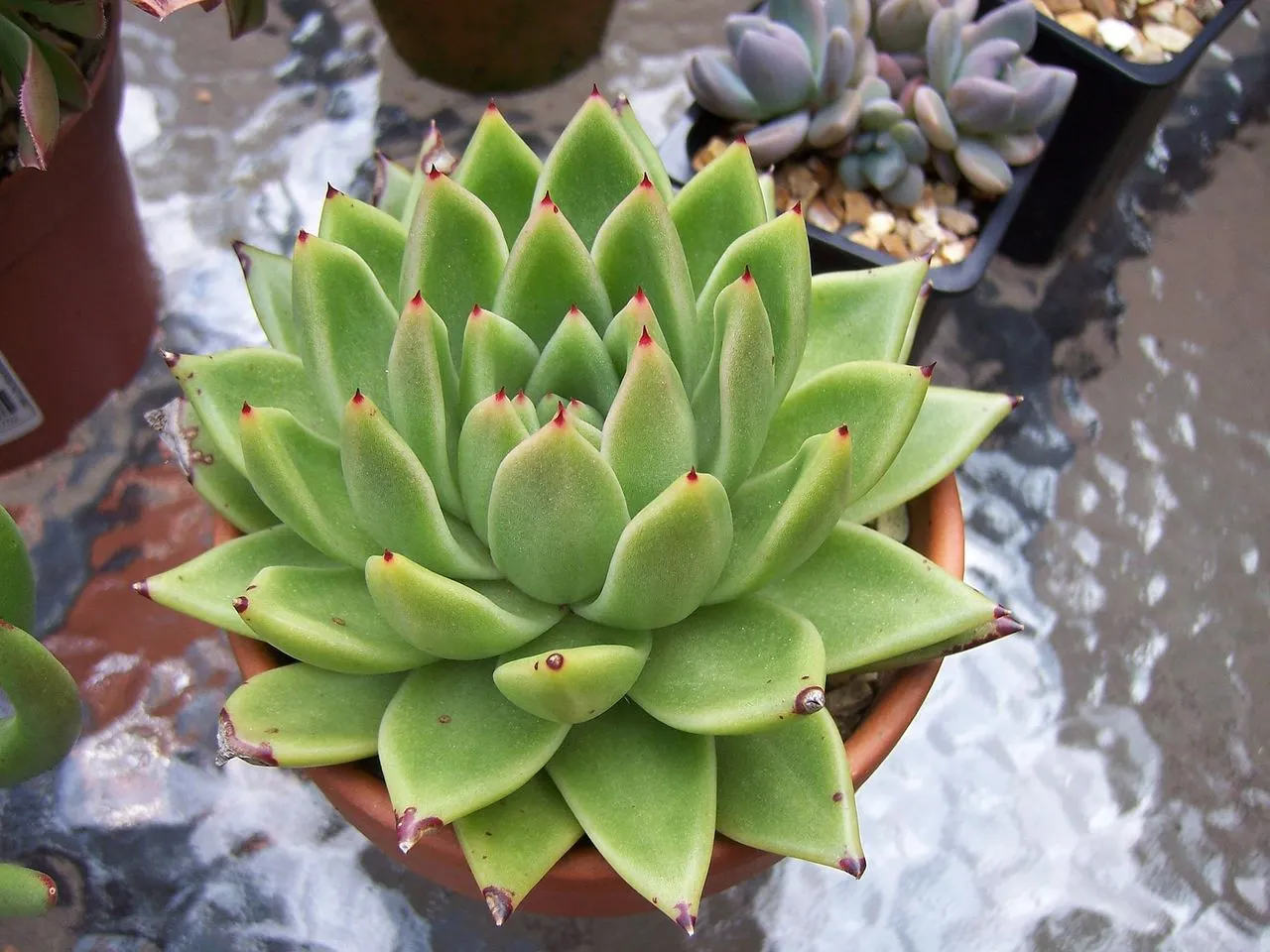
Echeveria agavoides (Lem.) Walp., sometimes called the lipstick echeveria or wax agave, is among the most rewarding species to propagate. It is a triangular-leaved species from the limestone hills of San Luis Potosí and Guanajuato in north-central Mexico, where it grows in exposed rock crevices at 1,400 m to 1,800 m.
The species differs from typical Echeveria in leaf shape — its pointed, stiff, triangular leaves look closer to a miniature Agave than to the classic spoon-leaved E. elegans. That morphology affects how it propagates.
Part of the Complete Echeveria Guide.
Before you propagate
Confirm you have the species rather than a cultivar. E. agavoides 'Ebony', 'Lipstick', 'Red Edge', 'Romeo', and 'Sirius' are all clonal selections that must be propagated vegetatively to keep the red-margin or dark-leaf phenotypes; they will not come true from seed. Wild-type E. agavoides is plain apple-green with a subtle red leaf tip, and seed from it is the only route worth seed-propagating for this species.
Leaf propagation
This is where E. agavoides behaves differently from most of the genus. The leaves are stiff and attach firmly, and the tissue at the base is tough. Use a clean sideways twist rather than pulling downward, and take the entire leaf including the whitish basal wedge. A leaf that snaps mid-blade will not root.
- Callus five to seven days in shade. The cut surface should be dry and glazed before going on substrate.
- Lay the calloused leaf on lightly damp pumice or 50/50 pumice/coir, base not touching the mix.
- Keep at 20 °C to 25 °C, bright indirect light.
- New roots typically appear at 3 to 5 weeks, the plantlet at 5 to 8 weeks.
Success rate for the wild-type species is 60 to 80 percent. For the slow cultivars (E. 'Romeo Rubin', 'Ebony') it drops to around 30 percent and the resulting plantlets often take six months to reach a potting-on size. Leaf propagation is worthwhile for the species; for rare cultivars, offsets are more reliable.
Offset division
Mature E. agavoides produces axillary offsets sparingly. A plant in its fourth or fifth year usually has two or three offsets at the base. Wait until each is at least a third the size of the parent, then cut it with a sterile blade at the stem junction, leaving as much of the connecting stem as possible. Callus three to five days. Pot into dry mineral mix and water lightly after a week.
Offset-propagated plants reach flowering size in 18 to 24 months, considerably faster than leaf-propagated plants (3 to 4 years).
Stem cutting
Rarely needed. E. agavoides does not etiolate as readily as soft-leaved species because the short, thick leaves tolerate lower light. If you do behead an old, corked-stemmed specimen, cut at least 3 cm below the lowest live leaf, callus ten days, and root on dry pumice. The stump will often produce multiple new rosettes, which is a useful way to multiply a named cultivar.
Seed
Seed is viable only for the wild-type species. E. agavoides is self-incompatible, so two unrelated plants flowering simultaneously are required. Collect dry follicles three to four weeks after petal drop, sow surface-fresh on a peat/perlite mix, cover with cling film to maintain humidity, and keep at 22 °C under bright diffuse light. Germination is 2 to 3 weeks. Prick out after the second true leaf pair; expect four years to flowering.
Notes
The species is monocarpic at the rosette level in the strict sense of the word — the individual flowered rosette will often enter decline after a heavy bloom, but because offsets have established by then, the clone persists. If you want to keep the individual rosette, cut the scape early before the flowers open. This preserves photosynthate and is common practice with the named red cultivars where rosette symmetry is the point.
See also
- Echeveria elegans — a contrast case where leaf propagation is trivially easy.
- Echeveria gibbiflora — another species often propagated by beheading.
- Echeveria losing bottom leaves — for the inevitable lower-leaf drop on older stems.
Frequently Asked Questions
Can Echeveria agavoides be propagated from leaves?
Yes. Cleanly removed wild-type leaves usually root at 60 to 80 percent, with roots in 3 to 5 weeks and plantlets in 5 to 8 weeks.
How long should Echeveria agavoides leaves callus?
Callus leaves for five to seven days in shade. The basal wound should be dry and glazed before the leaf goes on substrate.
What is the fastest propagation method for Echeveria agavoides?
Offset division is fastest when offsets are available. Rooted offsets reach flowering size in 18 to 24 months, while leaf-propagated plants take 3 to 4 years.
Does Echeveria agavoides come true from seed?
Only wild-type seed is worth sowing. Named cultivars such as Ebony and Romeo segregate from seed and must be propagated vegetatively.