| Question | Short Answer |
|---|---|
| How does 'Romeo Rubin' differ from Echeveria agavoides 'Lipstick'? | 'Lipstick' keeps red mainly on the mucro, while 'Romeo Rubin' colours across the whole leaf surface under bright cool conditions. |
| Why is my 'Romeo Rubin' not ruby red? | It needs direct sun and cool nights below about 12 °C for full saturation. |
| What is the best way to propagate 'Romeo Rubin'? | Offset division best preserves the deep ruby phenotype. |
| Is 'Romeo Rubin' frost hardy? | Dry plants can tolerate around −2 °C with cosmetic damage, but frost with wet substrate is lethal. |
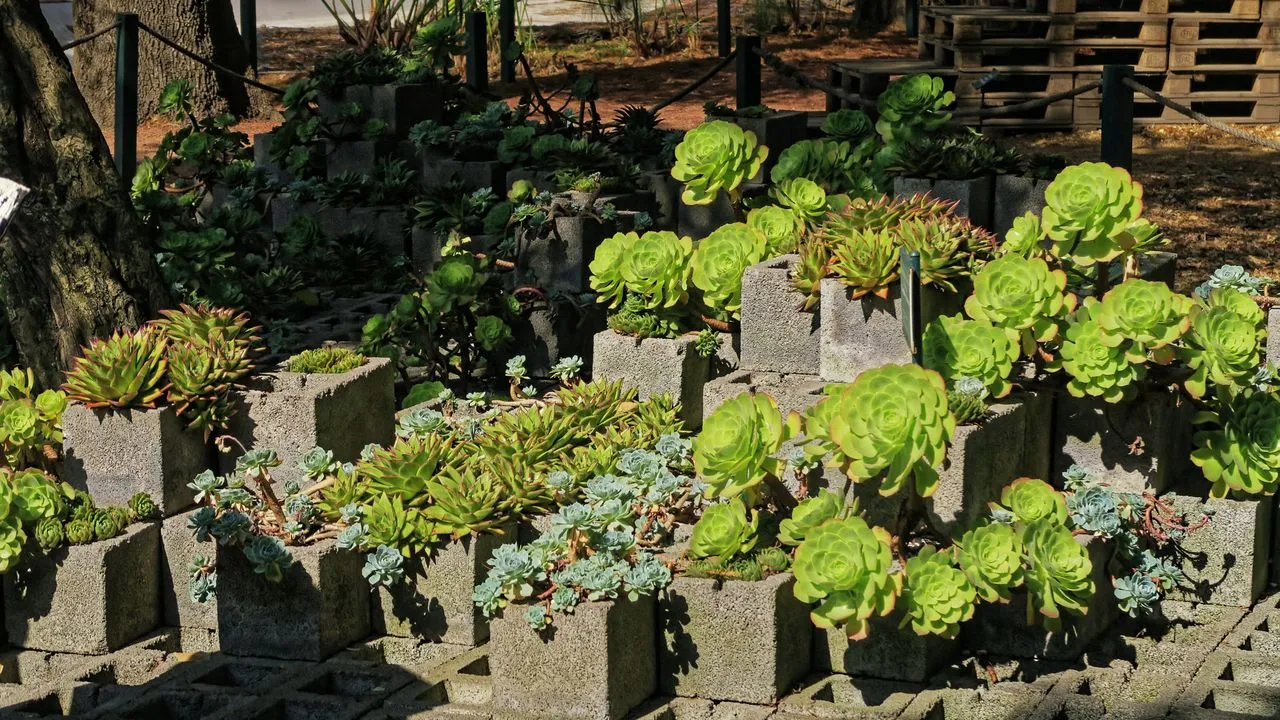
Echeveria 'Romeo Rubin' is a hybrid cultivar released by SunnySide Nursery in southern California in the early 2000s, with Echeveria agavoides as the dominant parent and Echeveria derenbergii the most likely cross partner. The plant forms a tight stemless rosette 8 to 12 cm wide of broadly triangular thick leaves, each ending in a sharp red apical mucro, and flushes from green-pink in moderate light to a deep ruby-red across the entire leaf surface under full sun and cool nights. That whole-leaf saturation runs darker than any standard E. agavoides 'Lipstick' selection, and is the trait the cultivar is grown for.
Hybrid origin
'Romeo Rubin' is not a wild species and has no natural population. SunnySide Nursery, a southern California grower that brought several E. agavoides dark selections into US trade around the turn of the century, released the plant as a patented clonal cultivar in the early 2000s. Some sources describe it as a fresh hybrid between E. agavoides and E. derenbergii; others as a stress-darkened selection from the existing 'Romeo' line. In practice the morphology sits squarely on the E. agavoides side, and the trade treats both interpretations interchangeably.
Because the cultivar is held as a clonal line, every plant descends from that original stock by offset division, leaf cutting, or commercial tissue culture. Seed-grown plants segregate so widely that none come true to the type, and 'Romeo Rubin' is therefore never sold as seed-raised. Tissue-culture lines in current circulation show visible drift: some batches lose colour intensity at the same growing temperature where reference stock holds the deep ruby flush, and a few read more bronze than red. If you are buying for a reference collection, look for cuttings or division stock with a documented chain back to a known grower rather than a generic supermarket label.
Part of the Complete Echeveria Guide.
Identification
A typical 'Romeo Rubin' rosette in cultivation runs 8 to 12 cm across, sits stemless or on a very short stem, and holds 25 to 40 thick leaves in a tight cup. Each leaf is 4 to 6 cm long, broadly triangular in cross-section, with a hardened red apical mucro that reads almost black when the plant is fully stressed. Slow growth is part of the diagnostic profile: a rooted offset typically takes 18 to 30 months to reach full mature rosette size, roughly twice as long as the wild-type 'Lipstick'. Offsets appear sparingly, usually one or two per mature plant per season, which keeps the cultivar genuinely scarcer in trade than 'Lipstick' or 'Red Edge'.
The signature character is the colour shift. In moderate light at 18 °C to 24 °C the leaves read olive green flushed pink along the upper face. Under direct sun, especially when night temperatures drop below 12 °C, the flush deepens until the entire leaf surface from base to mucro reads a saturated ruby-red, darker and more uniform than any E. agavoides selection that pigments only the tip. This whole-leaf saturation is the field separator from the sister cultivars in trade.
Three confusions are common. E. agavoides 'Lipstick' carries red only on the apical mucro itself, while the body of the leaf stays apple-green; the contrast is sharp but localised, and the rest of the rosette never flushes red. E. agavoides 'Ebony' approaches a similar dark colour but the leaves run distinctly more cylindrical and elongate, and the dark pigment concentrates at the leaf margins and tips with a green base, producing a bicolour effect 'Romeo Rubin' lacks. Echeveria 'Romeo', often labelled as a sister or parental clone, is paler in stress colour: it flushes pinkish-red rather than ruby, and at the same temperature and light intensity it reads at least one tone lighter across every leaf. If a plant labelled 'Romeo Rubin' fails to darken below pink-red even after a full cool autumn, it is either 'Romeo' under the wrong label or a drifted tissue-culture line.
Flowering is conventional for the E. agavoides side of the parentage. A lateral scape 20 to 30 cm tall carries 8 to 15 pink-orange tubular flowers with yellow throats, opening in early to mid summer. Individual rosettes seldom decline after a single bloom in this cultivar, in contrast with the wild-type E. agavoides, but spent scapes should still be cut at the base once flowering finishes.
Cultivation
Light is the single largest lever for the colour 'Romeo Rubin' is grown for, and the cultivar tolerates more direct sun than most Echeveria. Six to eight hours of unfiltered morning and early afternoon sun, after a careful spring acclimation, holds the rosette tight and pulls the leaves to their full ruby flush. Outdoors, full afternoon sun in temperate climates is acceptable on established plants; in regions where summer afternoons exceed 35 °C, a light shade cloth from 13:00 to 16:00 prevents bleaching of the colour without softening the rosette. Indoors, a south-facing window is the working minimum; supplemental grow-light at 6,000 to 8,000 lux for 14 hours a day maintains form and partial colour but seldom matches the saturation of plants grown outside.
Water is conventional for the genus. In active growth from spring through early autumn, water deeply once the top 3 to 4 cm of substrate is fully dry, typically every 7 to 12 days for a 9 cm pot at 22 °C to 28 °C. In winter, drop to one light watering every 4 to 6 weeks, or hold dry if the plant sits below 8 °C. Wet substrate at near-freezing temperatures is the primary kill switch for this cultivar. Water the substrate around the rosette rather than the rosette itself; the upward-angled triangular leaves channel water toward the growing point and standing water there invites crown rot.
Substrate runs at 65 to 75 percent mineral fraction. A working blend is 50 percent pumice, 25 percent coarse grit at 3 to 6 mm, and 25 percent peat-free loam-based compost. The pot should dry inside a 48 hour window after a thorough watering. Terracotta in 9 to 11 cm sizes suits a single mature rosette; the slow growth rate means a repot every 2 to 3 years is enough.
Temperature tolerance is moderate. Active growth runs from 8 °C to 32 °C. The frost limit on dry plants is around minus 2 °C; the leaves may show cosmetic tip damage at that point but the rosette recovers in spring. Frost combined with wet substrate is lethal. Bring the plant under cover or indoors before the first frost in regions where winter night temperatures drop below freezing.
Feeding is light. One dilute, low-nitrogen feed in mid-spring covers most plants for a season; heavier nitrogen pushes pale, soft growth that dilutes the colour the cultivar is grown for. The beginner's guide to succulents sets out the baseline rhythm the notes above adapt to 'Romeo Rubin'.
Propagation
Vegetative propagation is the only acceptable method for keeping 'Romeo Rubin' true. Three routes work, in this order of reliability.
Offset division is the cleanest, and the only method that reliably preserves the deep ruby phenotype. Plan on 1 to 2 rooted offsets per mature plant per year. Once an offset is rooted and a third the width of the parent, twist or cut it free, callus the wound for 5 to 7 days in shade, and resume light watering after about two weeks on dry mineral mix. Success runs above 90 percent on rooted offsets.
Leaf propagation works but is slower and noticeably less reliable than for E. agavoides 'Lipstick' or E. derenbergii. Take a clean sideways twist at the leaf base; torn leaves usually rot before producing a plantlet. Callus 5 to 7 days, set on barely damp pumice in bright shade at 21 °C to 25 °C, and expect a plantlet within 6 to 10 weeks at a success rate of around 30 to 40 percent. The young plant takes 8 to 12 months to reach a 5 cm rosette and another full year to express adult colour. A noticeable fraction of leaf-propagated 'Romeo Rubin' plantlets revert to a paler 'Romeo'-like colour, an instability that argues for offset division when phenotype matters.
Stem cuttings from older drawn plants are the third route. If a 'Romeo Rubin' has been kept in low light and put up a stem with a lifted rosette, decapitate the head, callus the cut for 7 to 10 days, and root it on dry mix; the stub usually flushes new offsets at the cut site within 8 to 12 weeks.
Seed is not a viable route. As a hybrid clone, 'Romeo Rubin' does not come true from seed, and even self-fertilised offspring segregate too widely to resemble the named clone. Anyone selling Echeveria Romeo Rubin seeds is selling a mislabelled product.
Notes
The most common provenance problem is tissue-culture drift. Stock from large Dutch propagation labs in the 2010s sometimes reads visibly paler than reference cuttings from California growers, and the gap widens under the cool, bright conditions where 'Romeo Rubin' should be at its darkest. If you are buying online, ask the seller whether the plant is propagated from offsets or from tissue culture, and compare a photo taken under cool autumn conditions, not high-summer indoor light.
Pests are conventional for the genus. Mealybugs hide in the dense crown and at offset bases and need a check every season; the stiff upright leaves make inspection easier than on soft-leaved species. Treat with a 70 percent isopropyl alcohol swab on a cotton bud at affected sites rather than a foliar spray, since alcohol pooled in the growing point can damage new leaves.
'Romeo Rubin' is not toxic to humans, dogs, or cats in any meaningful sense. It tolerates handling well, but the sharp apical mucros are stiff enough to score skin if you grab the rosette firmly, so lift by the substrate or the pot rather than the leaves.
See also
- Complete Echeveria Guide — genus-level substrate, light, and propagation principles.
- Echeveria agavoides — the dominant parent species, with cultivar notes on 'Lipstick', 'Ebony', and 'Red Edge'.
- Echeveria 'Perle von Nürnberg' — a different style of widely grown Echeveria hybrid for context on cultivar naming and trade circulation.
Frequently Asked Questions
How does 'Romeo Rubin' differ from Echeveria agavoides 'Lipstick'?
'Lipstick' keeps red mainly on the mucro, while 'Romeo Rubin' colours across the whole leaf surface under bright cool conditions.
Why is my 'Romeo Rubin' not ruby red?
It needs direct sun and cool nights below about 12 °C for full saturation. Warm dim conditions leave it olive-green to pink.
What is the best way to propagate 'Romeo Rubin'?
Offset division best preserves the deep ruby phenotype. Leaf propagation works at only about 30 to 40 percent and may produce paler plants.
Is 'Romeo Rubin' frost hardy?
Dry plants can tolerate around −2 °C with cosmetic damage, but frost with wet substrate is lethal.