| Question | Short Answer |
|---|---|
| How big does Echeveria agavoides get? | Mature rosettes are typically 8–12 cm across, occasionally up to 20 cm in prime conditions. |
| Is Echeveria agavoides cold-hardy? | Dry specimens tolerate brief drops to −2 °C with cosmetic tip damage only. |
| How do you tell Echeveria agavoides from Echeveria colorata? | E. |
| Why is my Echeveria agavoides losing its red tip? | Insufficient light. |
Echeveria agavoides (Lem.) Walp., described by Charles Antoine Lemaire in 1863, is endemic to north-eastern Mexico, occurring on limestone outcrops and rocky hillsides in San Luis Potosí, Hidalgo, and Querétaro at 1,400 m to 1,800 m. The defining character is a tight, solitary rosette of stiff, triangular leaves, each ending in a sharp, hardened red apical mucro (the feature behind the common name lipstick echeveria). Among cultivated Echeveria, it stands out for tolerating more direct sun than most relatives and for carrying the largest pool of named cultivar selections in the genus.
In the wild, plants occupy exposed calcareous substrate alongside small agaves and drought-adapted bunchgrasses. The climate is semi-arid: a dry season runs from October to April, with summer monsoon rains from June to September. Night temperatures at elevation fall near 0 °C in January and February. That high-altitude thermal range explains why E. agavoides handles cold and sun better than lowland soft-leaved relatives, and why cultivation routines written for the genus average tend to under-serve it.
Part of the Complete Echeveria Guide.
Identification
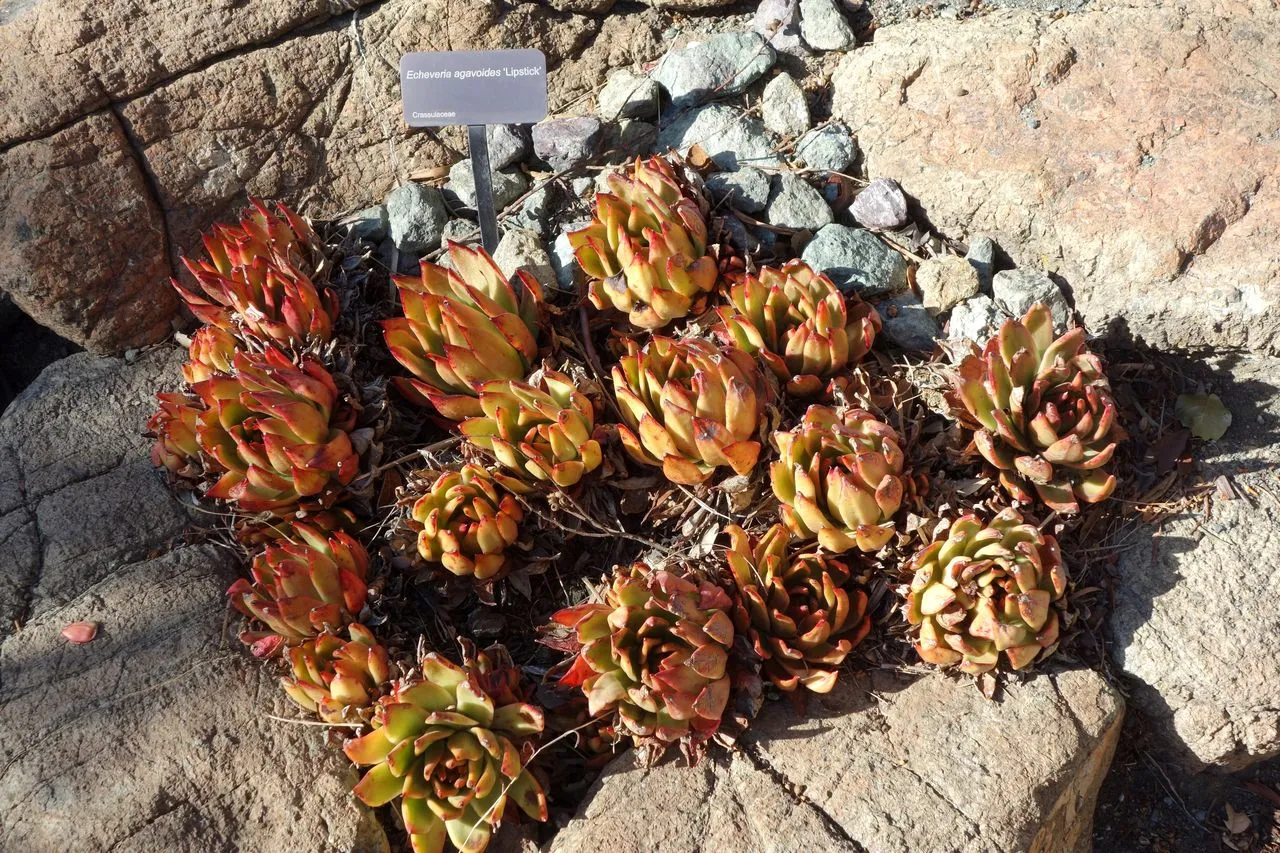
The rosette is solitary when young, typically 8–12 cm across at maturity in cultivation, with specimens recorded up to 20 cm in prime conditions. Leaves are 5–8 cm long, triangular in cross-section with a firm, keeled upper surface and a slightly rounded lower surface. Colour is apple-green to olive with a smooth, waxy finish. The single most diagnostic character is the terminal mucro: a rigid, red-to-carmine point at the tip of each leaf. In direct sun or at temperatures below 15 °C, the mucro deepens toward crimson; in shade it fades to dull pinkish-orange. Red pigmentation along the lateral margins varies considerably by cultivar and is covered in detail below.
Flowers emerge on a lateral scape 20–35 cm tall, carrying a cincinnus of 10–20 red-orange tubular flowers with yellow interiors. Flowering occurs in spring, typically March through May in the Northern Hemisphere. Individual rosettes may decline after a heavy bloom, particularly in older plants that have not yet produced offsets (see Notes).
Lookalikes. The most common confusion in trade is with Echeveria colorata, which shares the pointed, triangular leaf and red tip. The separator is the margin character: E. agavoides has a discrete red mucro with apple-green leaf edges, while E. colorata shows a diffuse pinkish-red blush running along the full leaf margin, giving each leaf a softer, dustier appearance. A second source of confusion is the large number of nursery hybrids sold simply as "agavoides" or "agavoides hybrid." These plants typically have broader, less pointed leaves with pinkish rather than carmine tips, and the leaves flex noticeably when pressed. True E. agavoides leaves feel rigid to the touch; that stiffness is a reliable field character absent in most hybrids.
Cultivation
Light. E. agavoides tolerates, and in most conditions prefers, direct sun for 6–8 hours daily. This is atypical in the genus: most Echeveria need shading during summer midday hours. Outdoors, established plants handle full afternoon sun without scorching once acclimated gradually. Indoors, a south-facing window is the minimum adequate position; supplemental grow-light at 5,000–6,000 lux for 14 hours per day maintains compact form in the absence of direct sun. Under-lit plants lose their red mucro colouration within 4–6 weeks and begin producing longer, thinner leaves that lose the triangular cross-section characteristic of the species.
Water. Water when the top 3–4 cm of substrate is completely dry. In active growth from spring through early autumn, that typically means every 7–10 days under warm indoor conditions. In winter, a single watering per month is adequate when temperatures stay below 12 °C. Water the substrate rather than the plant: the upward-angled, tightly packed leaves channel water toward the growing point, and standing water there invites rot.
Substrate. A mineral-dominant mix performs best: 50% pumice, 30% coarse grit (3–5 mm), 20% peat-free loam. Pre-packaged cactus compost from general garden retailers needs at least 50% additional pumice or perlite before it drains adequately for this species. Terracotta pots help: the porous walls wick moisture and reduce root saturation risk compared with glazed or plastic containers.
Temperature. The practical hardiness range for most cultivars is approximately 1 °C to 35 °C. Dry specimens tolerate brief drops to −2 °C with cosmetic tip damage only. Frost combined with wet substrate is lethal. The high-elevation provenance makes this one of the more cold-tolerant soft echeverias, but that tolerance disappears when the substrate holds moisture in freezing conditions.
Growth rate. Slow. A vegetatively propagated offset reaches mature flowering size in 18–24 months; a leaf-propagated plantlet takes 3–4 years. New leaves emerge one at a time from the growing centre; a healthy adult rosette adds 6–10 leaves per growing season.
Propagation
E. agavoides can be propagated by leaf, offset, stem cutting, and seed, but each method has species-specific quirks that differ from the genus average. Leaf propagation works at 60–80% for the wild-type but drops to around 30% for dark cultivars like 'Romeo Rubin' and 'Ebony'. Offsets are produced sparingly (usually two or three per mature plant) and take several years to appear. Seed requires two unrelated plants flowering simultaneously and comes true only for the wild-type, not for clonal cultivars.
For full step-by-step instructions, substrate mixes, and timing across all four methods, see the dedicated Echeveria agavoides propagation guide.
Cultivars in Trade
E. agavoides carries the deepest cultivar bench of any single Echeveria species in current commercial circulation. The distinctions between selections matter practically: red-leaf phenotypes vary enormously in intensity, thermal trigger temperature, growth speed, and propagation reliability.
'Lipstick'
The reference cultivar and the most widely available. Leaves are apple-green with a cleanly defined carmine mucro 3–5 mm long that deepens when daytime temperatures drop below 15 °C or light intensity increases in late summer. The red stays concentrated near the tip and does not travel far along the margins. 'Lipstick' behaves essentially as the wild-type in cultivation: robust, offset-producing by year three or four, and propagating by leaf at 60–75% success. It is a reasonable starting point before acquiring the slower dark selections.
'Romeo Rubin'
A Dutch trade selection with deep burgundy-red pigmentation spread across the entire leaf surface rather than concentrated at the tip. Under cool, bright conditions the leaves read near-black; in warm lower-light conditions they revert to a dusky olive-red. The cold-stress response begins when night temperatures fall below 18 °C and intensifies markedly below 12 °C, a wider trigger window than 'Lipstick'. Growth is noticeably slower: a rooted leaf typically takes 6–8 months to reach potting-on size. Sold sometimes simply as 'Romeo'. Offset propagation maintains the dark phenotype more reliably than leaf propagation for this selection.
'Ebony'
The most extreme of the commonly traded cultivars in terms of anthocyanin expression. Leaf margins and tips approach blackish-purple in high-sun and cool-night conditions; the leaf base remains green, producing a bicolour contrast absent in 'Romeo Rubin'. Growth is slow and offset production modest, which keeps it genuinely scarcer than 'Lipstick' or 'Red Edge'. Leaf propagation succeeds at roughly 30%, so offset division is the preferred multiplication method. Among collectors who grow for rosette form, the slow pace is part of the appeal.
'Red Edge'
Distinguished by the distribution of red rather than its depth: a continuous red band runs along the full lateral margin of each leaf while the central leaf face stays apple-green. The contrast is sharpest in direct sun and fades to pale pink in shade. 'Red Edge' grows faster than 'Ebony' and produces offsets at roughly the same rate as 'Lipstick'. It is occasionally confused with Echeveria pulidonis, which carries a similar red marginal stripe, but E. pulidonis has distinctly shorter, more spathulate leaves with a blunter tip and a considerably smaller mature rosette diameter.
'Lipstick Christmas'
A selection developed or marketed for reliable winter colour at the mild indoor temperatures common in northern European homes (15–18 °C). The mucro is longer and broader than in standard 'Lipstick', and the red extends further down the margin without requiring a cold-stress trigger below 10 °C. Provenance documentation is sparse in the horticultural literature, and some stock sold under this name appears to be propagated mixed seedlings rather than a single stable clonal line. To confirm the selection, grow through one full thermal cycle: genuine 'Lipstick Christmas' shows consistent deep carmine at 15 °C without supplemental cold stress. If the tips fade to orange-pink at that temperature, the plant is a seedling form or an incorrectly labelled cultivar.
A note on buying. All five selections above require vegetative propagation to maintain their phenotypes. Plants labelled 'Lipstick' from general garden centres are frequently open-pollinated seedlings with variable tip colour. If the mucro reads pinkish-orange rather than clean carmine, you have a seedling form rather than the clonal cultivar; it may still be a good plant, but it will not reliably darken on cue.
Notes
Mealybugs are the primary pest on this species, appearing most often in the tight axils at the base where the leaves meet the stem. The stiff, upright leaf arrangement makes inspection easier than on soft-leaved species. A weekly check during the growing season catches infestations before they establish. Treat with a cotton swab dipped in 70% isopropyl alcohol applied directly to each insect; avoid dripping alcohol into the growing point.
The common name "lipstick echeveria" refers to the species E. agavoides as a whole, not to the cultivar 'Lipstick' specifically. Both share the name, which causes genuine confusion when buying. Suppliers listing plants as "lipstick succulent" may be selling the wild-type, the 'Lipstick' cultivar, or occasionally an unrelated plant that borrows the name colloquially. Carmine-tipped tips under neutral light are the reliable differentiator from impostors.
See also
- The Complete Echeveria Guide: genus-wide cultivation, substrate, and propagation fundamentals.
- Echeveria elegans: the soft-leaved Mexican snowball; a study in contrast with the stiff, sun-tolerant E. agavoides.
- Echeveria 'Perle von Nürnberg': one of the most widely grown echeveria hybrids, for context on cultivar naming practices in the genus.
Frequently Asked Questions
How big does Echeveria agavoides get?
Mature rosettes are typically 8–12 cm across, occasionally up to 20 cm in prime conditions. Growth is slow: three to four years to flowering size from a propagated leaf.
Is Echeveria agavoides cold-hardy?
Dry specimens tolerate brief drops to −2 °C with cosmetic tip damage only. Frost combined with wet substrate is lethal. The high-altitude provenance makes it more cold-tolerant than most soft Echeveria.
How do you tell Echeveria agavoides from Echeveria colorata?
E. agavoides shows a discrete red mucro with apple-green leaf edges; E. colorata shows a diffuse pinkish-red blush along the full margin. Pressed leaves: agavoides feels rigid, colorata flexes.
Why is my Echeveria agavoides losing its red tip?
Insufficient light. Mucro colour fades within four to six weeks below adequate light, and leaves begin to lose their triangular cross-section. Move to a south window or supplemental grow-light at 5,000–6,000 lux.