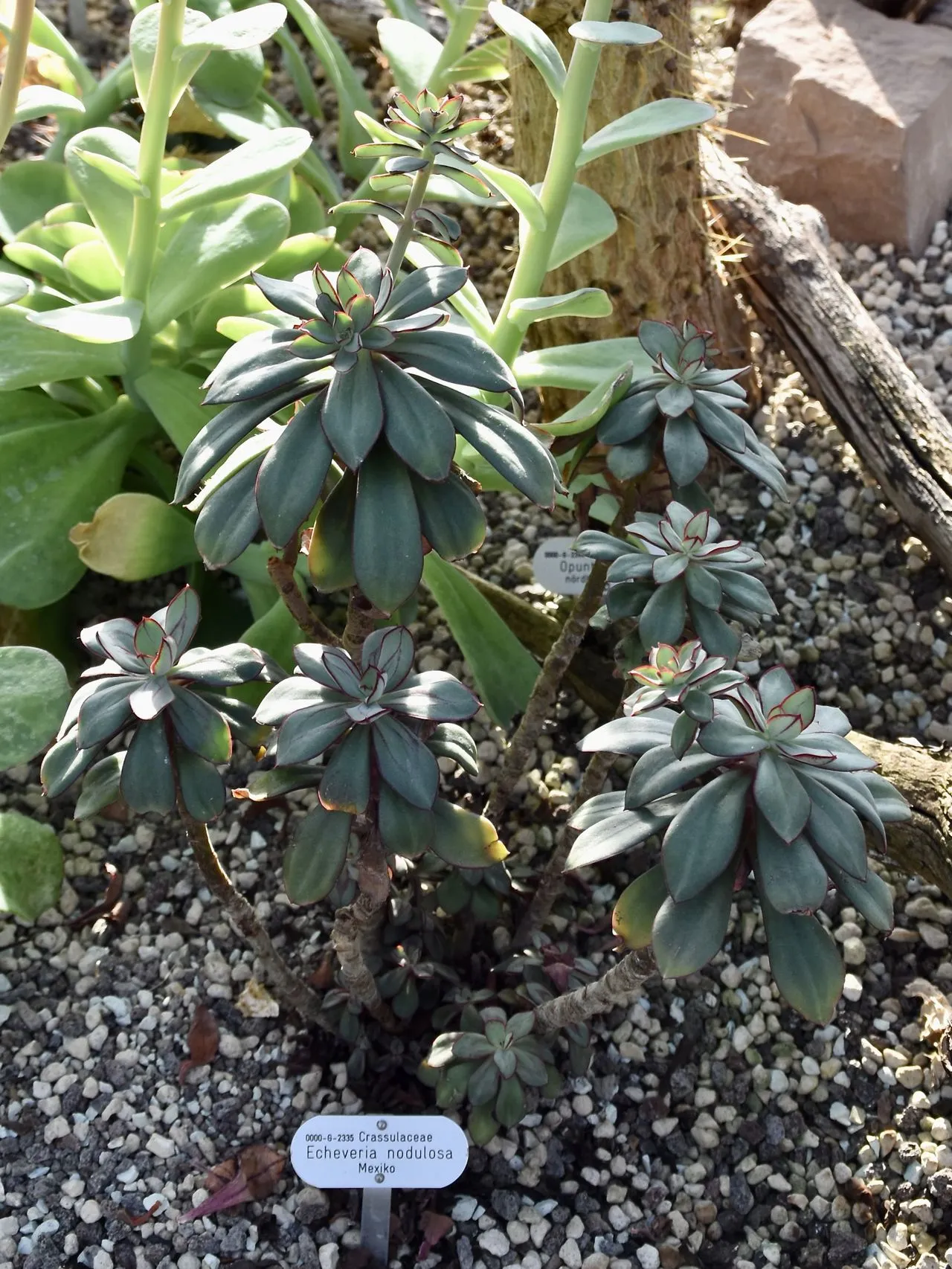
Crown rot is the most urgent Echeveria emergency. Unlike the gradual lower-leaf loss or the slow spread of yellowing driven by overwatering, crown rot at the growing point can move from a first soft spot to a collapsed stem base in 24 to 48 hours under warm conditions. The mechanism is primarily enzymatic: once bacterial soft rot or opportunistic fungi breach the cell walls at the meristematic growing point, they secrete enzymes that break down surrounding tissue in a cascade. The only reliable intervention is physical — cut all affected tissue back to visibly clean, firm, dry material, then re-root the surviving portion.
Part of the Complete Echeveria Guide.
Water pooling in the rosette
The primary cause. Echeveria rosettes are structurally cup-shaped: overlapping leaves direct rain, condensation, and irrigation water toward the growing point. In outdoor conditions with strong airflow and warm temperatures above 20 °C, the cup drains and dries within a few hours. In cooler, more humid, or still-air conditions, water can sit at the crown for 12 to 24 hours or more. Even a small volume of standing water in contact with the soft new-growth tissue at the growing point can trigger bacterial rot if conditions prevent evaporation.
Overhead watering is the most direct trigger. Echeveria must always be watered at soil level, not from above. A watering can aimed at the rosette cup rather than the pot rim, a sprinkler system, or overhead irrigation in a greenhouse delivers water exactly where it should not go. A single thorough soaking of the rosette on a cool, overcast day can initiate rot in a susceptible plant — and the damage will not be visible for 24 to 48 hours, by which point the process is already well advanced.
High humidity and restricted airflow
High ambient humidity slows evaporation from the rosette surface. Echeveria grown outdoors in dry, breezy conditions dry quickly after any moisture reaches the crown. The same species grown indoors in a still room at 60–70% relative humidity, or in a warm, poorly ventilated greenhouse in summer, may retain moisture in the crown for many hours.
Enclosed growing environments are particularly high-risk. A sealed glass cabinet, a terrarium, or a cold frame with limited ventilation creates the conditions that favour rot: moisture accumulates, airflow is minimal, and the temperature differential between night and day produces condensation directly onto the growing point. Echeveria are not terrarium plants. They need open air and airflow around the rosette.
Small wounds on the growing point — from pest feeding, accidental contact with tools, or rough handling — also become entry points under humid conditions that would be inconsequential in dry, well-ventilated settings. This is one reason mealybug colonies at the stem base can precede crown rot: feeding damage on the axial tissue creates entry points that only become a problem under the right humidity conditions.
Winter watering mistakes
Winter presents a compounded risk. Growth slows dramatically, the plant's water use drops, and indoor air is typically still rather than ventilated. Transpiration from leaves can fall to 10–15% of summer rates at temperatures below 12 °C. A substrate that dries in two days in summer may take 10 to 14 days at the same watering volume in a cool winter room.
If watering frequency and volume continue at the summer rate into autumn and winter — a very common mistake as the shift from outdoor to indoor conditions is gradual — the substrate stays wet for extended periods, and any moisture that reaches the crown cannot evaporate through the cold, still air. This is the standard recipe for late-winter crown rot in indoor Echeveria collections.
During winter storage, water only at the substrate surface. If moisture reaches the rosette, tilt the pot immediately and blot the crown with a clean dry cloth or folded paper towel. Keep plants in a ventilated position, even if that means a cooler spot near a slightly open window, rather than a warm, still interior shelf.
Root rot progressing to the crown
Crown rot can also be the visible end stage of root rot that has moved up through the stem. A plant with black, foul-smelling roots loses the ability to regulate water uptake. As the stem tissue becomes involved, the rot moves upward. By the time softness and discolouration appear at the rosette centre, the underlying stem section is often already compromised.
This pathway differs from water-on-crown rot in one diagnostic way: the lower stem feels soft before the crown shows obvious damage. Press gently at the stem base, between the substrate surface and the lowest leaves. If that tissue is soft or discoloured while the crown still looks firm, root rot is the origin. The root rot diagnosis and recovery guide covers this progression in detail.
How to identify crown rot
| Feature | Crown rot | Normal leaf senescence | Over-watering from roots |
|---|---|---|---|
| Location | Growing point, innermost leaves | Oldest outer leaves only | Lower to mid leaves |
| Texture | Soft, wet, translucent | Papery, dry | Mushy, glassy |
| Smell | Sour or fermented | None | Faint if advanced |
| Speed | Hours to a few days | Weeks | Days to weeks |
| Spread direction | Outward from centre or downward | Stable outer zone | Upward from base |
The diagnostic test is a gentle press on the very centre of the rosette with one fingertip. A healthy growing point feels firm and slightly resistant. Soft, yielding tissue indicates active rot. A sour or fermented smell at the centre — even before visible discolouration — is often the earliest detectable sign.
Do not mistake the naturally concave or cupped form of the growing point for a rot symptom. In many species, the innermost leaves form a tight column, and the centre looks like a small cup even on perfectly healthy plants.
Risk and severity
Crown rot at the growing point is a same-day emergency. Every hour the rot remains in contact with living meristematic tissue reduces the viability of a surgical rescue. A plant where only the innermost one or two leaves are affected, with firm tissue still visible when those leaves are removed, can usually be saved by cutting. A plant where the rot has moved into the upper stem — visible as soft brown tissue when the lowest leaves are pulled away — may still be saved by cutting deeper, provided at least 1 to 2 cm of dry, firm, green stem remains below the cut.
A plant where rot has reached the root collar — the junction of stem and roots at substrate level — is almost certainly lost as a rosette. The practical step at that point is to harvest the outermost healthy leaves for propagation before the rot reaches their leaf bases. Leaf propagation does not require any stem tissue, only that the complete leaf base is intact when detached.
Solutions
Immediate excision
Wipe a sharp blade with 70% isopropyl alcohol. Cut the rosette horizontally above the visible rot line, where tissue is dry and firm. Keep cutting until every surface of the exposed cut shows pale green, cream, or white tissue with no brown or translucent areas. Even a cut that removes most of the rosette is preferable to leaving any rot. Dust the cut surface lightly with powdered sulphur or activated charcoal to reduce secondary infection risk.
Set the cutting — cut-side exposed to airflow — in bright shade for seven to ten days to callus. Do not place it on substrate yet; contact with damp soil before the cut is fully sealed invites reinfection.
Re-rooting the surviving top
Once the cut surface has calloused to a dry, slightly papery seal, pot the cutting into dry mineral mix with 2 to 3 cm of stem embedded. The beheading and re-rooting procedure applies here exactly: hold the cutting dry for five to seven days, then water lightly at the pot edge. New roots emerge within two to four weeks depending on temperature and species. At 22 to 25 °C in good light, root initiation typically takes 10 to 14 days.
Salvaging leaves for propagation
If the rosette centre is entirely lost, remove healthy outer leaves cleanly before discarding the plant. Twist each leaf at the base to extract it with the full basal node — a torn base will not propagate. Lay the leaves on dry mineral substrate in bright indirect light. Plantlets develop from the leaf base within three to six weeks on most cultivated species.
Correcting the underlying cause
The physical cut is the emergency response. The underlying cause — overhead watering, standing water in the crown, or high humidity without airflow — must be corrected to prevent recurrence. Switch to a narrow-spout watering can aimed at the pot rim. Move the plant to a well-ventilated position. Reduce watering frequency through cool periods, calibrating to the actual drying rate of the substrate rather than a fixed schedule.
Prevention
Water at substrate level only. This single rule prevents most crown rot cases. A narrow-spout watering can, a bulb irrigator, or drip irrigation delivering water to the pot surface — not the plant — eliminates the primary cause.
Ensure airflow around the rosette. Packed windowsill collections and still greenhouse air both significantly extend drying time at the leaf surface. Space plants so rosettes do not overlap, run a small fan in enclosed spaces during warm months, and never place Echeveria directly against glass where condensation pools.
In winter, reduce watering volume and frequency proportionally to the drop in temperature and transpiration rate. A plant that needs water every 7 to 10 days in summer may need it only every 3 to 5 weeks in a cool indoor environment below 12 °C. The substrate drying rate — not the calendar — determines the interval.
Inspect the growing point during each watering session. A brief check — looking at the centre for any discolouration, unusual wetness, or changed texture — costs five seconds per plant and can catch crown rot a full day before it becomes an unrecoverable problem.
See also
- Root rot diagnosis — full procedure for inspecting roots and cutting back damaged tissue when rot originates below the substrate.
- Echeveria losing bottom leaves — basal leaf drop is frequently confused with early crown decline; the two have opposite spread directions.
- Echeveria leaves turning yellow — yellow tissue in over-watering scenarios moves from base toward crown; in crown rot it moves from the growing point outward.
Frequently Asked Questions
Can Echeveria recover from crown rot?
The rotted tissue cannot recover — rot is irreversible cell death. If firm clean tissue remains above the rot line, cut there and re-root the rosette as a cutting. If rot has reached the stem base, only outer leaves remain salvageable for propagation.
What does Echeveria crown rot smell like?
Sour, fermented, or faintly sulphurous. Any unusual smell at the centre of the rosette — even before visible discolouration — warrants pressing the centre gently to check firmness.
Is crown rot the same as root rot in Echeveria?
They are related but different. Root rot begins in the roots and moves up through the stem. Crown rot begins at the growing point, triggered by standing water at the rosette surface. Both require cutting all affected tissue back to clean, dry material.
Can I propagate from a plant that has crown rot?
Yes. Healthy outer leaves that detach cleanly at the base — with the full leaf node intact — can be laid on dry substrate for leaf propagation. Remove them before the rot spreads to their bases.