| Question | Short Answer |
|---|---|
| How large does Echeveria subrigida grow? | True plants mature at 25 to 40 cm wide, with broad 10 to 18 cm leaves and a short stout stem. |
| How is Echeveria subrigida different from Echeveria cante? | E. |
| Can Echeveria subrigida be propagated from leaves? | Leaf propagation is unreliable at about 30 to 50 percent. |
| Is Echeveria subrigida endangered? | The post notes a Vulnerable listing and warns against wild-origin material. |
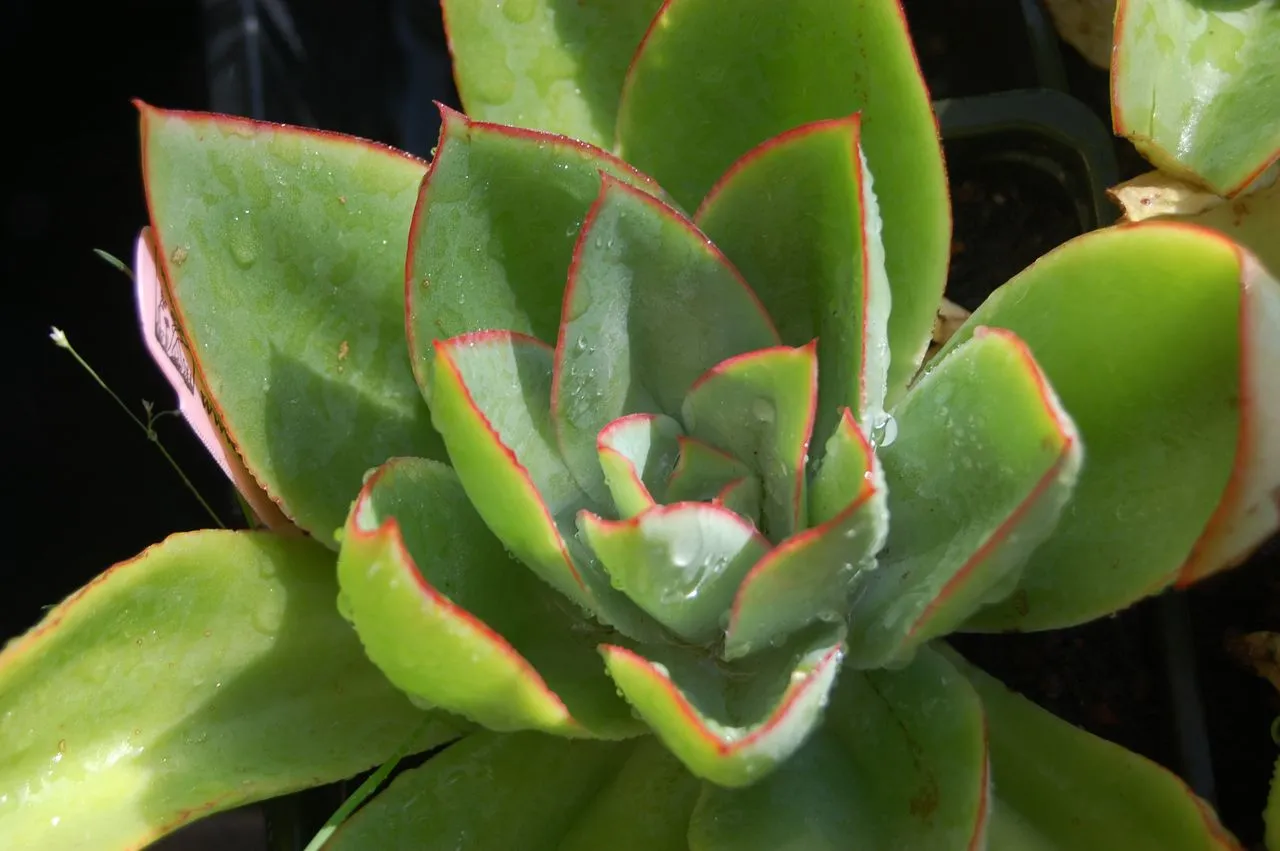
Echeveria subrigida (B.L.Rob. & Seaton) Rose was treated in its current genus by Britton & Rose in 1909, having been described originally by Robinson and Seaton as Cotyledon subrigida. The species occupies a narrow geographic band across the states of Hidalgo, San Luis Potosí, and Querétaro, in east-central Mexico, where rosettes anchor in fissures on near-vertical limestone cliffs between roughly 2,000 m and 2,800 m. It is one of the largest open rosettes in the genus, distinguished at sight by a vivid red to red-pink leaf margin running the full length of every leaf, framing a heavily glaucous blue-grey-green lamina. Collectors call it the hot-margined echeveria for that single feature.
In habitat, E. subrigida sits on the limestone country of the southern Sierra Madre Oriental and the Sierra Gorda. The substrate is decomposed limestone with negligible organic content. The climate is cool montane: cold dry winters with night frost, warm summer thunderstorms, and a heavy ultraviolet load that pushes the leaf chemistry toward the wax and red pigment for which the species is grown. The IUCN lists E. subrigida as Vulnerable, with collecting pressure and the slow, cliff-bound nature of the populations as the leading threats. Most cultivated material traces back to a small number of seed lots and clonal lines distributed since the 1970s, and hybrid drift is now a serious problem in the trade.
Part of the Complete Echeveria Guide.
Identification
A mature E. subrigida sits 25 to 40 cm wide and is comfortably one of the largest rosettes in the genus. The form is open and slightly cupped on a short stout stem. Leaves are broadly obovate, 10 to 18 cm long and 6 to 10 cm wide at the broadest point, thick and rigid with a rounded apex tipped by a short mucro.
Three characters carry the identification.
- The margin. Each leaf carries a strong red to red-pink edge running unbroken from base to apex, sharply demarcated against the silvery body. The colour intensifies under cold nights, dry roots, and high UV; in mid-winter on a Mediterranean balcony the margin can read near-magenta. This is the diagnostic feature of the species. No other large-bodied Echeveria carries a margin this saturated and this consistent across every leaf.
- The body. The lamina is a cool blue-grey-green coated in a moderate, even glaucous bloom. The wax reads silver in raking light but is markedly more durable than the bloom of E. cante or E. laui: a fingerprint dulls the surface without scoring it, and the wax re-films within a season on undamaged tissue. This is one of the few large pruinose echeverias that tolerates ordinary handling without lasting cosmetic loss.
- The inflorescence. In summer the species sends up a tall arching lateral panicle 50 to 80 cm long, sometimes branched once or twice, bearing pink to coral-red urn-shaped flowers with yellow throats. The scape is robust, the same waxy blue-grey as the leaves, with red-margined bracts.
Distinguishing from common lookalikes:
- Echeveria cante shares the red leaf margin and a broad size class, but the body reads paler (almost white-silver rather than blue-grey), the leaves are longer and narrower in profile (8 to 15 cm long, 4 to 6 cm wide), and the wax is far more fragile. A fingerprint leaves a permanent dark print on cante that subrigida shrugs off.
- Echeveria laui is much smaller (8 to 12 cm wide) and carries no margin at all. The body of laui is pinkish-grey under the heaviest white wax in the genus, with peach-coral stress flushes rather than a sharply defined edge.
- Echeveria peacockii is also red-margined but dramatically smaller (rosettes 8 to 15 cm), with thinner leaves and a redder, more saturated edge. E. subrigida × E. peacockii hybrids are extremely common in retail and combine a mid-sized rosette with a dramatic margin; a plant labelled E. subrigida that is obviously smaller than 18 to 20 cm at maturity and offsets prolifically has peacockii in the parentage.
Cultivation
Light should be full sun once acclimated. In Mediterranean conditions a south-facing position outdoors holds the rosette tight, deepens the wax, and brings the red margin to its full intensity. Indoors, anything less than a south or south-west window starves the plant: the rosette flattens, the margin fades to a dull pink, and the body greens up as the wax thins. Acclimate slowly when moving from indoor to outdoor sun; even though the bloom is durable, fresh tissue can scorch through the first hot week.
Water with mechanism, not habit. The cupped rosette holds water for hours after a watering, and crown rot is the leading cause of death in cultivation, so water onto the substrate at the rim of the pot, never overhead. In active growth (late spring through early autumn), water deeply once the top 4 cm of the mix is dry and the lower leaves have lost a fraction of their firmness. For an 18 to 22 cm pot, that is typically every 12 to 18 days in warm weather. In winter, drop to a single watering every 5 to 6 weeks, and only if the plant sits above 8 °C with airflow.
Substrate should be 70 to 80 percent mineral. A working mix is 4 to 8 mm pumice or lava grit with a small fraction of peat-free loam-based compost and a generous pinch of crushed limestone or oyster shell to match the cliff chemistry. The pot must dry inside 48 to 72 hours after a full watering. E. subrigida needs more root volume than smaller relatives: an unglazed terracotta pot in the 22 to 28 cm range suits a mature plant. Repot every two to three years before the substrate breaks down.
Cold tolerance is moderate. Dry plants take brief dips to about minus 2 °C without lasting damage; leaf tips and the margin may scorch and the wax may bleach in patches, but the rosette recovers cleanly in spring. Wet roots near freezing will rot the plant in a single weekend. Bone-dry below 5 °C is the rule, with moving air and bright light. In summer, the rosette tolerates 35 °C in shade with airflow and dislikes still hot air against a south wall.
If you are moving up from smaller, more forgiving rosettes, the beginner's guide to succulents covers the watering and substrate baseline that the notes here refine for a large pruinose species.
Propagation
Offset division is reliable but slow. Wild-type E. subrigida is a sparing offsetter; mature plants produce one or two basal pups a year on a short stout stem, sometimes none in cool growing seasons. Once an offset has put out its own roots and reached about a third of the parent's width, cut it free with a clean blade, callus the wound for 10 to 14 days in shade, and pot into dry mineral mix. Resume watering after about two weeks. Success on rooted offsets runs above 90 percent. Hybrid stock offsets much more freely, which is one of the easier circumstantial tells in the trade.
Leaf propagation is unreliable on this species. Detached leaves callus willingly, but the strike rate sits around 30 to 50 percent, and the resulting plantlets are slow to size up. It is not the right method for any quantity. Stem cuttings from a leggy plant work better: behead the rosette, callus the cut for 10 to 14 days, and root in dry pumice. The decapitated stump usually breaks dormancy and produces two or three new heads within a season, giving you both the rooted top and a multi-headed clump.
Seed is the route used by specialist nurseries, and it is the source of the trade hybrid problem. E. subrigida hybridises freely in cultivation with E. cante (similar bloom timing) and especially with E. peacockii (the basis for several named horticultural clones). Seedlings from a mixed collection segregate into a hybrid swarm within a few generations. For a clean species reference, propagate vegetatively from a known clonal line, or buy seed from a specialist with documented Mexican wild-origin provenance.
Notes
The hybrid problem deserves naming directly. A large fraction of plants offered as E. subrigida in retail are E. subrigida × E. peacockii or E. subrigida × E. cante hybrids. The tells are a mid-sized rosette (12 to 20 cm) where a true subrigida should reach 25 cm or more, prolific basal offsetting, a body colour closer to pure green or pure silver than to blue-grey, a thinner margin, and faster overall growth. The horticultural plant 'Subsessilis' (often listed as E. subrigida × E. peacockii) is one of the most frequently mislabelled of these. Specialist nurseries with Mexican provenance lines remain the safest source for collection-grade material.
Pests are conventional. Mealybugs colonise the dense leaf bases and the woolly basal stem, where the bloom hides them; check carefully at every repotting, and use a soft brush rather than a swab. Aphids cluster on the long inflorescence and clear with a fingertip wipe. Crown rot is the dominant cause of cultivation loss and follows almost every case of water sitting in the rosette in cool weather. The species is not toxic to humans, dogs, or cats in any meaningful sense.
The Vulnerable listing matters in practice. Wild-origin material still circulates among collectors, and the cliff-bound populations in Hidalgo, San Luis Potosí, and Querétaro do not recover quickly from collecting pressure. Buy from nurseries that propagate from cultivated stock, prefer named provenance where available, and avoid plants offered as field-collected without paperwork.
Compared with its closest siblings in the trade, E. subrigida sits in a useful middle position. It carries the red margin of E. cante without the bloom fragility, and the architectural scale of a large pruinose echeveria without the fastidious handling of E. laui. Treat it as a long-term resident, water it from the side, and let the margin earn its colour through dry winters and bright summers.
See also
- Complete Echeveria Guide — genus-level light, substrate, and propagation principles.
- Echeveria cante — the paler red-margined relative with much more fragile bloom.
- Echeveria laui — the small powder-coated relative without margins.
Frequently Asked Questions
How large does Echeveria subrigida grow?
True plants mature at 25 to 40 cm wide, with broad 10 to 18 cm leaves and a short stout stem.
How is Echeveria subrigida different from Echeveria cante?
E. subrigida is bluer and its wax is more durable. E. cante is paler white-silver and fingerprints permanently mark the bloom.
Can Echeveria subrigida be propagated from leaves?
Leaf propagation is unreliable at about 30 to 50 percent. Offsets are cleaner when available, and stem cuttings work for leggy plants.
Is Echeveria subrigida endangered?
The post notes a Vulnerable listing and warns against wild-origin material. Buy nursery-propagated plants with provenance where possible.