| Question | Short Answer |
|---|---|
| How big does Echeveria cante get? | Mature rosettes usually reach 25 to 40 cm across in cultivation. |
| How do you protect Echeveria cante's white bloom? | Handle only by the pot or lower base and water from the side. |
| Is Echeveria cante cold hardy? | Dry plants can take brief dips near 0 °C and sometimes −2 °C with scars. |
| How is Echeveria cante different from Echeveria lilacina? | E. |
Echeveria cante Glass, Mendoza-García & Foster, the white cloud echeveria, was described in 1997 from material collected in the limestone country of northwestern Zacatecas, Mexico. It is a relatively recent addition to formal taxonomy, but in the trade it has become one of the most recognised large echeverias, mostly because of the heavy white-pruinose wax that gives the species both its scientific epithet (cante meaning pale, gleaming) and its English name.
In habitat, E. cante clings to vertical and near-vertical limestone cliffs in Zacatecas and Durango, between roughly 2,200 m and 2,800 m. The exposure is severe and clean: full sun, cold dry winters, intense ultraviolet radiation, and very little organic substrate beyond what gathers in fissures. The IUCN lists the species as Vulnerable, with collecting pressure and the slow, cliff-bound nature of the populations as the main threats. The Cante Botanical Garden in San Miguel de Allende holds reference material and was the source of the type description.
Part of the Complete Echeveria Guide.
Identification
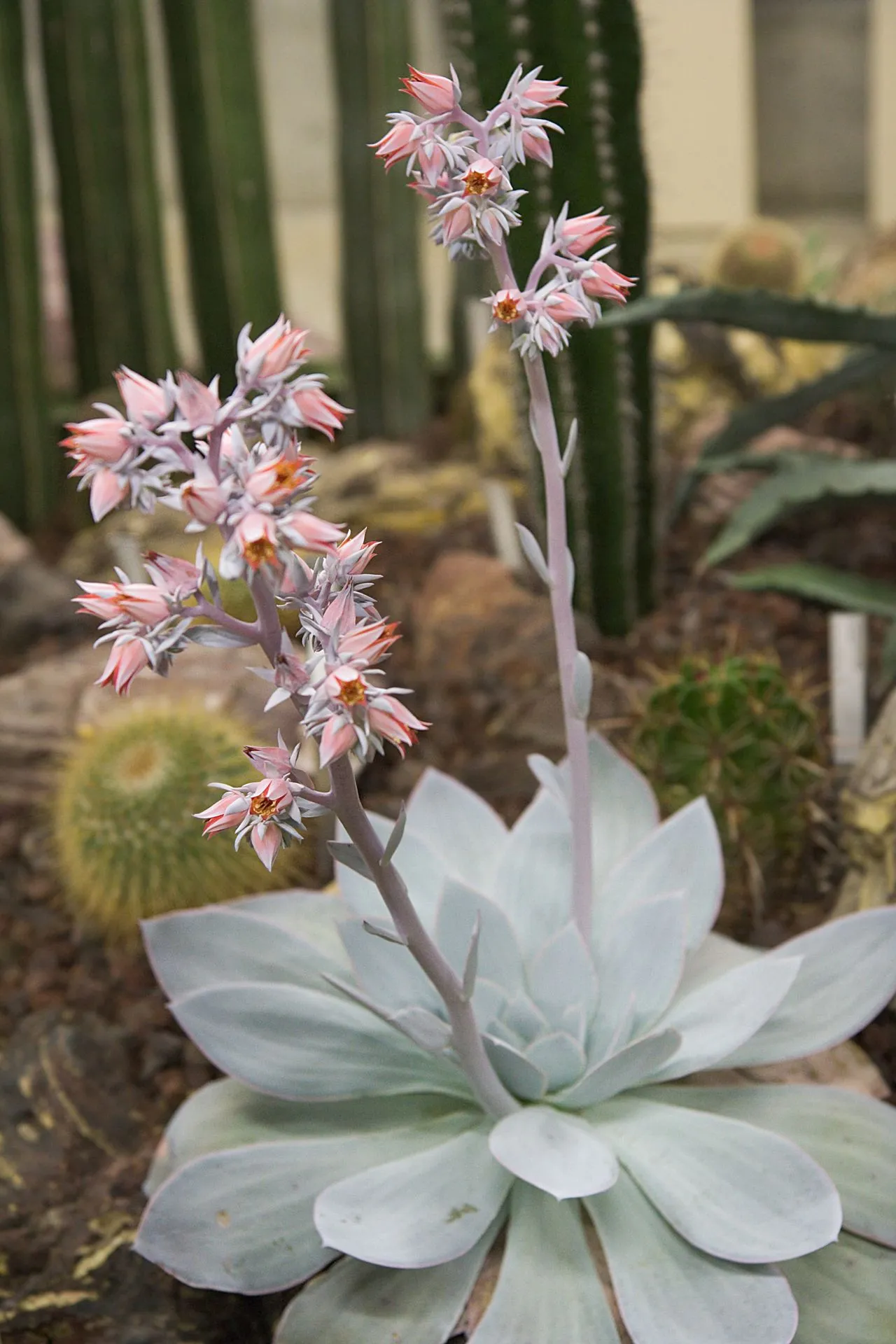
A mature E. cante is one of the largest open rosettes in the genus. Width runs 25 to 40 cm in cultivation, occasionally larger on old wall plants, with the rosette held nearly flat or slightly cupped on a short stout stem. The leaves are obovate-acuminate, 8 to 15 cm long and 4 to 6 cm wide at the broadest point, thick but not as fleshy as Echeveria agavoides.
Two characters identify the species at a glance. First, the wax bloom. The leaves carry the heaviest, whitest pruinose coat in the genus, a thick layer of epicuticular wax that turns the rosette near-silver in strong light. This bloom is also the single most fragile feature on any cultivated echeveria. A fingerprint leaves a permanent dark print. A water spot does not wipe off. Even soft tissue paper drags the wax. Second, the leaf margins. Each leaf carries a clear, intense red to red-pink margin running the full length, framing the white centre. The contrast between silver lamina and red edge is the diagnostic combination, and it deepens under cold nights and high light. In summer the species sends up a tall lateral inflorescence, 40 to 60 cm long, bearing pink-coral, urn-shaped flowers.
Distinguishing from common lookalikes:
- Echeveria lilacina is much smaller (10 to 15 cm rosette), carries a pale lavender-pink bloom rather than chalk-white, and has no red leaf margins. Its rosette outline is also rounder and tighter; E. cante is open and spreading.
- Echeveria laui has an even denser white bloom (often described as the whitest in the genus) but no red margins and a far smaller, more compact, almost spherical rosette of 7 to 12 cm. E. laui is more delicate than E. cante and notoriously slow.
- Echeveria 'Lola' is frequently mis-sold as E. cante in the European trade. 'Lola' is a hybrid usually given as E. lilacina × E. derenbergii (no E. cante parent), with a pale rosette around 8 to 12 cm, no red margin, and a soft pinkish flush rather than the sharp red edge. Any plant labelled E. cante and smaller than about 15 cm, with a uniformly soft-pink leaf, is almost certainly 'Lola' or a similar hybrid.
Cultivation
Light is the first variable. Give E. cante full sun once acclimated. In Mediterranean conditions a south-facing position outdoors holds the rosette tight and brings the wax and the red margin to their full contrast. Indoors, anything less than a south or south-west window starves the plant; the rosette opens flat, the margins fade to pink, and the white wax thins. Acclimate slowly when moving from indoor to outdoor sun, since the bloom does not regenerate evenly after burn.
Water with mechanism, not habit. The crown is a flat or slightly cupped funnel that holds water for hours after a watering. Water onto the substrate at the rim of the pot, never from above, and never with a rose attachment that produces a fine spray; the droplets etch the wax. In active growth (late spring through early autumn), water deeply once the top 4 cm of the mix is dry and the lower leaves have lost a fraction of their firmness. For an 18 to 22 cm pot, that usually means every 10 to 16 days in warm weather. In winter, drop to a single watering every 5 to 6 weeks, less if the plant sits below 8 °C.
Substrate should be 70 to 80 percent mineral. Use 4 to 8 mm pumice or lava grit, with a small fraction of peat-free loam-based compost; a pinch of crushed limestone matches the habitat and slightly raises the pH. The pot must dry inside 48 to 72 hours after a full watering. Pot size matters more than for the smaller species because the rosette can sit half a metre across and needs both root volume and visual mass; an unglazed terracotta pot in the 20 to 30 cm range suits a mature plant.
Cold tolerance is moderate. Dry plants take brief dips to about 0 °C without lasting damage, and brief exposure to about minus 2 °C may scorch leaf tips and edges but rarely kills the rosette. Wet roots near freezing will rot the plant in a single weekend. The rule is bone-dry below 5 °C, with moving air. In summer, ventilation matters more than absolute temperature; the rosette tolerates 35 °C in shade with airflow but bakes in still hot air against a south wall.
The bloom defines almost every handling decision. Always lift or move E. cante by the base of a leaf or by the pot, never by the upper leaf surface. Use a chopstick or a soft brush rather than a finger when settling a plant into mix, and never sponge or wipe the leaves to clean them. The wax regenerates slowly on the leaf in question, and not at all on damaged areas; lost bloom is effectively permanent until that leaf is shed. New collectors often handle the species like a more forgiving echeveria; if you have not grown small Echeveria successfully, the beginner's guide to succulents sets out the watering and substrate baseline that the notes here refine for E. cante.
Propagation
E. cante is among the slower large echeverias to propagate, and the methods sometimes listed for the genus do not all work well on this species.
Offset division is the most reliable, but E. cante is not a strong offsetter. Mature plants produce occasional basal pups, perhaps one or two a year, on a short stout stem. Once an offset has put down its own roots and reached a third the width of the parent, cut it free with a clean blade, callus the wound for 7 to 10 days in shade, and pot into dry mineral mix. Resume watering after about two weeks. Success on rooted offsets runs above 90 percent.
Leaf propagation is unreliable here and not the right method for any quantity. Detached leaves callus willingly, but root-and-pup formation runs around 30 to 50 percent at best, well below the rates seen on E. elegans or E. derenbergii, and the resulting plantlets are slow to size up. Stem cuttings from a leggy plant work well: behead the rosette, callus the cut for 10 to 14 days, and root in dry pumice. The decapitated stump usually breaks dormancy and produces several new heads within a season, giving you both the rooted top and a multi-headed clump.
Seed is the route used by specialist nurseries. E. cante seed is fine and germinates within 2 to 3 weeks at 22 to 26 °C on sterile pumice mix, but seedlings are slow and segregate visibly when crossed with neighbouring echeverias. For a clean species reference, propagate vegetatively or buy seed from a known wild-origin source.
Notes
The fragility of the wax has shaped the trade for this species. Healthy specimens with intact bloom are uncommon in general retail, because the plants are repeatedly handled in transport and the white surface ends up dotted with smudges and water marks. A clean specimen at a specialist nursery commands a premium and is worth the difference if you intend to keep the plant for years. Once you have a clean rosette, plan its position and pot up front, because each move costs bloom.
Pests are conventional. Mealybugs colonise the dense leaf bases and the woolly basal stem, where they are easy to miss; check new plants carefully and inspect every leaf axil at repotting. Aphids appear on the long inflorescence and clear with a fingertip wipe. Crown rot is the most common cause of death in cultivation and follows almost every case of water sitting in the rosette in cool weather. The species is not toxic to humans, dogs, or cats in any meaningful sense.
The IUCN Vulnerable listing matters in practice. Wild-origin material still circulates among collectors, and the slow, cliff-bound populations in Zacatecas and Durango do not recover quickly from collecting pressure. Buy from nurseries that propagate from cultivated stock, and prefer named provenance where available. The species is recent enough in formal taxonomy (1997) that good seed lines and known clonal lines can still be traced.
In horticulture E. cante sits in an interesting position. The bloom rewards growers who treat the plant as a long-term resident rather than a moveable display piece. Place it once, water it from the side, and let the rosette earn its silver year by year.
See also
- Complete Echeveria Guide — genus-level light, substrate, and propagation principles.
- Echeveria lilacina — the smaller lavender-toned relative often confused with cante seedlings in the nursery.
- Echeveria elegans — a smooth blue-white rosette useful as a size and texture comparison.
Frequently Asked Questions
How big does Echeveria cante get?
Mature rosettes usually reach 25 to 40 cm across in cultivation. Old wall-grown plants can become even larger under excellent light.
How do you protect Echeveria cante's white bloom?
Handle only by the pot or lower base and water from the side. The thick wax bloom marks permanently when touched or sprayed.
Is Echeveria cante cold hardy?
Dry plants can take brief dips near 0 °C and sometimes −2 °C with scars. Wet roots near freezing can rot the plant quickly.
How is Echeveria cante different from Echeveria lilacina?
E. cante is much larger, with a chalk-white rosette and strong red margins. E. lilacina is 10 to 15 cm wide, lavender-pink, and lacks red margins.