| Question | Short Answer |
|---|---|
| How large does Echeveria lilacina grow? | Mature rosettes usually reach 12 to 15 cm across, with 20 to 30 loose lavender-pink leaves. |
| Why is Echeveria lilacina growing so slowly? | Slow growth is normal. |
| How is Echeveria lilacina different from Echeveria elegans? | E. |
| Can Echeveria lilacina be propagated from leaves? | Yes. |
Echeveria lilacina Kimnach & R.Moran, known as the ghost echeveria, was described in 1981 from material collected in the Sierra Madre Oriental of Nuevo León, northern Mexico. It grows on limestone cliff faces between 600 m and 1,800 m, often in partial shade cast by overhanging rock.
Its native range is drier and hotter in summer than the range of most collected Echeveria, and in cultivation the species reflects that by being genuinely slow-growing.
Part of the Complete Echeveria Guide.
Identification
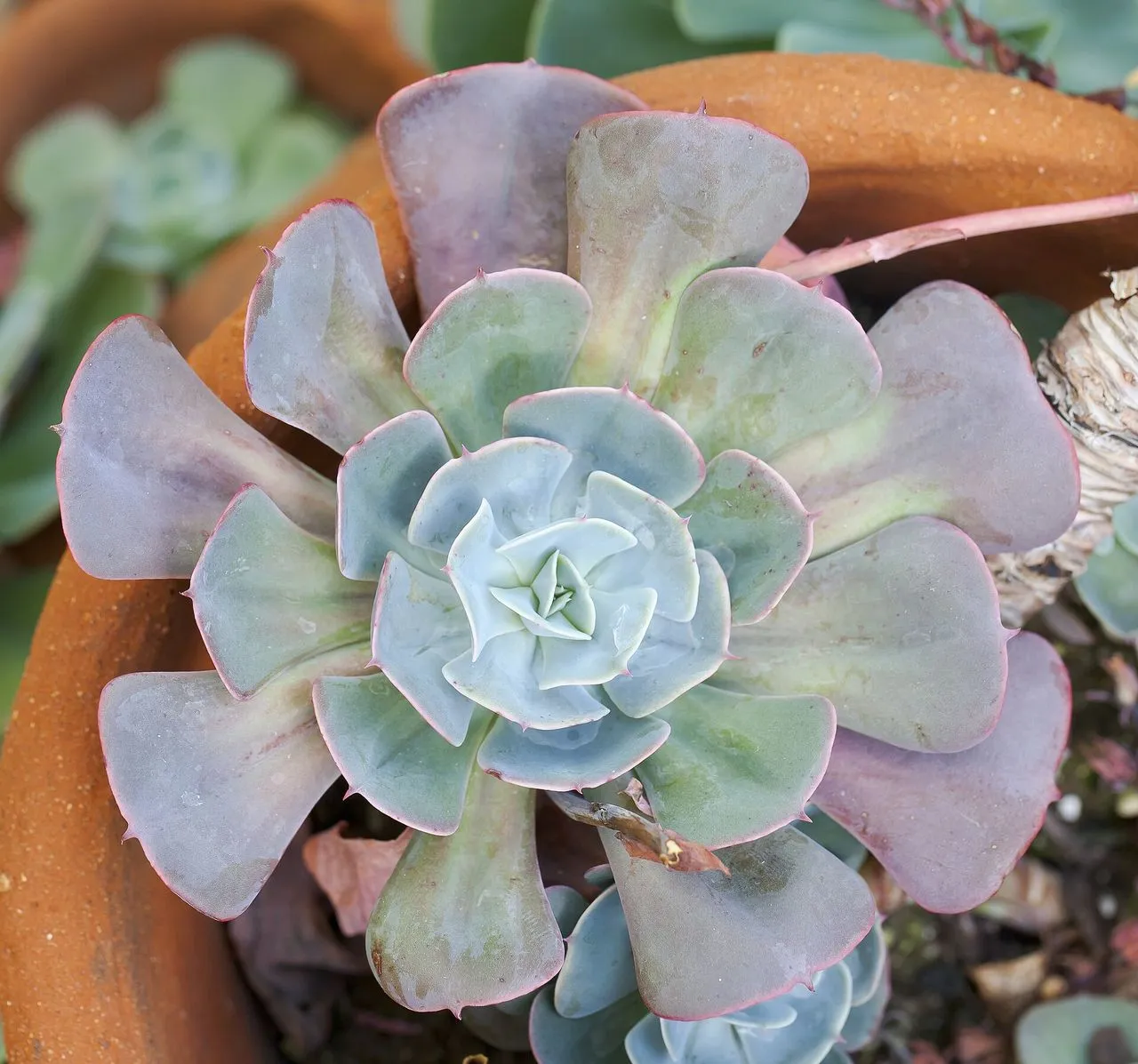
E. lilacina is recognised by its colour more than its form. A mature rosette is 12 to 15 cm across and carries 20 to 30 leaves arranged in a loose, open spiral. The leaves are 5 to 8 cm long, obovate with a gentle point, and heavily coated in a matte lavender-pink farina. Under cool bright light the rosette reads almost silver; under warm light or slight water stress it flushes pink.
The inflorescence is distinctive and useful for a confirmed identification. A short reddish scape, rarely more than 20 cm tall, bears a one-sided cyme of bell-shaped coral-pink flowers in late winter to early spring. The flowers are considerably shorter and more open than the tubular blooms of E. elegans.
Lookalikes. E. lilacina is frequently confused with E. elegans (blue-white, not lavender), E. lauii (heavier bloom, tighter rosette, pinker leaves), and the hybrid E. 'Lola' (one parent is E. lilacina, but 'Lola' has longer, more pointed leaves and flushes peach rather than pink).
Cultivation
The species diverges from the pillar defaults in three ways.
Light. E. lilacina keeps its lavender tone only in bright, diffuse light. Under strong direct sun the farina scorches off and the leaves go plain green; in deep shade the rosette etiolates within weeks. A position behind light curtain at a south-facing window, or an east-facing aspect with full morning sun and afternoon shade, produces the best colour.
Water. This is a conservative drinker. It evolved on shaded cliffs where water runs off quickly and is slow to arrive. Over-watering is the usual cause of death. Let the substrate dry completely between waterings even in summer, and halve the frequency in winter compared to what you would give E. elegans.
Temperature. Tolerant of 5 °C to 35 °C when dry. Frost kills unprotected tissue; unlike the high-altitude E. lauii it has no cold-hardy reputation, despite the similar farina.
Propagation
Leaf propagation is slow but reliable at 50 to 70 percent success. Detach mature lower leaves with a clean sideways twist, callus five to seven days, and place base-down on lightly damp mineral mix. Plantlets emerge at six to eight weeks; they take 18 months to reach display size.
Offset production is sparse. A well-grown specimen produces one or two offsets per year at most. This accounts for the species' relatively high market price, and it also means a clump of "mother-and-pups" E. lilacina represents a slow piece of horticulture, not a commodity plant.
Notes
Do not handle the rosette. The farina coats every leaf and does not regenerate; fingerprints and rain-splash marks persist for the life of the leaf. Move the plant by the pot, and if repotting is unavoidable, work from underneath the lowest leaves rather than gripping the rosette.
The name E. lilacina is sometimes misapplied to E. 'Ghost' hybrids of uncertain parentage. A genuine E. lilacina has flat, spoon-shaped leaves, not the thicker, rounder leaves of most ghost-type hybrids.
The species has been used extensively as a breeding parent in the last two decades, crossed with E. derenbergii, E. colorata, and E. agavoides among others. The most widely grown progeny is E. 'Lola' (E. lilacina × E. derenbergii), which inherits the pale colour but adds a more pointed leaf and a stronger offsetting habit. If you want a plant with the look of E. lilacina but less fussy care, 'Lola' is the sensible choice.
Growth rate is the single biggest source of buyer disappointment with this species. An E. lilacina rosette takes three to four years to reach the 12 cm to 15 cm size shown on most nursery photographs. A 5 cm plant purchased in year one will look the same in year two and only slightly larger in year three. This is normal; it is not a cultivation problem.
See also
- Echeveria elegans — the bluer, tighter species it is most often confused with.
- Echeveria desmetiana — another silver-blue species with similar habit.
- Echeveria 'Perle von Nürnberg' — a larger pink-purple hybrid for comparable colour.
Frequently Asked Questions
How large does Echeveria lilacina grow?
Mature rosettes usually reach 12 to 15 cm across, with 20 to 30 loose lavender-pink leaves.
Why is Echeveria lilacina growing so slowly?
Slow growth is normal. A 5 cm plant may need three to four years to reach the 12 to 15 cm size shown in nursery photographs.
How is Echeveria lilacina different from Echeveria elegans?
E. lilacina reads lavender-pink, while E. elegans is blue-white. E. elegans also forms denser clumps and is more forgiving.
Can Echeveria lilacina be propagated from leaves?
Yes. Leaf propagation is slow but reliable at 50 to 70 percent, with plantlets appearing after six to eight weeks.