| Question | Short Answer |
|---|---|
| Is Echeveria peacockii the same as Echeveria desmetiana? | In most European and North American trade, plants labelled E. |
| How large does Echeveria desmetiana grow? | A mature rosette is usually 10 to 15 cm across with 20 to 30 pale blue-grey leaves. |
| Can Echeveria desmetiana grow from leaves? | Yes. |
| How do you protect Echeveria desmetiana farina? | Move the plant by the pot and avoid gripping the leaves. |
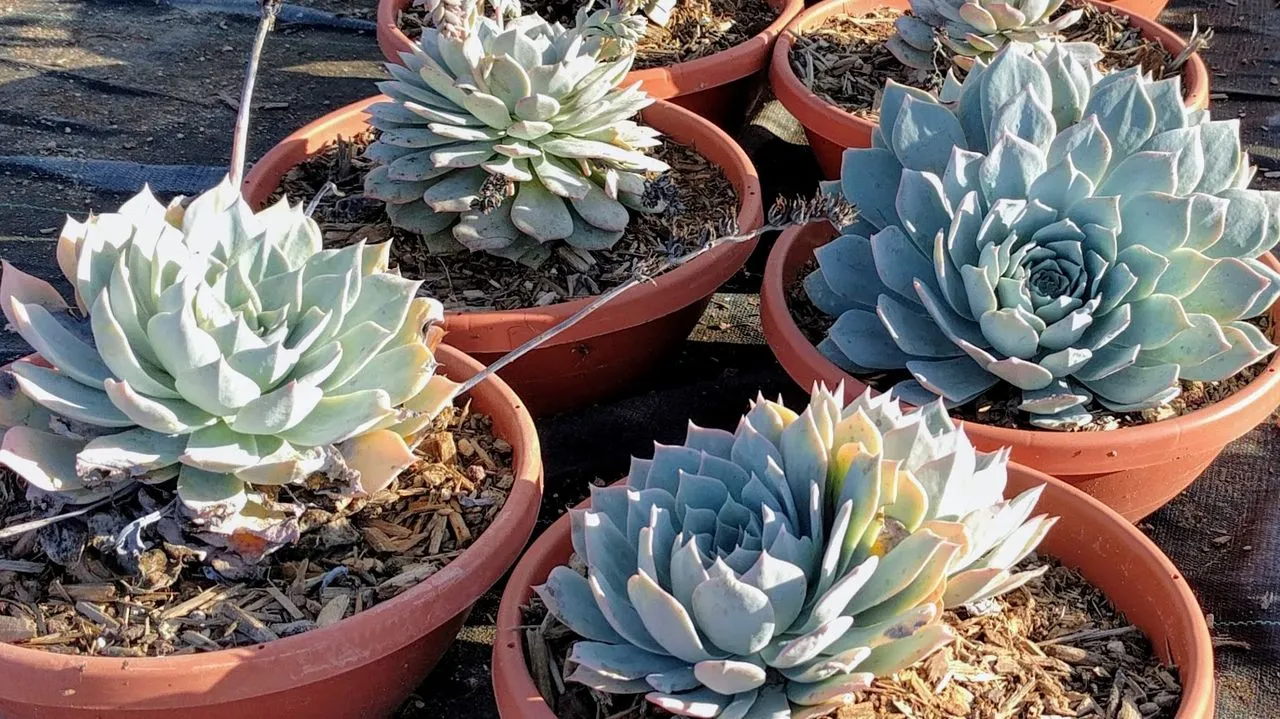
Echeveria desmetiana De Smet ex É.Morren is a silver-blue rosette-forming species from the limestone hills of southern Mexico. It is the plant most often sold in Europe and North America under the label E. peacockii, a name that current taxonomy treats as a synonym of E. desmetiana following work by Kimnach and others. If your plant is labelled E. peacockii, it is almost certainly this species.
Part of the Complete Echeveria Guide.
Identification
- Rosette. 10 to 15 cm across, fairly open, with 20 to 30 leaves.
- Leaves. Obovate-spathulate, 4 to 7 cm long, pale blue-grey, heavily coated in a waxy farina that gives the whole rosette a silver cast. The leaf tips carry a short red mucro, and in strong light the tips flush pink.
- Margins. Entire, not red-edged. This separates it from E. pulidonis (red margin) and E. 'Elegans Blue' (no mucro).
- Inflorescence. An arching scape 20 to 40 cm tall bearing bell-shaped coral-red flowers with yellow interiors in late spring.
The name is commonly misapplied. Plants sold as E. peacockii desmetiana are this species. Plants sold as E. peacockii 'Subsessilis' are typically a different, more robust clone that some authorities still treat as a separate species, E. subsessilis.
Cultivation
Cultivation matches the pillar defaults closely, with one practical divergence: E. desmetiana tolerates stronger direct sun than most farina-coated species because the wax layer is thick and uniform. Placed outdoors in full sun after a careful acclimation, the rosette develops its best silver-blue colour and pink-tipped leaves.
Water on the usual genus schedule: thorough soak when the top 3 to 4 cm of substrate is dry, discard runoff from the saucer. In winter, water sparingly — once every three to four weeks is usually enough in cool indoor conditions. The species is not cold-hardy; protect from frost.
Substrate should be sharply draining. A 50% pumice or perlite, 30% coarse sand, 20% loam-based compost mix suits it. The species is sensitive to peat-heavy commercial cactus mixes and shows rot at the rosette base within one wet winter in that medium.
Propagation
Leaf propagation is straightforward and reliable at 70 to 90 percent success, similar to E. elegans. A mature lower leaf twisted cleanly off and calloused for four to five days will produce roots and a plantlet within three to four weeks on lightly damp mineral mix.
The species offsets slowly. A mature rosette will produce one to three offsets per year at the base; wait until each is a third the size of the parent before separating it. Offset division recovery is rapid — roots appear in two weeks, and the plantlet reaches display size within a year.
Seed is uncommon in cultivation because the species is self-incompatible and flowering plants of unrelated origin are not often available together.
Notes
The farina is the feature and the vulnerability. Handle the plant only by the pot; every handling mark persists. If you must repot, grip the substrate ball or the stem below the lowest leaf. The pink leaf-tip colouring is stress-induced; plants grown in low light will be plain silver-blue without the tip flush, and this is not a sign of poor health.
One further point on nomenclature. The specific epithet desmetiana commemorates the 19th-century Belgian nurseryman Louis De Smet. If a supplier insists the plant is "E. peacockii", it is worth asking whether they mean E. desmetiana (this species) or E. subsessilis, because the latter has a considerably larger and looser rosette.
The species is not strictly monocarpic. Individual flowered rosettes survive and continue producing new leaves the following season, although a heavy bloom year often shows as a slight reduction in rosette size the year after. If you value the specimen form, cut the flower scape at the base as soon as it emerges. If you want seed or want to enjoy the bloom, let it run — the plant will recover within a year.
E. desmetiana makes a sensible second species for a beginner who has kept E. elegans alive for a year. Care is nearly identical, the silver-blue colouration is more striking, and the response to light levels is more instructive than the forgiving E. elegans. It rewards attention to light and substrate quality without punishing minor lapses.
See also
- Echeveria elegans — the pale-blue species this is most often confused with.
- Echeveria lilacina — lavender-pink rather than silver-blue, but a similar "ghost" look.
- Echeveria pulidonis — similar compact size, red leaf margins instead of plain silver.
Frequently Asked Questions
Is Echeveria peacockii the same as Echeveria desmetiana?
In most European and North American trade, plants labelled E. peacockii are E. desmetiana. Current taxonomy treats E. peacockii as a synonym in this context.
How large does Echeveria desmetiana grow?
A mature rosette is usually 10 to 15 cm across with 20 to 30 pale blue-grey leaves.
Can Echeveria desmetiana grow from leaves?
Yes. Leaf propagation is reliable at 70 to 90 percent, with roots and plantlets usually appearing within three to four weeks.
How do you protect Echeveria desmetiana farina?
Move the plant by the pot and avoid gripping the leaves. Handling marks persist because the waxy farina is the vulnerable feature.