| Question | Short Answer |
|---|---|
| How do you identify Echeveria pulidonis? | Look for a small flat rosette, a sharp red leaf margin, and bright yellow flowers. |
| How large does Echeveria pulidonis get? | Mature plants usually stay 8 to 12 cm across, with older specimens sometimes developing a corky 5 to 10 cm stem. |
| Can Echeveria pulidonis be propagated from leaves? | Yes. |
| Why is my Echeveria pulidonis losing its red edge? | The red margin fades in diffuse indoor light. |
Echeveria pulidonis E.Walther was described in 1959 from material collected in the dry canyons of northern Oaxaca, Mexico, at elevations around 1,800 m. The species honours Maximino Pulido, a Mexican plant collector. It is a compact, slow-growing species that stays small in cultivation and develops one of the cleanest red leaf margins in the genus.
Part of the Complete Echeveria Guide.
Identification
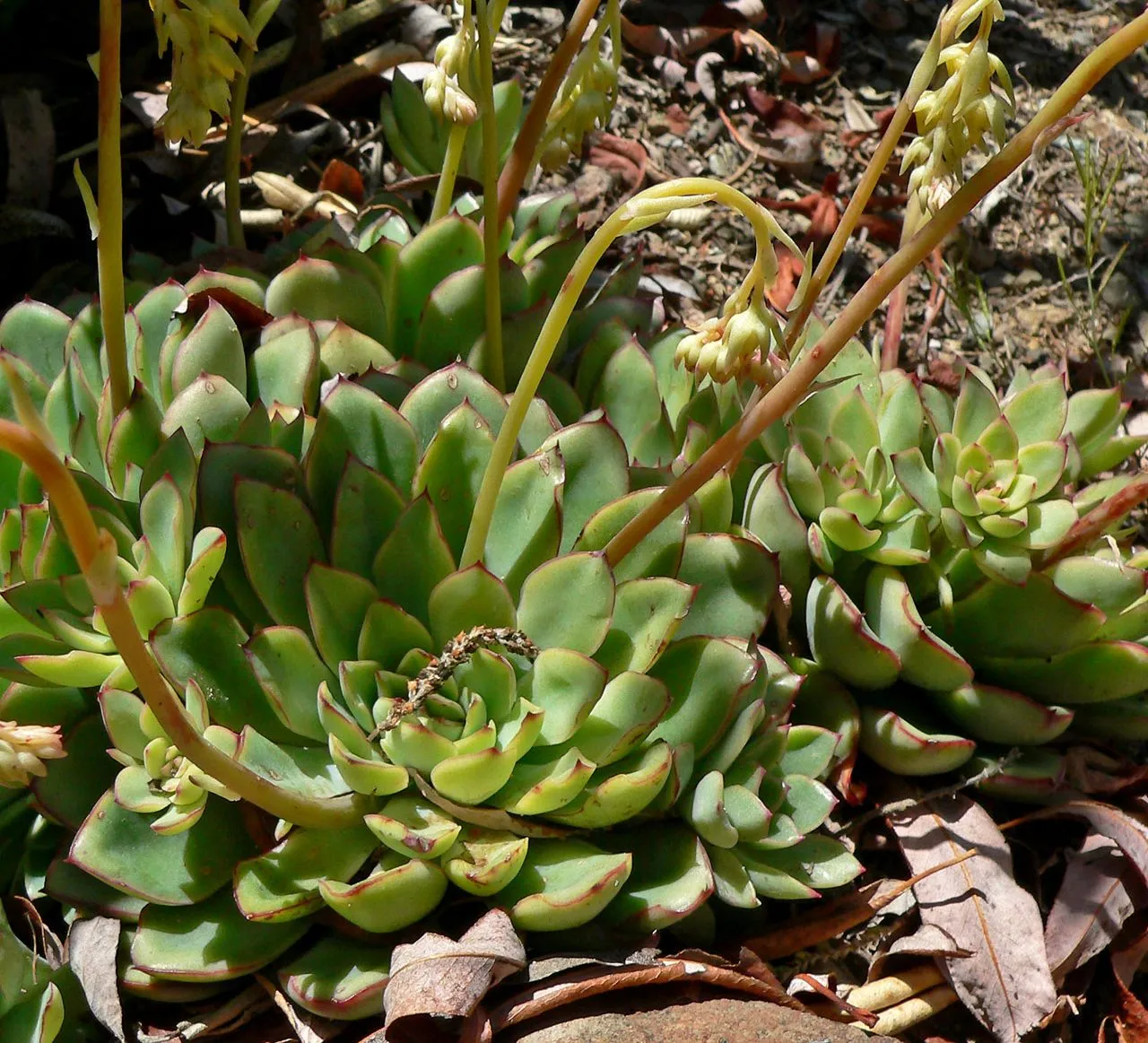
- Rosette. 8 to 12 cm across in mature plants, flat, with 20 to 30 leaves.
- Leaves. Obovate-spathulate, 3 to 5 cm long, apple-green with a slight bluish cast, smooth and essentially glabrous (no significant farina). The leaf margin carries a sharp, narrow red line that thickens in strong light. The leaf tip has a small mucro.
- Stem. Short, usually unbranched. Older plants develop a visible corky stem 5 to 10 cm tall with dead leaf scars.
- Inflorescence. A short arching scape 15 to 25 cm tall bearing bell-shaped bright yellow flowers in late winter to early spring. The yellow flower is diagnostic — most closely related species have red or pink flowers.
Lookalikes. E. pulidonis is frequently confused with E. agavoides 'Red Edge' (thicker, more triangular leaves and red flowers), and with the hybrid E. 'Ben Badis' (E. pulidonis × E. derenbergii, smaller and with a more pronounced red tip). The yellow flower reliably separates E. pulidonis from both.
Cultivation
Cultivation mostly matches the pillar defaults. Two adjustments.
Light. The species needs stronger light than the average Echeveria to develop and hold the red leaf margin. In diffuse indoor light the margin fades to pale orange or disappears; in full summer sun outdoors the margin deepens to crimson. This is a pigmentation response to UV and temperature stress, and a fully green-margined plant is still healthy, just not at its best.
Watering. More conservative than the genus default. The species is compact and has a small root mass; it responds badly to sustained substrate moisture. Let the mix dry completely between waterings, and in winter give only enough water to prevent leaf shrivel — once every four to six weeks in cool conditions.
Substrate must be sharply draining. A 60% pumice, 20% coarse sand, 20% loam mix suits it; peat-based commercial cactus mixes are not appropriate for this species. Not cold-hardy; protect below 2 °C.
Propagation
Leaf propagation is easy and reliable at 70 to 85 percent success. Detach a mature lower leaf with a gentle sideways twist; the leaf releases cleanly. Callus four to six days, place base-down on damp mineral mix, keep at 20 °C to 25 °C in bright indirect light. Plantlets appear at three to five weeks and reach display size in 12 to 18 months.
Offset production is sparse to moderate. A mature plant produces one to three offsets per year from the leaf axils. Separate each when it reaches a third the size of the parent, callus three to five days, pot into dry mix.
Beheading is useful for older corky-stemmed plants where the stem has become unsightly. Cut 3 cm below the lowest live leaf, callus a week, re-root. The remaining stem produces multiple new rosettes, a useful bulk-propagation route.
Notes
E. pulidonis is the pollen parent of several widely sold hybrids — notably E. 'Ben Badis' and Echeveria 'Lola'. If you grow the true species alongside its hybrids, the compact size and the yellow flower are the two characters that separate it.
The species is monocarpic at the rosette level in a weak sense: heavy flowering weakens the individual rosette, but offsets usually compensate. Cut the scape early if you want to preserve a symmetric specimen rosette for show.
The early spring flowering is also a practical planning point. E. pulidonis opens its yellow bells in late January to March in the northern hemisphere, at a time when few other Echeveria are in bloom. For collectors looking to extend the flowering season in a collection of mostly late-spring- and summer-flowering species, it fills a useful seasonal gap.
Finally, a note on authenticity. The true species is not especially common in general horticulture; many plants sold under the label are hybrids or seedlings that approximate the red-margin phenotype. A genuine E. pulidonis is small (rarely over 12 cm across), flat, and carries yellow rather than red flowers. If any of those three characters is wrong, the plant is probably something else.
See also
- Echeveria elegans — similar size and forgiving care, without the red margin.
- Echeveria agavoides propagation — the other red-margined species beginners often confuse with this one.
- Echeveria desmetiana — similar compactness, silver-blue instead of red-edged green.
Frequently Asked Questions
How do you identify Echeveria pulidonis?
Look for a small flat rosette, a sharp red leaf margin, and bright yellow flowers. The yellow flower separates it from many red-edged lookalikes.
How large does Echeveria pulidonis get?
Mature plants usually stay 8 to 12 cm across, with older specimens sometimes developing a corky 5 to 10 cm stem.
Can Echeveria pulidonis be propagated from leaves?
Yes. Leaf propagation is easy at about 70 to 85 percent, with plantlets appearing in three to five weeks.
Why is my Echeveria pulidonis losing its red edge?
The red margin fades in diffuse indoor light. Stronger light and cool conditions deepen it to crimson.