| Question | Short Answer |
|---|---|
| How fast does Echeveria laui grow? | Very slowly. |
| How do you tell Echeveria laui from Echeveria cante? | E. |
| Can Echeveria laui be leaf propagated? | It can, but the strike rate is only about 30 to 50 percent and plantlets may need 18 to 24 months to reach 3 cm. |
| What water is best for Echeveria laui? | Rainwater, distilled water, or low-mineral filtered water is safest. |
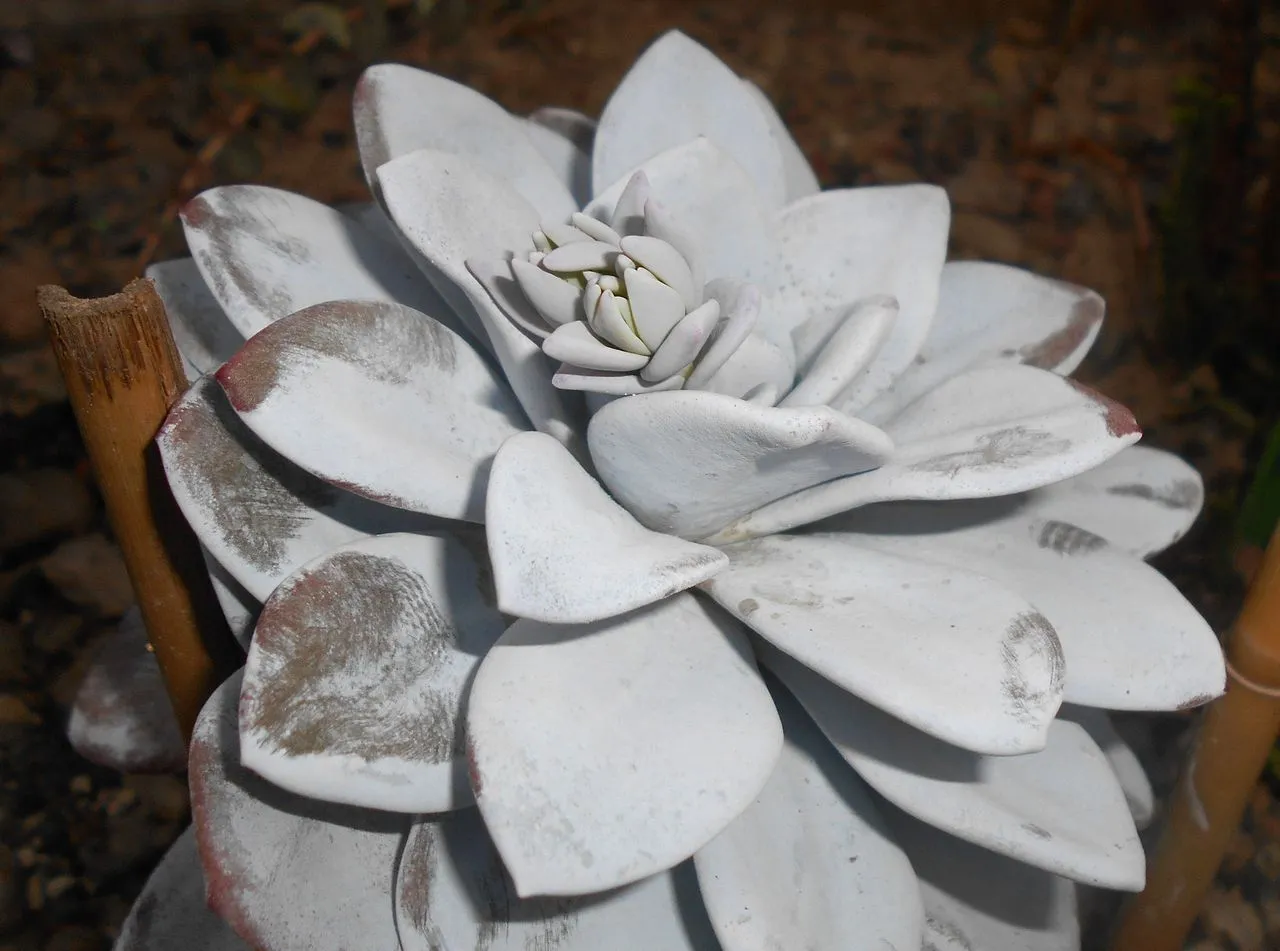
Echeveria laui Moran & Meyrán was described in 1979 from material that Alfred Lau, the German cactus collector for whom the species is named, brought out of southern Mexico in the 1970s. The plant occurs naturally on limestone cliffs in northern Oaxaca at roughly 1,300 m to 2,000 m, where the rosettes sit in fissures on near-vertical faces holding little more than a thin film of mineral grit. Within the genus it is unmistakable: the rosette wears the heaviest pruinose bloom of any Echeveria, a powdery white to pale grey-pink coating so dense that on a fresh leaf it reads almost ceramic in the light.
The Oaxacan habitat is dry, bright, and mild rather than cold. Frost is rare on the cliffs. Rainfall arrives mostly as summer thunderstorms; winters are dry with cool nights. The substrate is decomposed limestone with a little leaf litter blown into the cracks. The plant is locally restricted and trade-pressured; clean wild-provenance material is uncommon, and most cultivated specimens trace back to a handful of clones distributed since the 1970s. The species hybridises freely with cultivated relatives, which shapes a trade quirk worth flagging up front.
Part of the Complete Echeveria Guide.
Identification
E. laui is a small to mid-sized echeveria. A mature rosette sits 8 to 12 cm wide and rarely much more, low and tight on a short stout stem. The leaves are broadly ovate to almost rounded, plumper and shorter than on most pruinose species, with a soft apex rather than a sharp point. The base colour is a cool grey to pinkish grey, but you rarely see it directly; the entire leaf surface is covered in a thick, almost ceramic white wax that reads silver-pink in indirect light and chalk-white in full sun.
Two characters separate it cleanly from the other heavily pruinose echeverias.
- The bloom is the thickest in the genus. A new leaf can carry a layer dense enough to hide the underlying leaf colour until the wax weathers. By comparison, Echeveria cante carries a heavy bloom but with the leaf colour clearly visible through it, and Echeveria elegans carries only a light wax veneer.
- The leaf margins are clean. There is no red, no pink edge, no contrasting line. The diagnostic separation from E. cante is exactly this: cante carries a bright red to red-pink margin running the full length of every leaf, while laui never does. If a plant labelled E. laui shows even a faint red edge, it is almost certainly a hybrid with E. cante or another red-margined parent.
Compared with Echeveria lilacina, which is the other species often confused with laui at small sizes, the bloom on lilacina is thinner and reads pale lavender-pink rather than chalk-white, and the rosette is slightly smaller and flatter. E. lilacina also carries an open inflorescence with a paler scape; E. laui sends up a short, stout, pink-coral inflorescence whose scape, bracts, sepals, and petal exteriors are themselves coated in the same translucent white wax as the leaves. The bloom extends to nearly every part of the plant, which is the cleanest way to tell a true E. laui in flower from any of its hybrids.
Stress-blushed leaves shift from grey-pink toward soft peach-coral under cold nights and high light. The colour change is restrained; a strong pink flush usually points to hybrid blood, often E. lilacina or E. cante in the parentage.
Cultivation
The first thing to internalise is the speed. E. laui is among the slowest-growing echeverias in cultivation, adding roughly 1 to 2 cm of rosette diameter per year and reaching mature width in five to seven years from a small offset. Treat it as a slow-build plant. A 6 cm specimen is two or three growing seasons of work; do not expect a 12 cm rosette inside a year regardless of feeding.
Light should be bright but filtered through the hottest part of the day. A south-facing spot with a couple of hours of summer shade suits Mediterranean conditions; a south or south-east window indoors is enough through winter. The wax handles ultraviolet well once acclimated, but harsh midday sun can scorch tiny patches that will not regenerate. Move the plant slowly between light levels.
Water is conservative. The cupped rosette and dense bloom mean any drop sitting on a leaf will mark it permanently, so water onto the substrate at the rim of the pot, never overhead, and never with a fine spray. In active growth (spring through early autumn), water deeply once the top 4 cm of the mix has dried and the lowest leaves have softened a fraction. For a 12 to 14 cm pot that is typically every 14 to 21 days. In winter, drop to a single watering every 6 to 8 weeks, and only if the plant sits above 8 °C with airflow.
Hard water is the silent killer of laui presentation. A single drop of tap water on a leaf evaporates and leaves a permanent calcium ring fixed in the wax; the only way to remove it is to wait for the leaf to be shed. Use rainwater, distilled water, or low-mineral filtered water for any watering that risks contacting a leaf.
Substrate should be 80 percent mineral or higher. A working mix is 4 to 8 mm pumice or lava grit cut with a small fraction of peat-free loam-based compost and a pinch of crushed limestone to match habitat chemistry. The pot must dry inside 48 to 72 hours after a full watering. Use a small unglazed terracotta pot, no larger than the rosette plus a finger's width. Oversized pots stay wet at the centre and rot the slow root system before the plant has filled the volume.
Cold tolerance is moderate. Dry plants take brief dips to about minus 1 °C without lasting damage; wet roots near freezing rot the plant in a single weekend. The species evolved with mild winters, not harsh ones, so the rule is bone-dry below 5 °C with moving air. In summer the rosette tolerates 32 to 35 °C in shade with airflow but bakes against a still south wall.
Handling defines almost every other decision with this species. Pick the plant up only by the base of the pot, never by the leaves. The wax is the most fragile in the genus: a fingerprint mark is permanent, a water spot is permanent, and even a nudge from a soft brush leaves a faint trace visible under raking light. Use a chopstick or a length of bamboo when settling roots into mix at repotting, and keep the plant in one position once placed, since each move trades a little bloom for a little dust. New collectors who succeed with more forgiving echeverias often still lose bloom on laui; if you are starting out, the beginner's guide to succulents covers the watering and substrate baseline that the notes above refine.
Propagation
Vegetative methods work, but E. laui is the slowest-yielding pruinose species in the genus.
Offset division is the most reliable route. Mature plants produce occasional basal pups, perhaps one or two in a good year, on a short stout stem. Once an offset has put out its own roots and reached about a third of the parent's width, cut it free with a clean blade, callus the wound for 10 to 14 days in shade, and pot into dry mineral mix. Resume watering after about two weeks. Success on rooted offsets runs above 90 percent; the rate-limit is how rarely the parent produces them.
Leaf propagation is unreliable here. Detached leaves callus willingly, but the strike rate sits around 30 to 50 percent, and the resulting plantlets are very slow, taking 18 to 24 months to reach a 3 cm rosette. It is not the right method for any quantity. Stem cuttings from a stretched plant work better: behead the rosette, callus the cut for 14 days, and root in dry pumice. The decapitated stump usually breaks dormancy and produces one or two new heads within a season.
Seed is the route used by specialist nurseries, and it is the source of most of the trade hybrid problem. E. laui hybridises freely with E. lilacina, E. cante, and other pruinose species blooming at the same time, and seedlings raised in a mixed collection segregate into a noticeable hybrid swarm within a few generations. For a clean species reference, propagate vegetatively from a known clonal line or buy seed from a specialist with documented wild provenance.
Notes
The hybrid problem deserves naming directly. A large fraction of plants offered as E. laui in retail are E. laui × E. lilacina or E. laui × E. cante hybrids. The tells are a thinner bloom that scratches more easily than the species, a faint pink margin where there should be none, a stronger stress flush, and faster growth than laui supports. A plant that doubles its rosette diameter inside a year is not laui. A plant with any red on a leaf edge is not laui. A plant whose flower scape and bracts are not also coated in white wax is probably not laui. Specialist succulent nurseries with Mexican provenance lines remain the safest source.
Pests are conventional. Mealybugs colonise the dense leaf bases and woolly basal stem, hidden under the bloom; check carefully at repotting, and use a soft brush, not a swab, to clear them. Aphids appear briefly on the inflorescence and clear with a fingertip wipe. Crown rot is the dominant cause of death and follows almost every case of water sitting on the rosette in cool weather. The species is not toxic to people or pets in any meaningful sense.
Treat the plant as a long-term, low-traffic resident. Place it once, water it from the side, and let the rosette earn its silver year by year. The discipline that protects its bloom keeps the rest of a pruinose collection clean too.
See also
- Complete Echeveria Guide — genus-level light, substrate, and propagation principles.
- Echeveria cante — the larger red-margined relative most often confused with laui hybrids.
- Echeveria lilacina — the smaller lavender-bloomed lookalike that frequents nursery mix-ups.
Frequently Asked Questions
How fast does Echeveria laui grow?
Very slowly. It adds about 1 to 2 cm of rosette diameter per year and may take five to seven years to reach mature width.
How do you tell Echeveria laui from Echeveria cante?
E. laui is smaller and has no red margin. E. cante is much larger and carries a strong red edge along each leaf.
Can Echeveria laui be leaf propagated?
It can, but the strike rate is only about 30 to 50 percent and plantlets may need 18 to 24 months to reach 3 cm.
What water is best for Echeveria laui?
Rainwater, distilled water, or low-mineral filtered water is safest. Hard tap water leaves permanent calcium rings if it touches the wax.