| Question | Short Answer |
|---|---|
| Is Echeveria 'Afterglow' cold-hardy? | No. |
| How large does 'Afterglow' grow? | Mature rosettes reach 30–40 cm across at three to four years from a rooted cutting under good light and a wet-dry watering cycle. |
| Does a stable variegated 'Afterglow' exist? | No. |
| Why are the pink colours fading on my plant? | Insufficient light is the dominant cause. |
Echeveria 'Afterglow' is a hybrid bred by the California horticulturist Don Worth in the 1980s from a cross of E. cante and E. shaviana. It is among the larger and more colourful cultivated echeverias, reaching 30 cm or more across when grown well, with a heavy white farina that flushes pink through violet in strong light.
Part of the Complete Echeveria Guide.
Identification
- Rosette. Large and open — 25 to 40 cm across at maturity, somewhat flat, with 30 to 50 leaves.
- Leaves. Broad, obovate-cuneate, 10 to 15 cm long and 5 to 8 cm wide, with a pronounced pink-violet flush and a fine white farina. Leaf margins are slightly wavy, a feature inherited from the E. shaviana parent, but not as frilled as E. shaviana itself.
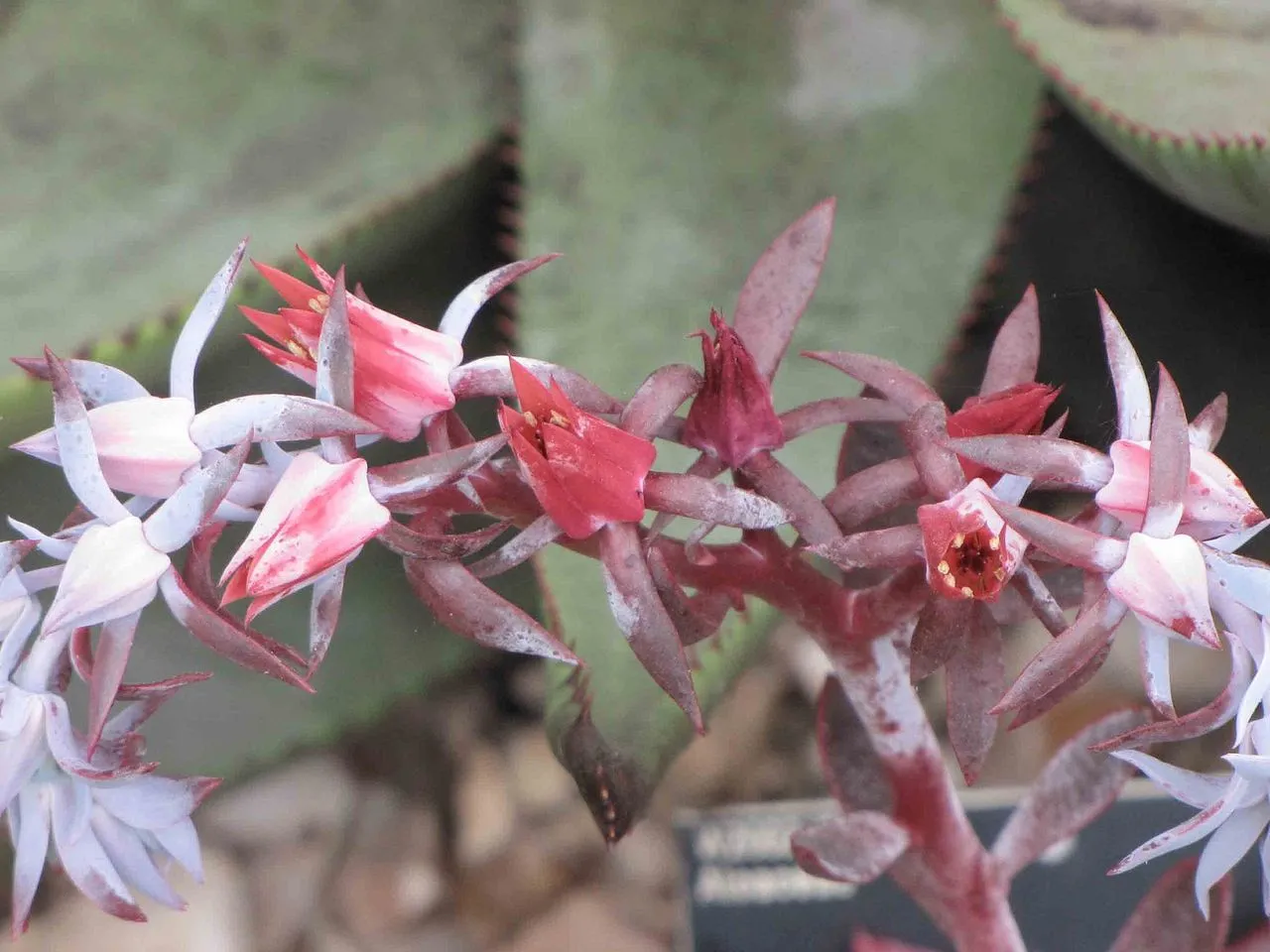
- Inflorescence. A branching scape 40 to 70 cm tall bearing orange-pink bell-shaped flowers with yellow interiors in late spring to summer.
The cultivar is frequently confused with E. 'Perle von Nürnberg' (smaller, more dusty-lavender, flat margins) and E. cante (the pollen parent — larger still, with a considerably heavier pure-white farina and plain, non-undulating margins). The intermediate leaf size, gently wavy margins, and the warm peach-pink flush distinguish 'Afterglow' from both.
Cultivation
Cultivation follows the pillar defaults with three species-specific notes.
Light. Colour depends on high light intensity. Indoors under ordinary windowsill conditions, 'Afterglow' fades to pale grey-green. Outdoors in full sun with a good day-night temperature differential, the leaves develop the full pink-violet flush the cultivar is known for. Acclimate carefully — the farina does not regenerate once burnt off, and sunburn scars are permanent.
Watering. Moderately thirsty during active growth. The large leaf mass means the plant holds substantial stored water, but it also means recovery from under-watering takes weeks. Water thoroughly when the top 4 cm of substrate is dry; in winter, water sparingly.
Space. At 30 to 40 cm across, 'Afterglow' needs a wide shallow container; a deep pot is wasteful and accumulates wet substrate below the root zone. A terracotta or plastic pot 25 to 30 cm wide and 15 cm deep is appropriate for a mature specimen.
Not cold-hardy. Protect below 2 °C.
Propagation
Leaf propagation is unusually slow and unreliable for this cultivar, at 20 to 40 percent success. The thick farinose leaves are prone to rot during callus and plantlet emergence. Take leaves from the mid-rosette rather than the oldest base leaves, callus for seven to ten days, and use a very free-draining medium (pure pumice is better than any mix containing organic matter). Expect plantlets in eight to twelve weeks.
Offset production is moderate. A mature plant produces two to four basal offsets per year; separate when each is a third the size of the parent.
Beheading and stem cutting are the most reliable routes. Cut a mature rosette with 5 cm of stem, callus ten days, re-root on dry pumice. The stump reliably produces three to six new rosettes within three months. This is the standard commercial method and the one to use for bulk production.
Do not propagate from seed. 'Afterglow' is a primary hybrid; F2 and backcross seedlings do not replicate the parent. All legitimate 'Afterglow' plants in circulation are vegetative propagations of Don Worth's original cross.
Notes
The farina coating is the cultivar's defining feature and its greatest vulnerability. Handle only by the pot or the stem below the lowest leaf; every fingerprint leaves a permanent dark mark. Rainwater splash during outdoor growth also marks the leaves, so shelter the plant from direct rain if possible.
'Afterglow' is frequently sold under confused names — "E. 'Afterglow' x E. 'Perle von Nürnberg'", "E. 'Afterglow' Variegated" (no stable variegated form exists), and various "Afterglow"-labelled plants that are actually seedlings. A genuine 'Afterglow' carries uniform colour across the rosette and the gently wavy leaf margin; seedlings rarely match the type.
See also
- Echeveria 'Perle von Nürnberg' — smaller, related-looking cultivar often confused with this one.
- Echeveria gibbiflora — another large-rosetted species for comparable display presence.
- Echeveria 'The Rose' — a cabbage-form cultivar with contrasting rosette architecture.
Frequently Asked Questions
Is Echeveria 'Afterglow' cold-hardy?
No. Protect below 2 °C. Tender like its E. cante parent, and frost contact permanently scars the farina layer.
How large does 'Afterglow' grow?
Mature rosettes reach 30–40 cm across at three to four years from a rooted cutting under good light and a wet-dry watering cycle. One of the larger named Echeveria cultivars.
Does a stable variegated 'Afterglow' exist?
No. Plants sold as 'Afterglow Variegated' are typically mislabelled seedlings or unstable juvenile chimeras that do not propagate true.
Why are the pink colours fading on my plant?
Insufficient light is the dominant cause. Indoors on a windowsill the rosette reverts to grey-green; full-sun outdoor conditions with cool nights restore the violet flush within two to three weeks.