| Question | Short Answer |
|---|---|
| What makes Echeveria 'The Rose' different? | Its leaves curve inward around the growth point, forming a globular rosebud rather than a flat dish-shaped rosette. |
| How big does Echeveria 'The Rose' get? | Mature rosettes are usually 8 to 12 cm across, with a short stem hidden by the outer leaves. |
| Why is my Echeveria 'The Rose' opening flat? | Warm rooms above 25 °C and diffuse light relax the cabbage form. |
| Can Echeveria 'The Rose' be grown from seed? | No. |
Echeveria 'The Rose' is a compact, tightly-whorled cultivar of Korean hybrid origin, first distributed through nurseries in the late 2000s. Parentage is not formally published; the rosette morphology and flower form are consistent with an E. shaviana-derived line. The cultivar is named for its resemblance to a tight rose bud, with overlapping leaves curving inward around the growth point rather than opening flat.
Part of the Complete Echeveria Guide.
Identification
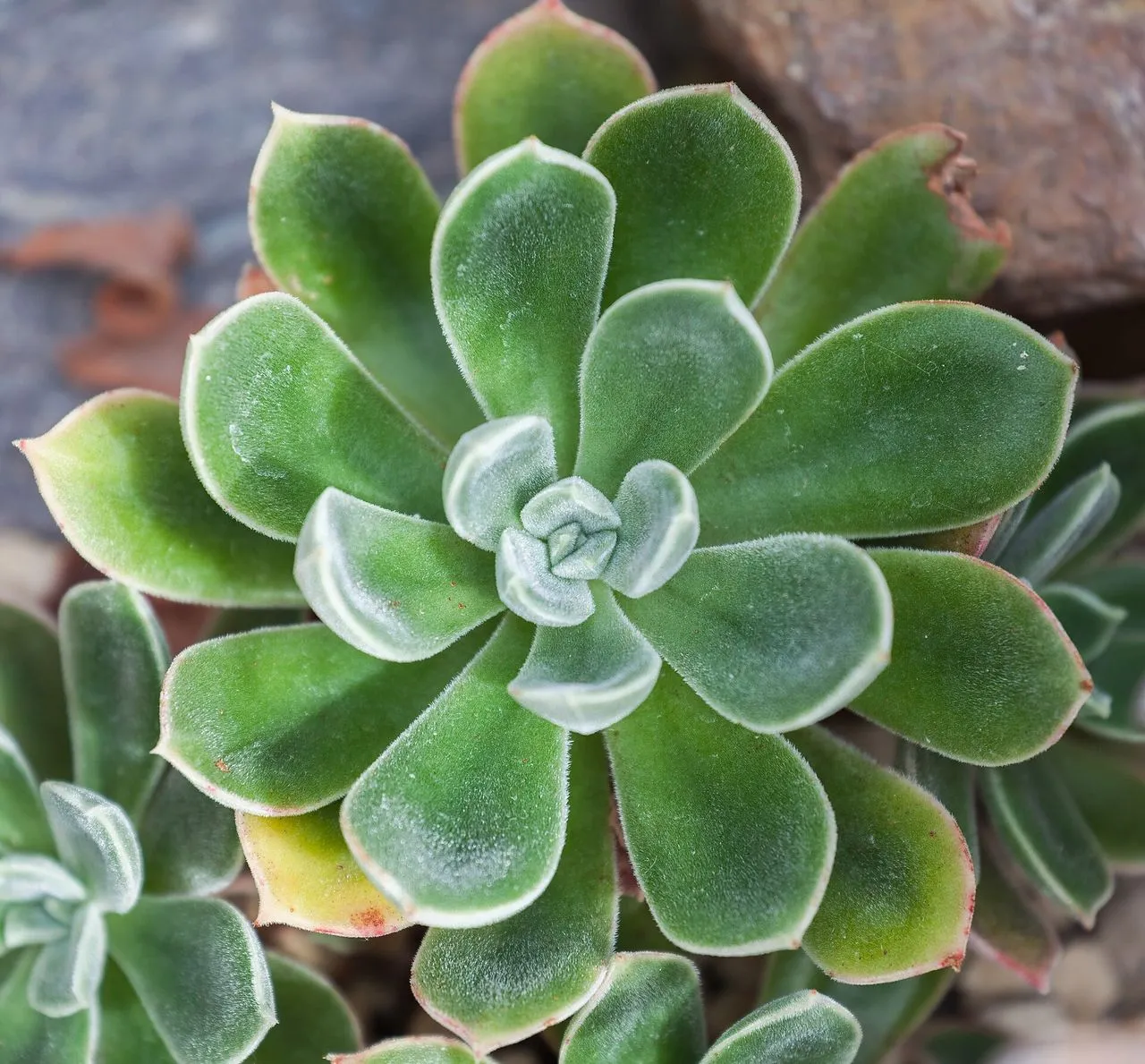
- Rosette. Compact, 8 to 12 cm across at maturity, globular rather than flat — the leaves fold inward so the rosette forms a ball shape rather than a dish.
- Leaves. Obovate with a rounded tip, 3 to 5 cm long, with slightly wavy margins. Base colour is pale grey-green with a light farina; under cool bright conditions the leaf tips and margins flush pink to rose-red, which gives the cultivar its name.
- Stem. Short, usually hidden by the low outer leaves. Older plants develop a stem 3 to 5 cm tall as the oldest leaves shed.
- Inflorescence. A short arching scape 15 to 25 cm tall bearing coral-pink bell-shaped flowers in late spring.
The cultivar is one of a cluster of similar cabbage-form Korean hybrids — E. 'Pink Rose', E. 'Romeo Rubin', E. 'Rainbow Rose', and various unnamed seedlings sold as "pink rose echeveria". 'The Rose' specifically is identified by its medium size (neither miniature nor full-size), the cool rose-pink tip colour, and the tight inward curl that persists year-round rather than only in stress.
Cultivation
Cultivation follows the pillar defaults with two species-specific notes.
Light and temperature. The cabbage form and the pink tips depend on cool bright conditions. In warm indoor rooms (above 25 °C sustained) with diffuse light, the outer leaves relax outward and the rose form is lost; the rosette opens into a more ordinary flat Echeveria shape. Grown in a cool conservatory or outdoors with a good day-night temperature differential, the cultivar holds its cabbage shape and develops pronounced rose-pink flushing on the leaf margins.
Watering. Conservative. The tight rosette traps moisture in the inner leaf axils; water that sits there leads to crown rot and the loss of the entire rosette. Water the substrate around the base, never the rosette centre. In humid conditions, consider watering by partial submersion of the pot for 15 minutes rather than top-watering.
Not cold-hardy. Protect below 2 °C. Good air movement is particularly important for this cultivar because the tight rosette is otherwise a natural trap for still, humid air around the growth point.
Propagation
Leaf propagation is moderately successful at 40 to 60 percent, lower than typical soft echeverias. The leaves are smaller than average and callus quickly, but plantlet emergence is slow and many leaves rot before rooting because the leaf base is often damaged during detachment. Take leaves from the middle rosette (not the oldest base leaves, which are too soft), callus a week, place base-down on pure pumice, and keep on the dry side during the six to eight weeks it takes for plantlets to emerge.
Offset production is the usual commercial route. A mature 'The Rose' produces three to six offsets per year at the base, each maintaining the parent's tight rosette form. Separate when each is a third the size of the parent.
Beheading is less commonly needed because the cultivar does not etiolate as readily as flat-growing Echeveria — the inward-curving leaves are structurally stiffer. If beheading is needed, treat as standard: cut, callus a week, re-root on dry pumice.
Do not propagate from seed. Parentage is unclear and the cultivar is held as a single clone; seedlings will not match.
Notes
Do not peel or trim outer leaves to "improve" the rose form. Each outer leaf supports the next one inward structurally and nutritionally; removing healthy outer leaves destabilises the rosette and frequently causes the inner growth point to open.
The cultivar is sometimes mis-sold as E. shaviana 'The Rose', E. gibbiflora 'The Rose', or E. 'Pink Rose'. The unqualified name Echeveria 'The Rose' in a cultivated plants context refers to this compact Korean hybrid specifically.
See also
- Echeveria 'Afterglow' — a larger pink-flushed cultivar with a contrasting flat rosette form.
- Echeveria 'Perle von Nürnberg' — standard flat-rosette pink-purple hybrid.
- Echeveria pulidonis — compact species with red-edged rather than pink-tipped leaves.
Frequently Asked Questions
What makes Echeveria 'The Rose' different?
Its leaves curve inward around the growth point, forming a globular rosebud rather than a flat dish-shaped rosette.
How big does Echeveria 'The Rose' get?
Mature rosettes are usually 8 to 12 cm across, with a short stem hidden by the outer leaves.
Why is my Echeveria 'The Rose' opening flat?
Warm rooms above 25 °C and diffuse light relax the cabbage form. Cool bright conditions restore the tighter whorl.
Can Echeveria 'The Rose' be grown from seed?
No. Parentage is unclear and the cultivar is held as a clone, so seedlings will not match. Use offsets or cuttings.